Even before the first drumbeat, the crowd senses it: this is not a night for safe choices. Under a blast of lights, a man in a white suit sprints onto the Britain’s Got Talent: The Champions stage, throws his arms wide, and reveals a cape the color of warning signs. It’s the right opening note for a showcase built on trust, timing, and the thin line between spectacle and real risk. Over and over, the audience will put their hands over their mouths while the judges lean forward, unsure whether to watch through their fingers or look away.
This is a tour through the show’s most dangerous performances—acts that draw heat, sparks, blades, and nerves. It’s also a reminder that risk on television is still risk. Even with rehearsals, even with safety teams, the margin for error is measured in heartbeats.
The night starts on the wheel, and the room forgets to breathe
Two performers step into their own giant metal rings, like twin moons hung low over the stage. A woman in a red jumpsuit plants her feet, eyes up. The man in the white suit lifts into motion, his body and the ring moving as one. Soon they’re running inside the circles, then along the rim, then across a long, inclined track connecting both contraptions. It looks like a playground built by a daredevil engineer—clean lines, polished metal, no margin for a misstep.
From the first pass, the danger is obvious. Behind the desk, one judge stares up, hand over mouth. Onstage, the hosts—Ant and Dec—mirror the audience with wide eyes and the kind of nervous laughter that fills the space between hope and fear. The man in white rides the edge, literally, balancing on a lip that seems too narrow to hold a shoe, then hops in a backward flip inside the rolling ring. The crowd gasps, then cheers when he lands and grins as if he’s been here all his life.
There’s a moment when he climbs to the highest point of the entire structure, a shining spine that arcs over the stage like a rail to the sky. He pauses there, a single foot anchored, arms wide for balance. It’s a pose that says: I understand gravity. I just choose to negotiate with it. Pyrotechnics flare. Confetti drifts. They meet back in the center to a storm of applause, hands clasped, alive to the rush of what they’ve just done.
“When I was a kid…” The escape artist who runs toward the fuse
Then the tone shifts. A man in a black t-shirt steps forward, calm and almost conversational. Behind him, a heavy wooden box descends like a secret. He nods to an old photograph on the giant screen—sepia-toned proof of a magic lineage—and begins a story.
“When I was a kid, I saw a magician perform a routine where he got locked inside of a box and in front of everyone, he picked the locks to the box and escaped. Now it wasn’t the most exciting thing, but as a kid, I was absolutely fascinated.”
He smiles as he talks about his father, who built him a box of his own. It’s a tender origin story wrapped inside a stunt that is anything but gentle. The nod to family makes what comes next feel even more personal.
“Tonight as a homage to my dad, I’d like to perform for you a version that he built for me. However, I’ve never done it this way before and I’ll never do it this way again.”
The rules are brutally simple. He explains what the audience can already see: four long fuses snake away from the box’s base. The box will be lifted high. The fuses will be lit. He will be locked inside with his hands sticking out through small openings—cuffed on the outside so he cannot use them freely. There is a safety rope hanging beside the box, but it’s only helpful if he can get to it in time.
“The fire takes approximately fifty six seconds to travel up the fuse and reach the box. When it does, the box is set to explode. My job is to free myself from the handcuffs, open up the box, and grab the safety rope hanging beside it.”
Ant and Dec join him onstage to handle the tools that could be tricks—except he’s adamant they are not.
“These are police regulation handcuffs… They’re not trick cuffs in any way, shape, or form.”
They test the key, turn it in the lock, look for secret buttons. There aren’t any. The cuffs click closed around his wrists. The lid seals. A final padlock goes on with an audible snap. The hosts back away faster than their banter can catch up—this is not their part of the show.
A camera gives the audience a view of his enclosed space. You can hear the collective inhale when a crew member bends to the fuses with a torch. Sparks. Heat. A line of fire starts its steady run. It’s not just a countdown; it is a plot device lit in real time.
He works. He twists. He disappears into concentration. The hosts speak in short bursts from the wings, the way people do when they need words to keep their nerves company. The fire climbs. There’s no reset, no pause. The burning lines climb toward the suspended box, then disappear into it—and the stage erupts in a shower of sparks and smoke that swallows everything.
For a beat, no one knows where to look. Ant and Dec whip their heads from the rig to the audience and back to the wreckage. Then, relief: the magician reappears high at the back of the stage on a raised platform, arms out, alive and grinning. The reaction is less applause and more an exhale that turns into cheering. Whatever secret pulled him free, the equation was clear: the math demanded perfection, and tonight, he delivered it.
A sword, a phone, and a new way to prove the impossible
The same performer returns in a different skin—black leather vest, yellow gloves, the clean lines of a stage that has shifted into something infernal. A motorcycle snarls through smoke. He lifts a long, slender sword, breathes fire across its length, and lets the flames roll off like water. The judges’ expressions snap from delight to concern when he turns the blade toward himself.
It is one thing to see a sword swallowed. It is another to see it verified in the palm of a judge. He turns to the panel with a simple request.
“Amanda. Yes. Can I use your phone for one second? Yes. Please.”
She hands it over. He opens the camera, angles the screen toward the audience, and then raises the sword. As he lowers the blade into his mouth, the phone becomes unblinking proof. The room tilts from skepticism to awe when the live image shows what everyone feared and hoped to see at once. Somewhere between disbelief and reverence, someone breathes, “Oh, it’s actually looking in… oh my god.”
He pauses long enough for the shock to bloom, then adds an escalation: an aerial pole descends. He inverts, hanging upside down, the sword still seated. Muscles lock. The stage spins very slightly as he shifts his weight and holds a shape that looks half statue, half dare. Simon Cowell, eyes wide, steps forward and taps the tip of the sword with the kind of respect you give a sleeping animal. Later, the blade drops free from the performer’s mouth; he snatches it from the air and lands with a jolt that shakes sweat off his brow.
Between feats, a warning rolls across the room like a drumbeat everyone agrees to hear.
“Do not try this at home.”
He smiles a little—showman and survivor—and for a moment lets the silence say what theater can’t: the difference between a trick and a tragedy is a lifetime of training and a decision to do it on a stage lit like day.
Knives, flames, and a crossbow that doesn’t blink
Later, the danger doubles. A man and a woman face the audience, partners in a dance of precision where a mistake leaves marks. She moves like water—contortion and control—while he studies a board and a blade with the intensity of someone doing math in his head. The first knives hit home, then another lands close enough to make the judges flinch. The hosts’ commentary goes ragged around the edges. When a throw misses her head by inches, a ripple of shock goes through the room that reads like a shared shiver.
The stage grows hotter. Literal heat. A metal frame rises into a wall of fire, and she steps into it, composed as if this were ordinary. He tests the air and takes a breath that seems almost ceremonial. The crowd catches itself. They all know the next thing could be the one they replay when they get home.
As if to erase any doubt, the performer invites the harshest verifier in the business: a skeptic’s touch. He turns to the judges and holds up a bolt.
“Simon, can you check the arrow? You see that’s real, deadly, original? That’s deadly.”
Simon handles it, weight testing the point with the same face he used for the sword. Onstage, a balloon blooms in the woman’s hand—a bright target in the heat haze. The bow lifts. Time slows. This is the job: calculation disguised as bravado. The shot flies and the balloon bursts with a firm, almost rude pop that turns the audience’s tension into a bright, grateful roar. Flames roar higher in response, a chorus of heat for relief. The pair grab each other and kiss while sparks run like rain behind them. They’ve earned it.
Between laughs and gasps, the hosts carry the room
In a night of hazards, Ant and Dec play the part of a collective heartbeat. Their faces often tell the story before the crowd finds words; they step forward to hold a cuff key, then step back when a torch meets a fuse. They take on the small talk that fills the space before the moment of truth. “Hope this isn’t stressful,” one of them jokes at the wrong time, which of course makes it exactly the right time. Another beat later, in the middle of a nail-biting setup, a barely-whispered protest slips out: “Little closer. Go. No. What?!”
When the explosive box detonates and the audience’s attention cracks like glass, they’re the ones looking everywhere at once, searching for a body and finding a magician. When a blade hangs in the air, they go still. When a balloon disappears in a clean shot, they leap up like kids at a match-winning goal. They’re the bridge between near-silence and applause, the reminder that fear and delight sit on the same bench.
Why danger works—and why it unsettles
There is a particular alchemy at play on a night like this. Part of it is engineering: the metalwork of massive rings that move like rolling planets; the fuses that measure out a story as flames run toward a deadline; the carefully tuned bow that delivers precision from a breath and a pull. Part of it is flesh: the throat trained to swallow a blade and to give it back; the ankles that understand balance at heights where there is no second chance; the hands that can throw to a heartbeat or steady one at full draw.
But the larger portion is trust, revealed in small gestures. A performer asks a judge to lend a phone—a kindness rushed across a table—and then uses it to turn doubt into proof. Another asks a judge to inspect a bolt, to feel the weight and edges, to say out loud that it is what it looks like. A partner holds still inside a frame of fire and a halo of knives because the person across from her has made a promise with practice. These are intimate acts in public, and perhaps that is why they land so hard.
There’s humor threaded through, of course. The cape and bow tie at the start, campy and defiant. The wry asides. The thumb’s-up after a vertigo-inducing balance as if to say, yes, I know you worried, but I wouldn’t be here if I didn’t know where my feet are. Danger without levity can feel like punishment. Danger with a wink feels like mastery.
Still, the warning is constant. The performers say it. The staging underlines it. The entire production returns to it like a chorus: these feats are not invitations. They are demonstrations. The difference matters. The line between a living-room dare and a professional routine is as real as steel and skin.
The small human moments inside the spectacle
Amid the fireworks and gasoline-bright visuals, there are quieter notes. After wrenching his body into an inverted hold with a blade seated inside, the sword swallower lets slip a stray confession: a short, pained murmur that reads on his face before it reaches his lips. It’s the truth cutting through showmanship—“still in pain” hides behind the smile. The woman beneath the knives breathes evenly, eyes forward. The man who nearly slips from his wheel lands and throws a grin toward the wings, collecting courage the way some people gather applause.
There are callbacks to heritage and home. The magician’s “homage to my dad” hangs in the air like a second set of hands steadying the lockpick. He talks about childhood fascination, about a box built by a parent who saw a spark in a kid and fed it. It’s no accident that he says, without theatrical flourish, “I’ve never done it this way before and I’ll never do it this way again.” It is both a promise and a plea: witness this, then let it live where it belongs—in memory, not imitation.
How the stage becomes a character
The set itself works like a partner. When the escape begins, a camera reveals the box’s interior so the audience can track progress in a place designed for concealment. When the shot with the crossbow lands, flames answer the scream of release. When the rings fly, you feel the light grid blink and steady as if the building is watching too. Even the confetti at the end of that first routine isn’t just celebration; it’s the natural result of a pressure valve opening.
The visuals push the eye around the theater: sparks run along the stage in hot lines; smoke curls in a way that makes the frame feel like it’s holding its breath. A motorcycle rolls into focus as if summoned. The props look less like tools and more like characters with their own arcs—rings that flirt with gravity, a box that becomes a trap and then a chrysalis, a sword that starts as a threat and ends as a badge of control.
Fear, relief, repeat: the rhythm that keeps us watching
If you charted the audience’s heartbeat across the night, it would look like mountains. Peaks when a performer steps into a ring, valleys when a safe landing turns panic into cheering, a jagged spike at the instant of a blast. That rhythm itself is part of the entertainment. To be a spectator on a night like this is to agree to a cycle of dread and joy, to trust people you don’t know with your nervous system, to accept that fear can be a kind of fun when it is well-managed and expertly staged.
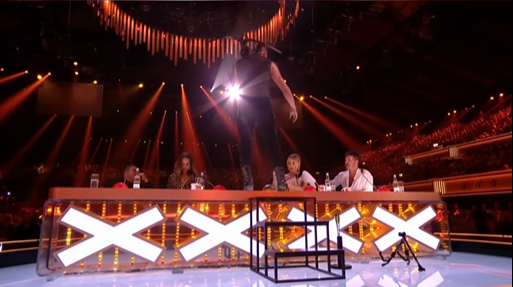
Judges know that balance better than anyone. The panel’s faces become a kind of mirror: the shock on a backward flip, the wary nod over a blade’s edge, the squint at flames that look a little too ambitious. They press palms to lips when they need to, then pound the desk when relief shows up on cue. It’s not false. It’s a way to embody the pact between viewer and performer: we will go with you if you bring us back.
After the fireworks, what remains
When the smoke clears and the audience files out, the strongest memory isn’t the confetti or even the explosion. It’s the faces. The man in white smiling as if to say, I almost slipped, and I’m alive to tell you about it. The escape artist, loose-limbed after the blast, looking down from the platform like someone who’s just crossed back over a bridge that burned at his heels. The woman with the balloon standing inside a frame of heat, so still she seems painted there, and then laughing into a kiss when the danger passes.
There’s a lesson knitted through the spectacle: great danger acts are not stunts stacked for shock value; they’re stories told in muscle memory and careful design. They are hours and years collapsing into a handful of seconds where the outcome is not guaranteed and that uncertainty is the point. That’s why a 56-second fuse can feel like a lifetime, and why the pop of a punctured balloon can release a room like a prayer answered.
Across the night, small refrains keep returning—bits of dialogue that land with extra weight because of where and when they’re spoken. “These are police regulation handcuffs,” says the man who is about to trust an audience with his breath. “Do not try this at home,” echoes after a sword leaves a throat unbroken. “Can I use your phone?” flips a skeptic’s script into a proof no one can deny. “Check the arrow,” turns a judge into a witness.
Watch with your eyes open
This feature gathered the most perilous, ambitious moments from a stage that thrives on taking chances. It honors the way a good danger act pulls us to the edge of our seats and then teaches us something about skill, fear, and human nerve. If you’ve ever wondered what it looks like when a performer hands over their fate to a fuse, a blade, or a partner’s aim—and then takes it back—this is your night.
Set aside the time, turn up the sound, and watch it unfold. You’ll see rings fly and a single foot find balance above a long fall. You’ll watch a box burn while a man races a clock he can neither pause nor plead with. You’ll look at a phone screen held by a judge and feel your stomach drop as a blade goes where nothing should. And when a crossbow quarrel pops a balloon in a flash of heat, you’ll feel the same flood of relief that makes strangers cheer together. That’s the promise and the payoff. Press play and let your pulse decide the rest.