On a talent show built on cheers, the first thing you hear is a safety warning. The room settles as a voice steps in: save the applause until a performer is “back on the ladder.” Moments later comes the firmer line, delivered without any wink: “Do not try this at home.” It sets the tone for a showcase where danger is not a prop but a partner—a constant presence that pushes skill, judgment, and nerves to their edges.
This video gathers the most perilous moments from Britain’s Got Talent in 2020 and strings them into one mounting argument: risk, when owned and controlled, can be a kind of art. Yet the thread that runs through every act is the same: absolute focus, and a trust that feels earned in real time. On this stage, danger is not there to shock alone; it is there to test how far live performance can go before instinct or science must take over.
A stage that opens with a warning
The safety line is drawn early. When the crowd starts to roar at one precarious feat, a voice cuts through: “In the interests of safety, please save your applause for when Wesley is back on the ladder.” It’s the kind of sentence you only hear when a show understands the stakes. The message repeats a beat later, harder this time: “Do not try this at home.”
That mix—hype and hush—becomes the rhythm of the night. There are laughs, too. Someone jokes, “The lights are cool. I wasn’t expecting lights. Really showbiz. That’s nice.” But the levity never erases the edge. A judge mutters, “This is serious.” Another adds, “It just looks like it could end really badly.” Those are not throwaway lines. They are truth checks, tiny breaths before each leap.
Knives, nerves, and the line between brave and foolish
Nothing triggers the nervous laugh like a blade. A knife act turns the judging panel into part of the set. There’s a squirmy aside—“I’ve had one of those thrown at me before”—and a quick back-and-forth about whether to look or not look as steel whistles past.
“Don’t you get up and have knives thrown at me.”
It’s playful. It’s also plain fear. One judge asks, “Is it better to look or not to look?” Another teases, “David, your flies are undone,” a crack that cuts the tension for a second before the room locks in again. Trust is the real subject here: trust in aim, in distance, in the thin margin between a perfect throw and a headline for the wrong reason.
It’s easy to forget how much of this genre depends on consent and control. The judges step up. They square their shoulders. The performer signals. Everyone holds still. Precision becomes a group project, and the applause that follows feels like relief.
“His life is in your hands”
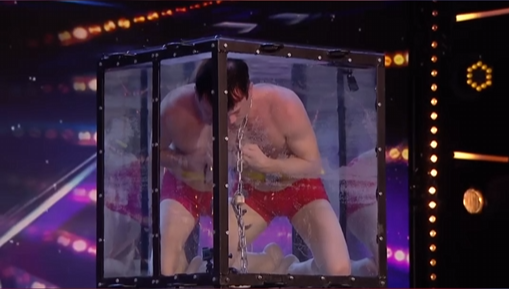
The night’s most harrowing sequence begins with a clear claim: “Underwater escape act.” The performer explains what is about to happen, piece by piece, as if listing supplies for a deep-sea dive.
“I will be locked up inside, chained handcuffs and padlocks … I will be attempting to unpick these padlocks, but first, it will be up to you to select the correct key that opens the padlock on the outside of the box. So you’ll be responsible if I survive or not.”
A judge asks the question everyone is thinking. “How dangerous is this?” The answer draws a line straight back to the legend: “Houdini’s record was three minute and thirty seconds. And at that time, it is a possibility of dying.” Another voice tries to thread the needle between conscience and curiosity: “I am not encouraging you to do it, but I’m really excited. Good luck.”
The setup turns the panel into a lifeline. A padlock. Five keys. Only one will open. They try them in turn. They hiss: “None. No.” They pass the lock down the line. “One last key.” A click of hope: “It does work. Leave it open and give it last.” The performer is bound in chains around the waist and neck, wrists locked, gear clamped to the bottom of the tank. A final warning lands like a verdict: “His life is in your hands.”
The tank seals. A timer starts. The panel scrambles again for the right key on the outside. “Oh. God, don’t like this. Don’t want this.” Someone thinks a key is breaking. Another voice asks the nightmare question: “Does the guy in the box know what he’s doing?” The search becomes frantic. “Quick. Fast as you can. You are almost two minutes.” A cheer breaks through: “Yes. Yes. It’s open.”
But the ordeal is only half over. The performer still has to pick the locks inside. A reminder floats up: “The lock picks. Have lock picks, man.” The clock nags in blunt numbers: “Two and a half minutes. Four locks to pick.” Off to the side, someone mutters what half the room is thinking: “I don’t think I’d like to rely on Hans … No. He’s a bit forgetful, isn’t he?” It’s gallows humor, offered to cover the sound of time.
When three minutes turns into four
As the timer climbs, the tone shifts. The stage chatter thins. The judges count with their eyes.
“Three and a half minutes. Oh god.”
Another voice, lower now: “If you go over four minutes, we’re in a very bad place.” Then the phrase no one wants to hear: “Right. This is danger time now.” Legs thrash in the water. Someone says it out loud, helpless: “Look at his legs.”
The clock hits four. The room tips from performance to emergency in a single beat.
“No. He can’t get off. He can’t get off his shoulder. Guys. Guys. Get him out. Bro. Go. Get … him out. Out. Come on.”
And then air. The first words on the other side are oddly calm.
“How are you feeling?”
“Unchanged.”
Adrenaline collapses into understatement. That one word—“unchanged”—is a small thesis about stage danger. The show returns to rhythm. The performer is safe. The audience exhales. But the weight of what almost happened lingers. You can measure it in the way the judges sit a little straighter for the next act.
Instinct, steel, and the “Magic Marine”
The next act tries to explain risk. He starts not with props but with a résumé.
“I wanna show you some very special skills that I learned in my previous job … In my hand, I’ve got some tags. They’re numbered one to six … Simon, I want you to select one tag … Try not to let anyone else see the number you choose.”
He adds an object that sharpens everyone’s focus.
“This is razor sharp commando dagger.”
He asks for it to be placed under a bag that matches the chosen number. Then he works the room. He counts down. He watches a face. He calls out, one elimination at a time, until two numbers remain: “Number 3 and number 5.” The audience hears the choice tighten. The performer holds the gaze: “Simon, look at me.” Then he commits.
“Simon, the number you chose is number 5.”
Only then does he lay out why he trusts himself to play this close to the line.
“I served in the military for fourteen years, with the last ten years as a Royal Marines commander … A job which required me to routinely risk my life without fear … trust my instincts, have courage in the face of danger, and to hold it together when lives are on the line.”
That background becomes the logic for what happens next, an escalation that trades on nerve as much as technique.
Explosives, choices, and a very public coin flip
The stage now holds five plungers tied by cables to five boxes. The performer says the quiet part out loud: even he does not know which plunger connects where. He gives the panel a safe start—one plunger and one box that are clearly linked—and asks for a push.
“Simon, can you come forwards, please, and push down plunger number five?”
It detonates as promised. The floor shakes. The room jolts. Then the premise turns live. The panel is invited to pick which of the remaining boxes will matter.
“There is an explosive device in each one of these four boxes on stage. Nobody warned us about this … Simon, please point to one of these four boxes. Whichever box you select is the box I will use.”
Does the audience believe in instinct? The performer does. He praises a choice—“I believe this is one of your better ones”—and asks for a number between one and four. “Two,” comes the reply. Another detonation roars. “That’s loud, aren’t they?” someone says, half laughing, half bracing.
Now the choices tighten further. “One, three, or four.” The panel stands where they think it’s safest. Another push. Another blast. The field narrows until the performer says the sentence that no one on live TV wants to hear before pressing a button.
“We are now fifty fifty from potential disaster … Simon, my intuition is telling me something.”
Nerves spill into the open: “Get back. They’ll have teeth flying everywhere.” Then, to settle any cynic who thinks the setup is smoke and mirrors, the performer invites the final proof.
“There are some people that may think this explosion isn’t real. Can you please push down the final plunger?”
Another shock wave. When the noise dies, the performer signs off with a grin that explains the act in three words: “I have the magic marine.” It is showmanship, but the method leans on a point made earlier—courage is a habit, trained in high places and adapted for lower ones, and risk can be managed without being neutralized.
Science set on fire
The final stretch shifts from battlefield to blackboard. A performer fuses physics with theatrics. He leads not with flames but with flowers, conjuring a bouquet for a judge and calling it both “magic and science.” Then he lays out a plan to show how science can be “beautiful” and “dangerous” in the same breath.
“This is my very favorite science desk toy. It’s called a harmonic pendulum … The first one was built one hundred and fifty years ago by physicist Ernst Mach.”
He explains what his eye learned from watching patterns repeat: in theory, an object can move through a swinging grid without being struck. Then he shifts from theory to threat.
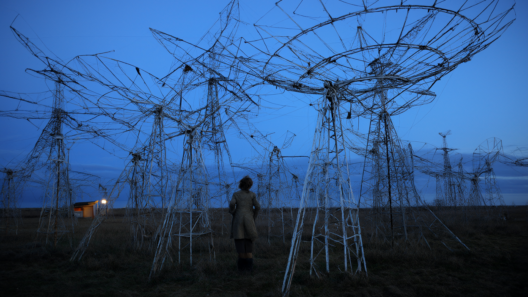
“The important phrase here, of course, was in theory … the one I have here on stage tonight is a giant industrial sized one, which can be deadly … In a moment, these cannonballs will career across the stage taking out literally anything in their path. When that happens, I will attempt to walk through them without being struck.”
Because this is television—and because doubt always lingers—he adds fuel. Literally.
“We know that you love a bit of drama. So tonight, we will be setting these cannonballs on fire.”
To demonstrate the stakes, he invites the host to lift a cannonball over a watermelon. There is slapstick in the heave—“Quite heavy … Oh, it is heavy”—then a soft countdown: “Three, two, one.” The melon explodes into pulp. The line that follows lands with the thud of the metal itself.
“Yeah. I mean, you’re laughing, but that could be my head.”
And then the twist. He will not see his way through. He will be blindfolded. The room cannot believe it: “What? What?” The performer pulls the hood over the host’s head first, to prove it blocks every signal. “No flinching whatsoever.” He thanks him and turns back to the task at hand.
“Ladies and gentlemen, I need complete faith and science to make this work … Just let me know when they’re lit.”
Flames bloom. Someone near the front whispers what half the audience is thinking: “It’s crazy.” Another voice tracks a doubt in the setup: “That’s not right, is it? Is that right? Is that right?” The last line before motion is a cliff edge in words: “Is he gonna run?”
What follows is not a rejection of science but a tribute to it. The timing, the arcs, the patience to read a pattern without seeing it—these are the tools that turn a lecture into a high-wire act. And yet the same rule applies as in the other performances: the margin for error is paper thin, and the difference between a near miss and a collision is the space that skill buys from chance.
Why we watch
Taken together, these acts reveal a strange truth about live entertainment in a year when the world learned to measure risk in daily life. Danger on stage is not a dare. It is a study. The underwater escape strips a human task down to breath and will. The military mentalist turns choice into a pressure test and asks whether instinct can be trained. The physics walkthrough shows how a pattern—abstract, elegant—can become a shield when the stakes are high. Even the knife toss, dressed in banter, is a quiet pact between people who understand what one wrong inch could cost.
For the judges, it is a series of roles: volunteer, witness, guardian. “His life is in your hands,” they are told, and for a few minutes, it is true. They are asked to choose keys, push plungers, hold still. They are also asked to say stop. When the timer hit four minutes, someone did. That, too, is part of the show’s ethic. Drama has to bend to duty when the line moves from risk to harm.
For the performers, the appeal is deeper than applause. You can hear it in the way one speaks about his past. Fourteen years in the military, ten as a Royal Marines commando. “Hold it together when lives are on the line.” That sentence frames a lot of what you see. If you have spent years turning fear into a tool, you may see a live TV stage as one more place to practice control. The difference here is that the audience shares the fear. They hear the clock. They see the flame. They do not know how it ends until it does.
For the audience at home, the value is a kind of permission. We are allowed to feel the clean edge of danger without the real cost, because the people on stage have done the work to carry that weight. But the show does not lie about the cost. It tells you not to try this at home. It stops a stunt when the margin collapses. It proves the blasts are real. It lets a performer say “unchanged” and lets that relief land as a lesson.
None of this would land without craft. The acts are paced to let the mind catch up with the heart. Explosions puncture the doubts at just the right beats. The lock clicks open at two minutes, and you think the worst is over, only to learn about the four locks left inside. The cannonball smashes the melon, not to terrify, but to convert an idea into a tactile truth. Even the small jokes—the undone flies, the weary quips—make the fear sharper by contrast.
What ties every segment together is the quality of attention. Everyone is busy watching the same small things: a hand shake, a cable hum, a leg kick, a judge’s eyes flicker at a number. Attention on this stage is not passive. It is the last line of safety. When someone says, “That’s not right,” the whole room recalibrates. When a voice says, “Get him out,” the show yields to the call. The rules are written as they go, and they are enforced by people who are paying very close attention.
In the end, that is what makes danger on TV feel both credible and earned. It is not chaos disguised as skill. It is skill that allows the artists to step into the jaws of chaos and step out again. Sometimes the exit is silky, all smoke and grins. Sometimes it is messy, with water everywhere and sharp breaths and a single word—“unchanged”—carrying a stadium’s worth of relief. Either way, the passage is the point. The audience travels with them, and that shared travel is what sticks.
There will always be debate about where to draw the line. Should a bomb go off within arm’s reach of a judge? Should a person hold their breath longer than Houdini? Should fire be added to a machine that was already “deadly” before the flames? Reasonable people can disagree. What this showcase makes clear is that when those lines are crossed carefully—when the warning is given, when the emergency stop works, when the courage is more than a pose—danger can illuminate more than it threatens. It can reveal what steady hands and clear heads can do under pressure.
And so the stage keeps calling for silence before each leap. The hush is not for drama alone. It is for attention, for care, for the strange bond that lets a room of strangers hold a breath together while someone gambles with theirs. This is the rare promise a show like this can make and keep: that we will watch closely, that we will feel that clock in our ribs, and that we will leave with a deeper respect for the line between spectacle and harm.
If you crave the rush that comes when skill meets peril, this collection delivers it with clarity. You will see chains, flames, steel, and nerve, but also judgment calls and the sober reminders that frame them. Take the warning seriously. Then press play, and watch how people who train their instincts—and trust science—turn danger into a story you can’t look away from.