There is a particular hush that settles over a live audience moments before risk becomes real. On Britain’s Got Talent, that hush is part of the show’s grammar. You can feel it when a magician tosses away the safety of a polite card trick. You can hear it when a judge’s voice cracks, or a presenter gulps and laughs a little too loudly. You can see it in the way even the camera seems to hold its breath as the acts edge toward catastrophe—and, if everything goes right, pull back at the last possible second.
In this collection of Britain’s Got Talent’s most dangerous performances, a pattern begins to emerge. It isn’t only about the tricks; it’s about the scaffolding of suspense. The setup is meticulous. The volunteers are familiar—Ant, Dec, Simon, Amanda—so their reactions bring the stakes home. And the acts themselves move from alarming to astonishing, carrying the crowd through rising waves of tension. By the end, what started as a variety show becomes a study in fear, control, and the thin line between them.
The opening gambit: a card trick with teeth
It starts the way so many evenings of magic do, with a deck of cards and a casual challenge. “Well, I’m sure that many of you guys have seen a card trick,” a performer tells the room. He pauses just long enough for the recognition to land. Then he promises to raise the stakes—“a sense of danger.”
He brings Ant and Dec to the stage. One of them selects a card and tears off a corner, a small act of vandalism that transforms a simple choice into a singular object—proof that whatever happens next, that card is unique. The other host is instructed to hold the deck wide, to turn a playful puzzle into a shooting gallery of paper. The performer breathes them into position. “Take a deep breath,” he says, “and relax.”
Then he says the part that pries a gasp out of even the most jaded. “I’m gonna throw this knife at you.” It’s half a threat and half a thesis about what danger does to an audience. Everyone onstage wears the moment in a different way: Ant tries to joke it off; Dec focuses on the deck; the judges quarry the faces of people they know and like for clues. The room turns into a gauntlet of eyes. The count begins somewhere, a beat that ratchets up the dread. The promise in a sentence—knife, throw, you—transforms a common trick into a test of nerve.
There’s something telling in that shift. The question is no longer whether the magician is clever; it’s whether the human beings onstage will be all right. In that turn, the show taps the same vein of suspense that made stagecraft into a spectator sport a century ago. We come for the puzzle. We stay for the people.
Targets, proof, and the credibility of peril
In dangerous acts, verification becomes part of the spectacle. The audience needs proof that the threat is real, and the performers know it. A voice calls to the judges from the stage: “Simon, can you check the arrow and see that’s real,” the performer asks, collapsing the distance between demonstration and jeopardy. The arrow glints under studio lights—solid, pointed, unambiguous.
Next comes a request that would be absurd anywhere else and feels chilling here. “Amanda? Yes. Can I use your phone for one second? Yes. Please.” A personal device becomes collateral, a stand-in for trust. Phones are our private worlds; when a performer asks for it, the audience registers the risk twice—first for the object, and then for the person willing to hand it over. On this stage, even props double as affidavits. The more we believe, the more we fear.
The best of these acts are built on consent and clarity. Every instruction is spoken out loud, every choice made in public. Even when the method remains hidden, the stakes are served plain.
History lessons in flames
It is one thing to flirt with danger and another to name it. One escape artist on this stage speaks his dare in full, anchoring it to a lineage that stretches back to vaudeville. “The first person to escape from a straight jacket was Harry Houdini,” he says, “and it was a feat which he said was the most difficult of his entire career.” The homage starts as a nod to history; quickly, it becomes a launchpad for escalation.
“Tonight, I would like to attempt to escape from a straight jacket for you.” It sounds noble in its restraint—familiar, achievable—until he elaborates on the twist. He reminds the room how Houdini amplified the drama: hanging upside down, suspended by a single rope, high above the ground. He reveals how others tried to outdo the master by setting that rope ablaze, forcing a race against time and physics. Then comes the line that pulls the oxygen out of the room.
“Tonight won’t be the rope that’s on fire. It will be me.”
He walks everyone through the checklist of peril. “I’m going to be doused in fuel, hung upside down, and set alight.” For a heartbeat, it’s too much to absorb, and then he offers the part that gives the audience a foothold: “My only lifeline will be the fire extinguisher hanging next to me.”
There is dignity to the formality that follows. “Are you satisfied that I’m restrained, sir?” he asks the person tasked with locking him in. “Absolutely.” “And your work done.” “Thank you.” It is a ritual as old as escapology: the host, the inspector, the bonds, the confirmation. The more official it feels, the more the crowd trusts its own sense of peril.
Even the casual commentary lands harder under this heat. Someone in the wings mutters what the room is already thinking: “He is nuts. You know that.” Another voice cracks into a nervous confession: “I’m actually quite nervous for him.” The fire is not yet lit, but the stage is already burning through the distance between show and life.
Showmanship, safety, and the line that blurs
No television program can, or should, trade lives for ratings. What makes these sequences so enrapturing is the show’s tightrope walk between spectacle and stewardship. The performers address the judges as witnesses and the hosts as agents. They narrate the risk so that the audience can measure it. And they scatter lifelines—extinguishers, scissors, crew members at the ready—like breadcrumbs that map responsibility if something goes wrong.
The crowd senses that care even as it wrestles with fear. It hears the boots-on-the-ground warning from the panel: “These are the acts that actually can go wrong.” It watches hands hover near the emergency release and then retreat, trusting the performer to pull himself free. The obligations are visible, and they make the achievement, when it comes, feel earned rather than reckless.
“A hundred”: calibrating fear for prime time
The most chilling moment of candor in the show may be the simplest. Before another escape attempt, someone asks the question every viewer is silently weighing. “How dangerous on a scale of one to 10 is it?” The answer arrives without a wink: “A 100.” It’s bravado, yes, but it also names a truth about how these acts function on TV. They can’t hover at a seven and make a dent. They have to feel impossible and then yield to skill.
Instead of hoping the threat remains abstract, the show invites the public to participate in building it. Volunteers make choices that either hobble or help the performer, and those choices are made in full view. That is the central mechanic of a standout underwater escape that swallows the final stretch of the program.
The lockbox: breath, keys, and needle-in-a-haystack odds
The performer outlines the plan with the calm of a craftsman reading his own blueprint. There’s no sting of surprise here—only the pressure of practicality.
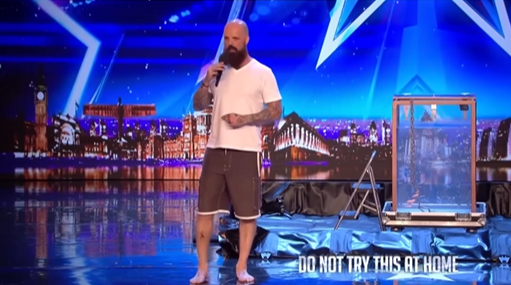
“I’ll go underwater. The lid will be closed and padlocked shut. A chain will be wrapped around my neck. My hands will be handcuffed on the outside of the box. The lock around my neck and the handcuffs, I’ll be attempting to pick using a lock pick. But the last lock, the one that keeps the lid closed, that one’s a little different.”
He brings Ant and Dec to the table. The rules are plain. Verification first, then chaos.
“Here on the table, I have a glass. It contains 20 keys. None of these keys will open that lock. Now we don’t have time to go through all 20, so take three or four at random. Try them in the lock. When you’ve tried them, drop them in the glass, please.”
They follow along, fumbling in the most human way, because they are not props; they are people. He produces the outlier, the one lifeline the stunt allows.
“I have one more key. This is the one that opens the lock. Would you try that in the lock now, please? As he’s doing that, would you put pull the keys in the glass? Yes. Would you take the key out and put it in the glass with the 20 that don’t Like that? Yes. Now put your hand on top and shake up the keys.”
The premise settles on the audience like a weight. The key that matters has been surrendered to chance, and now the man who needs it most will have to find it underwater, by touch, while fighting his urge to breathe. He sums up the odds for anyone who missed the brutal elegance of the setup: “The last lock is like trying to find a needle in a haystack.”
Before the lid comes down, there is a final, sober briefing from the stage to the judges and the audience. It lands like a contract.
“Now tell me, what should we be looking out for? Is this a period of time or what? I’m gonna try and do it in a minute and a half, but if we start getting up around the minute forty, minute fifty underwater holding my breath, then then we’re starting to have problems. If I start floating and I pass out, then you get me out.”
That candor reshapes the room. The stunt isn’t a riddle anymore; it’s an argument with the human body. The water presses in. The clock starts its inexorable nibble at the upper edge of safe. Somebody whispers what the crowd is feeling: “I mean, this is crazy. Feel sick already.” Another voice names the bone-deep dread: “I feel really anxious.”
It’s not only the performer who is trapped. Everyone is stuck with him, on the far side of a decision nobody else can satisfy. His hands work in a dance the water hides. The panel leans into their monitors, scanning for the barely visible signs of progress. Time, meanwhile, becomes a character of its own—cruel, loud, and indifferent. The seconds slip past the first landmark he’d warned about, then past the next. The air that held the opening laughter now tastes metallic with worry.
The play-by-play grows frantic and broken. Someone blurts, “How many minutes did he say? Oh my god.” Another voice tries to stiffen the room with a status call—“Last two minutes now. Two minutes”—though minutes are elastic in fear and a heartbeat can feel like a mile. The audience is reduced to one universal language: held breath, hands clasped, a tide of whispered please.
In the end, these sequences hinge on a paradox. The more carefully they are engineered, the more chaotic they feel. The producers scaffold the danger with redundancies and preparedness; the performer welcomes the randomness of keys, cards, fire, and water. The show must be safe enough to do again and again, but it must also feel like it could fail tonight, and that knife edge is where live television burns brightest.
Why we watch
It would be easy to dismiss these acts as reckless or to flatten them into puzzles to be solved. But the truth lies somewhere more artful. The performers are not merely courting death; they are creating portraits of control. They teach the audience how to measure risk in real time—what a straightjacket binding means, how a padlock behaves under tension, why a breath-hold past a certain point becomes a countdown to blackout. They layer in public checks, from the moment someone asks, “Are you satisfied that I’m restrained, sir?” to the invitation for the hosts to select and stir the keys.
On this stage, danger isn’t an accident; it’s a language. The syntax is familiar: choose a constraint, verify it publicly, describe the escape, accept randomness, begin the work, and let time beat overhead. The punctuation is human. The laughs that don’t quite land when the room is scared. The barked instructions that are really pleas. The hush when a person that everyone knows by their first name is asked to stand still while a blade flies.
When a performer says, “I’m gonna throw this knife at you,” he is not only telegraphing a physical act; he is asking for a compact of trust. Everyone around him—hosts, crew, judges, crowd—agrees to inhabit the same stretched second. And when a voice answers a danger scale with “A 100,” the hyperbole acknowledges a moral reality: on live television, with living bodies, the cost of a mistake can feel incalculable.
The craft of consent and control
What keeps these spectacles from tipping into exploitation is the show’s shared ownership of risk. The audience is not treated as a gullible mark; it is invited to inspect, to question, to hold the performer to his own standards. The judges ask the banal but essential questions. The hosts become both provocateurs and custodians. The performer himself narrates the safety rails: the extinguisher in reach, the signal that means intervene, the boundary beyond which the stunt is no longer a show but an emergency.
That last piece is crucial, and it’s rare. In many corners of entertainment, secrets are power. Here, certain secrets stay hidden—the method, the misdirection—but the terms are laid bare. When he says, “If I start floating and I pass out, then you get me out,” he hands the room a moral obligation. He gives the audience a role that is not voyeur but witness. It’s a burden and a relief.
There is also a democratic genius to putting famous hosts at the center of the danger. With Ant and Dec holding cards, stirring keys, cracking jokes that falter as their hands shake, the audience measures risk in a currency it recognizes. If it’s too real for them, it’s too real for us. Their presence is a barometer that cuts through hype and lands squarely on the gut.
The aftertaste of adrenaline
Long after the stage has been swept and the tank wheeled away, what lingers is not a single reveal but a set of sensations: the shock of recognizing an object in a new context (a mobile phone as target), the bright clang of a sentence that redefines a stunt (“It will be me”), the ragged chorus of people trying to fill the silence that terror makes. The show is unabashed about its intent. It wants to make you flinch, and then it wants to earn your applause.
There are moments of goofy relief, too—small bubbles of normalcy that remind everyone that this is still a family show built to deliver wonder, not trauma. But the greatest of these acts are not the ones that hide danger with jokes; they are the ones that fold humor and horror into a single lived minute and let you feel both without apology.
At its best, Britain’s Got Talent becomes a masterclass in managed fear. The engineering is invisible until it needs to be obvious; the theater is honest enough to admit its own artifice, and the performers are brave enough to stake their bodies on the bargain. Whether you come for the mechanics, the courage, or the cold rush of uncertainty, you leave with the same realization: danger, when staged with care, can make television feel more human, not less.
Watch, listen, and decide for yourself
The acts here sketch a map from knife-edge showmanship to full-body fire and a final, breathless wrestle with a lock that may or may not yield in time. Along the way, you’ll hear the performers explain their odds, watch trusted faces harden with worry, and feel the audience lurch from laughter into silence. You’ll hear, clear as a bell, the phrases that define the night: “a sense of danger,” “It will be me,” “A 100,” “needle in a haystack,” and that sober promise—“If I start floating and I pass out, then you get me out.”
However you read those words—bravado, blueprint, or plea—the only way to grasp their gravity is to see them tested in real time. Watch the video, follow the breath of the room, and decide where you draw the line between safe spectacle and something more primal. Then ask yourself, as the countdowns tick and the crowd tenses: are you watching a trick, or are you witnessing courage? On this stage, the answer can be both.