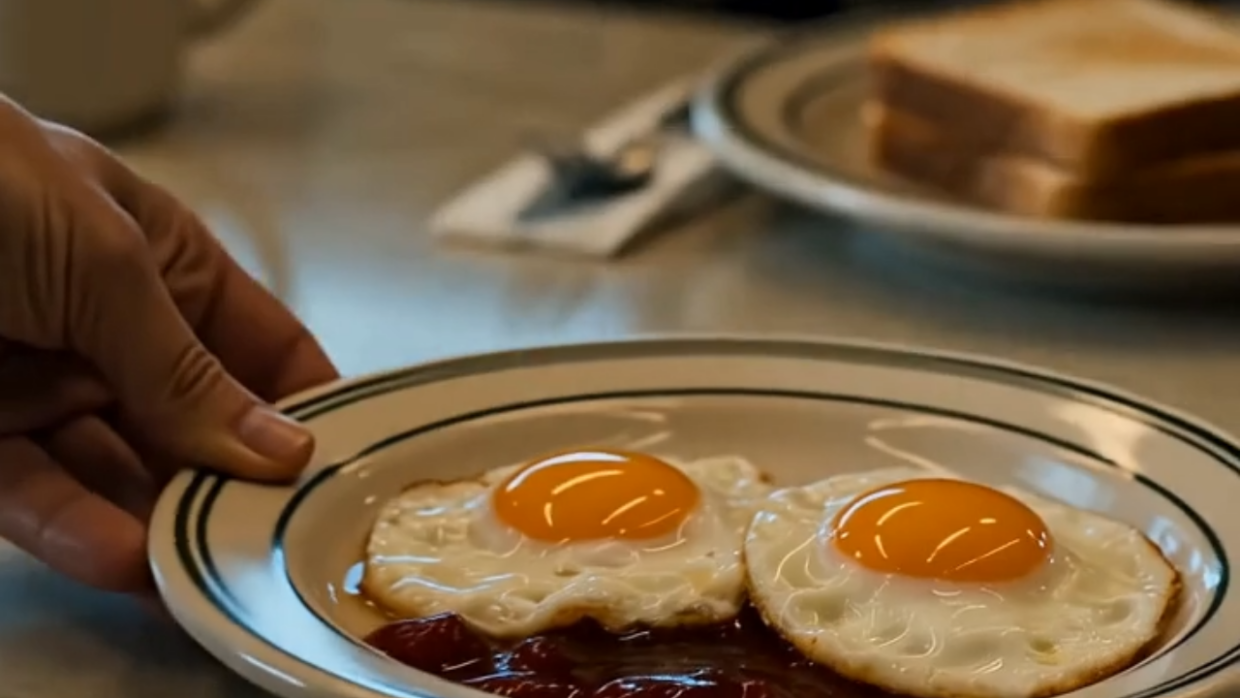
She fed a homeless man free meals for two years using her own waitress tips… Then his lawyer walked into the diner with a briefcase and told her Walter had left her $14 million — and that he owned a company.
The bell jingled at 6:47 a.m. I looked up from wiping down the counter at the diner.
“Morning, Walter. Coffee and the usual?“
The old man shuffled in, his coat too thin for November in Ohio. “If it’s no trouble, sweetheart.”
“Never any trouble.“
I poured the coffee myself. Two sugars, a splash of cream. Then I walked back to the kitchen and tapped the bell.
“Carlos, one Lumberjack Special. On me again.“
Carlos shook his head. “Megan, that’s the third time this week.”
“And?“
“And you make eleven bucks an hour.“
“Just cook the eggs.“
I carried the plate to his booth by the window. He looked up at me with those pale blue eyes and folded his hands.
“My daughter, you don’t have to keep doing this.”
“I know I don’t.”
“One day, these kindnesses you do? They come back. Life is a boomerang, Megan. Remember that.“
I laughed, sliding into the seat across from him. “You tell me that every week, Walter.“
“Because every week it’s still true.”
I’d been feeding him for almost two years. It started one rainy Thursday when he walked in soaked to the bone, counting nickels on the counter for a cup of coffee. I told the manager he was my uncle and put the meal on my tab.
The manager quit six months later. The new one didn’t ask questions as long as the tips kept coming.
But my tips weren’t great. Most nights I walked home with forty bucks and aching feet, back to the studio apartment above the laundromat where my rent was three weeks past due.
My phone buzzed. I knew without looking it was the landlord.
“Everything okay, sweetheart?” Walter asked.
“Peachy.“
“You’re a terrible liar.”
I sighed. “Rent. I’ll figure it out.”
He set down his fork. “How much?“
“Walter, no. Don’t even.”
“How much, Megan?“
“Eight hundred. And don’t you dare offer me a dime. I see you counting change for coffee.”
He smiled, slow and strange, like he was holding back a secret. “You’re right. I don’t have it.”
“See? So eat your eggs.“
Three days passed. No Walter.
Then a week.
By day ten, I was checking the door every time the bell rang.
“He probably just found somewhere warmer,” Carlos said.
“He always tells me when he’s going somewhere.”
“Megan. He’s homeless. He doesn’t have an itinerary.”
“He’s not just homeless, he’s Walter.”
I drove to the shelter on Pine Street after my shift. The director didn’t recognize the name. I tried the soup kitchen. Nothing. I drove past the bench by the library where he sometimes sat.
Empty.
That night I sat on my fire escape with a cigarette I’d quit smoking two years ago, and I cried for an old man whose last name I didn’t even know.
Day fourteen.
I was bussing table six when a black town car pulled up outside. Long, glossy, the kind of car that doesn’t belong in a diner parking lot off Route 30.
A man in a charcoal suit stepped out. Briefcase. Silver hair. He scanned the windows, then walked straight in.
“Looking for Megan Calloway.“
I froze, dish tub in my hands. “That’s me.”
“My name is Daniel Hartley. I’m an attorney. Is there somewhere we can speak privately?”
Brad was already gawking from behind the register. “Use the back office. Take all the time you need.“
I set the tub down. My hands were shaking and I didn’t know why.
The office smelled like ketchup and old paper. Hartley sat across from me and opened his briefcase.
“Miss Calloway, do you know a man named Walter Bennett?“
My chest tightened. “Walter? Is he—“
“I’m very sorry. Mr. Bennett passed away last Tuesday. Peacefully, in his sleep.”
I didn’t cry. Not yet. It hadn’t landed.
“He was sick?“
“Pancreatic cancer. He’d known for about three years.”
“Three—” My voice cracked. “He never said anything.“
“No. He wouldn’t have.”
Hartley slid an envelope across the desk. Cream-colored, my name in shaking blue ink.
“He asked me to deliver this personally. Before we proceed with anything else.“
“Proceed with what?“
“Read the letter first, Miss Calloway. Please.“
My hands were shaking so hard I almost tore it.
*My daughter,*
*If you’re reading this, then I’ve gone on ahead, and I’m sorry I couldn’t say goodbye in person. I didn’t want you to watch me wither. You’d already given me too much.*
*I owe you the truth.*
*I wasn’t homeless. I haven’t been homeless a day in my life.*
*My name is Walter Bennett, and forty-two years ago I started a company that makes machine parts you’ve never heard of. My wife Eleanor passed in 2009. We had no children.*
*When the doctors told me how much time I had left, I realized I had everyone in the world to leave my money to and nobody to leave it to.*
*So I went looking.*
*I dressed in old clothes and I sat in diners and coffee shops across three counties. I wanted to find someone who would be kind to a person who couldn’t pay them back. Someone who’d be kind when no one was watching.*
*Do you know how many people I met, Megan? Hundreds.*
*Most looked through me. Some told me to leave. Two called the police.*
*You called me “sir.” You remembered my coffee. You paid for my food out of your own pocket when you couldn’t afford your own rent, and you never once mentioned it.*
*You told me once that your mother died when you were sixteen and your father drank himself into a grave six months later. You told me you understood being alone.*
*So did I, daughter. So did I.*
*Everything I have is yours now. The house. The company. The accounts. Mr. Hartley will explain it all.*
*Use it well. Be kind to people who can’t pay you back.*
*And remember what I told you. Life is a boomerang. Throw good things. They come home.*
*— Walter*
I was crying before I finished the second paragraph.
Hartley waited. He’d done this before; he knew how to wait.
When I finally looked up, my face wet, my voice barely there, I whispered, “How much?“
He opened a folder. “The estate, after taxes and final expenses, totals approximately fourteen million, two hundred thousand dollars. There’s also a property in Bexley, the company itself, which is currently valued at—”
“Stop.“
He stopped.
“I can’t. Mr. Hartley, I bus tables. I can’t—”
“Miss Calloway. He didn’t choose you because he thought you’d be a good CEO. He chose you because he thought you’d be a good steward. The company has a management team. The house has a caretaker. What you do with the rest is entirely up to you.”
I stared at the letter. “He sat in my booth for two years.“
“He told me once that they were the best two years he’d had since his wife died.”
That broke me. I put my head in my hands and sobbed for a man who’d ordered the same eggs every Tuesday and called me daughter and never let me know he was dying.
Brad knocked an hour later. “Megan? Everything okay?“
I wiped my face and opened the door. Hartley was still beside me, briefcase closed.
“Brad. I need to give my two weeks’ notice.”
His face dropped. “What? Why? Did something happen?“
I looked at the lawyer. Then at my boss. Then at the diner where I’d worked for four years, where I’d cried in the walk-in freezer more times than I could count, where a lonely old man had walked in soaked from the rain.
“Something happened,” I said quietly. “But I’m finishing my two weeks.”
Hartley raised an eyebrow.
“Walter wouldn’t have wanted me to leave Carlos hanging on a Thursday rush.”
The lawyer almost smiled. “No. I don’t suppose he would.”
I worked the full two weeks.
I tipped Carlos a thousand dollars on my last shift and told him it was from a regular. I paid off Brad’s overdue produce bill anonymously. I slid an envelope under the door of the laundromat downstairs where the owner, Mrs. Park, had let me pay rent late three months running.
Inside was six months’ rent and a note: *”Thank you for your kindness. — A grateful tenant.“*
Hartley took me to the house in Bexley on a Wednesday morning.
It was a beautiful old Victorian with a wraparound porch and flower boxes in the windows. Inside, everything was clean and warm. Walter’s books were still on the shelves. His reading glasses were on the side table next to his favorite chair.
“He asked that you keep whatever you want and donate the rest,” Hartley said.
I picked up the glasses. They were heavier than I expected.
“I want to keep everything,” I whispered.
Hartley nodded. “Then we will.“
The company was called Bennett Industrial. It made precision parts for medical equipment and employed over two hundred people. The management team was professional and kind. They’d known Walter for decades.
“He talked about you,” the operations manager said at our first meeting. “He called you his daughter. Said you had the kindest heart he’d ever known.”
I cried again. I seemed to cry every day now.
“What do you need from me?” I asked.
“Nothing, Miss Calloway. Just your signature on a few documents. We’ll keep doing what we’ve always done. Walter trusted us. We hope you will too.”
“I do.“
Six months later, I started the Walter Bennett Foundation.
We gave grants to waitresses and busboys and line cooks who were struggling to pay rent. We partnered with diners across Ohio to provide free meals to homeless people, no questions asked. We paid off medical debt for families who couldn’t afford treatment.
Every Tuesday, I went to the diner.
I sat in Walter’s booth by the window. I ordered the Lumberjack Special. And when I saw someone counting change for coffee, someone whose coat was too thin for the weather, someone the world had decided to look through—
I bought them breakfast.
“You don’t have to do that,” a young guy said once, eyes wide.
“I know I don’t.”
“Why?“
I smiled. “Because life is a boomerang. Throw good things. They come home.“
He looked confused, but he ate the eggs.
Carlos brought me coffee without asking. Two sugars, a splash of cream.
“You miss him,” he said.
“Every day.“
“He’d be proud of you, Megan.”
“I hope so.“
I kept Walter’s letter in my purse. I read it when I felt lost. When I wondered if I was doing enough, being enough, honoring him enough.
The last line always steadied me.
*Life is a boomerang. Throw good things. They come home.*
I’d thrown kindness to a lonely old man in a thin coat.
And he’d thrown back a fortune, a purpose, and a family I never knew I needed.
The world kept spinning. The diner kept serving eggs. And I kept buying breakfast for strangers who needed to know that someone saw them.
Because Walter had seen me.
And that changed everything.


Love that story, life is a boomerang so true