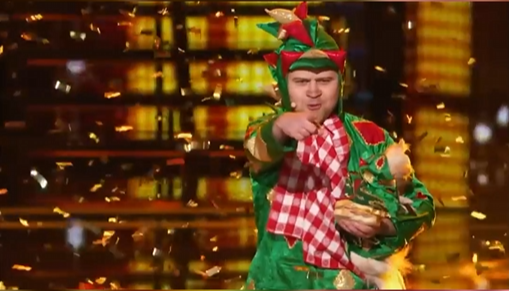
A man in a green dragon suit shuffled onstage with a red prop box and a stare as dry as the desert. He was both the joke and the punchline. He was also, in short order, a magician with a signed card that wouldn’t behave, a showman with a Chihuahua in a dragon hoodie, and a flirt bold enough to earn a kiss from Heidi Klum. By the time the confetti fell and the boxes loomed over Radio City Music Hall, Piff the Magic Dragon had turned a talent show run into a running bit about failure that somehow never failed.
A dragon walks into a talent show
“Welcome to America’s Got Talent,” the judges said. “What’s your name?”
“My name’s Piff the Magic Dragon. You might have heard of my older brother, Steve.”
The room laughed. Piff didn’t. That was the trick. He stood there in green scales, a bright red case marked with the letters of his name, and spoke like a man who’d wandered into the wrong audition and decided to make the best of it.
“It was either this or Game of Thrones. And I’ll be honest, Mel. I don’t want to die yet.”
There was a pause—then Mel B covered her face, helpless. The bit snapped into focus: Piff was a character who undercut the spectacle even as he fed it. The dragon suit said children’s party; the voice said world-weary professional.
He called Heidi Klum to the stage and, with mock formality, mentioned a wife named Heidi. “We’ve only just met,” he added, and Heidi’s smile widened. He produced a deck of cards, improbably, and then a pen, right when she needed one. What looked like absentminded fumbling flickered into clean, startling magic.
If he could really do magic
Klum signed a card—her name and a small heart—and slid it back. Piff declared he had made a prediction in advance. He showed it with almost bored pride: the Seven of Spades. Heidi’s choice, of course, was not the Seven of Spades. It was the King of Hearts. Piff stared, unimpressed, at the wrongness of the world.
“Ladies and gentlemen, my prediction is Seven of Spades… so, basically, Heidi was wrong.”
A gasp, a groan, a grin. Then the twist.
“If I could really do magic, it would look a bit like this.”
The signed King of Hearts became the Seven of Spades. Her name still rode the new face of the card. The crowd noise flipped from laughter to shock. Piff never moved faster than necessary; he let the impossible sit in the air. He offered Heidi her miracle back—at a price.
“Is that your name still on the card?… You got—yeah. Yeah. It’s just $12. It’s genuinely $12.”
The joke was the sale; the kicker was that people wanted to buy anyway. A dragon who chased gas money. A Vegas pro who ate his lunch onstage. Howard Stern called him a “phenomenal actor.” Howie Mandel liked the audacity. Heidi gave a smiling “thumbs up.”
“Are you ready, Piff?” — “I’m ready.” — “One, two, three.” — “Yes.”
Four yeses. Confetti? Maybe only in spirit. Either way, the dragon had landed.
Backstage and in asides, the legend of Piff deepened: he was “$8 short,” he joked, angling for a handout, counting bills like a busker with rent due. “Give him $8,” someone quipped. The myth of the underfunded wizard stuck to him and made everything that followed funnier. A man whose show looked barely held together kept pulling off pristine miracles.
Enter Mr. Piffles
Next time out, Piff returned with a sidekick: a small Chihuahua in a matching dragon outfit. He introduced him with full ceremony, even as the joke sharpened.
“This is Mister Piffles.”
The world’s only magic-performing Chihuahua, Piff said, and for a moment it seemed true. Heidi once again took a card and signed it. Piff grinned at the excuse to hand over the dog for a cuddle.
“I always wanted to do that. It’s the only reason I got a dog, Heidi.”
The trick was simple in shape and slippery in execution: Mr. Piffles would sniff out Heidi’s signed card. But when the dog’s “search” led to the wrong result—an Ace of Hearts with her signature eerily gone—Piff turned the failure into a plot.
“Mister Piffles has found Heidi’s card… and he’s changed it into the Ace of Hearts, and he’s got rid of Heidi’s name… Now what are we gonna do?”
The answer, as it turned out, was dog food. Piff announced a prize for success—“an entire year’s supply of dog food”—and then switched the stakes with a deadpan that never cracked.
“Oh, Heidi. He says he’s very sorry. He says he’s on hunger strike. He says no food, no card.”
The can appeared. The lid came off. Inside the mess, the absurdity, the commitment to the gag, was Heidi’s signed card. Real ink, real shock, real delight. She hugged the tiny dragon dog; she grabbed Piff. He stepped back, blinking, and made the moment bigger with a shrug.
“You didn’t need to kiss me on the lips.”
“I think I did need to.”
“How was it?”
“Yeah. It was pretty good.”
On AGT, kisses are usually stagecraft or victory laps. This was different, a burst of warmth dropped into Piff’s cool routine. For once, the dragon seemed surprised.
Golden rain
Then came a bonus judge with a Broadway smile and a fast hand. Neil Patrick Harris, sitting in as a guest, didn’t wait for deliberation.
“I’m kind of blown away by it, and I think it’s great. And I don’t think we need to deliberate much because I’m using my golden buzzer.”
The confetti fell for real. “You’ve earned it,” he said. Piff stood amid the glitter with Mr. Piffles and looked, at last, like a man who might afford a cab. He was going straight to Radio City Music Hall.
Game of Groans vs. Game of Thrones
Scaling up is where acts often lose themselves. Close-up magic becomes an over-lit question mark. Gags drown in production. Piff knew that, and he mocked it even as he tried to beat it. He parked himself on a throne that looked borrowed from fantasy TV. He kept eating onstage—at one point, a ham-and-cheese sandwich mid-judging. He ordered takeout. A delivery showed up. He grumbled about being “$8 short.” The act of being an act became the act.
But he also built a set piece big enough to fill the hall. Four boxes hung over the stage, each labeled, sealed, and bathed in light. Piff faced the crowd with a pitchman’s lean and a conjurer’s pause.
“Four hermetically sealed boxes. One magic performing Chihuahua. Just a single question. Welcome to Dog or No Dog.”
The title was a wink. The rules were clean. In one box: Mr. Piffles. In the others: “the hopes and dreams of Mr. Piffles.”
“In other words, they’re empty.”
Howie Mandel joined as the contestant. Piff handed him a treat like a host handing out prizes at a carnival.
“Are you having a good night, Howie?” — “I’m having a fantastic night.” — “Let’s change that.”
Round by round, Howie guessed “dog” or “no dog.” A box opened to reveal not a dog but a woman in a red dress. Another box opened—the same. Piff grinned like a magician who’d seen this trick go wrong in rehearsals and decided that would be funnier. When it came time to settle the last uncertainty, he pointed to a machine that no talent show needs and every great gag deserves.
“Please bring on the wood chipper of destiny.”
Howie balked. Piff nudged. The switch flipped. A box met a fate that made people wince and laugh in the same breath.
“No dog. Probably.”
The tease was perfect. The math was complete. By elimination, Mr. Piffles had to be safe, which is when Piff pulled a Piff: an extra beat, an extra reveal, a second punchline where most acts would stop at one. He played the moment long enough that the audience questioned their own certainty, then moved for the final box.
“Inside Box Number 3… little Mr. Piffles… Oh. That’s me.”
There was a comic fake-out, then relief: the tiny dragon dog, alive and unbothered by show business. The stunt had worked. The character had survived the scale—mostly.
Judges vs. the dragon
The debate that followed was as much about tone as about trick.
Heidi, who had cuddled the dog and kissed the dragon weeks earlier, wasn’t thrilled this time. She praised Piff’s natural charm but pushed back on the staging.
“For me, this was more like game of groans. I did not enjoy having Mister Piffles in this box all this time. You know? And I also think when people come to Radio City, they have to do this major, you know, stage performance, and I don’t think you need that… You being you is so amazing.”
Mel B called it a risk that “worked kind of half of it.” Howie, drafted into the bit and made to swing the “wood chipper of destiny,” swore his innocence.
“I swear to you, I had nothing—I wasn’t in on this… So I found it… amazing. The magic was amazing.”
Howard Stern landed on the essence: Piff was a magician, yes, but also a comedian, and the balance mattered.
“Was this his strongest performance? No. And the reason it wasn’t was because Piff is a great comedian as well. He’s separate from all the other magic acts… We need lots of comedy with Piff… His other two performances were insane… This guy is the real deal.”
Meanwhile, Piff kept being Piff. He built a sandwich. He fielded a delivery. He asked the host for help with that stubborn $8. The bit blurred into the man, and the man into the bit. It felt less like a criticism of spectacle than a campaign to bend it to his scale.
The method behind the deadpan
Magic on television is hard because the frame makes a liar of the eye. Piff’s solution is to make the frame part of the act. He asks for things onstage—pens, cards, favors—so that the audience sees what the camera cannot: a performer juggling real people and real time. When the trick lands, as with Heidi’s king that becomes a seven with her name still on it, the win feels authentic. When it “fails,” as when Mr. Piffles converts a signed card into the wrong one and erases the signature, the failure becomes story—fuel for a rescue that pays off bigger.
His comedy serves the same engine. Jokes about “finding the will to live” in the middle of a card selection compress the stakes into a single beat: the act shouldn’t work, and yet it does. Selling the signed card for “$12” undercuts the sanctity of the souvenir, then elevates it when the buyer realizes the price is also a punchline. Even the “$8 short” thread isn’t just a gag; it’s character-building. The dragon who can do anything onstage is weirdly powerless at the ATM. That’s not just funny. It’s an anchor.
On a big stage, those anchors matter more. Suspended boxes can feel anonymous; a “wood chipper of destiny” can slide into parody. Piff kept the audience rooted by never letting go of his voice. He slowed his delivery. He called out the absurdity. He spoke to Howie like a friend he trusted with a secret and a lawsuit.
“You’re gonna take full responsibility for this legally speaking.”
That matters. It signals to the crowd that while the set grows, the lens through which they see it stays the same. They’re not watching special effects. They’re watching Piff.
Why the kiss mattered
In a season bursting with fireworks and choirs, the lasting image from Piff’s run might be the quietest: Heidi Klum, laughing, kissing a dragon on the lips after a card soaked in dog food proves itself to be the real thing. It’s a cutaway of trust. It says that the line between “bit” and “bond” can be thin on live TV, and that an act built on irony can still make room for sincerity.
The exchange was silly. It was also specific to Piff. Another magician might spike the trick with high drama. He invited banter.
“How was it?” — “Yeah. It was pretty good.”
That shrug is part of why he stuck. He’s not just chasing applause. He’s collecting moments. A judge’s deadpan. A dog’s blink. A joke about Game of Thrones that lands because the man in the dragon suit seems genuinely glad he’s not in it.
Lessons from a dragon
There’s a reason Piff collected fans across a panel that doesn’t always agree. He scratches multiple itches at once. For the magic-minded, he delivers clean mechanisms and brazen reveals—the signed card that won’t quit; the can that shouldn’t hold paper and ink but does; the logic puzzle of boxes resolved with math and misdirection. For the comedy-minded, he offers a character so finely tuned you can quote him like a sitcom.
He also models, in real time, how to handle a rough landing. After Radio City, Heidi said the big staging blunted his natural shine. Howard said he needed more jokes next time. Piff didn’t argue. He ate, he quipped, he paid the delivery boy, he lived to riff another night. That resilience, that ability to keep the atmosphere light while absorbing notes, is rare on a show built on nerves.
Even his props tell the story: a bright red carry-on labeled with his name, opened and closed like an old friend; a pen conjured when needed; a banana treated like a hot dog, then abandoned when the bit moved on; a tiny dog who might be the most patient working animal on television. The toolbox is small and weird on purpose. It makes you lean in.
The road ahead
So where does a magic dragon go next? If Piff’s arc so far is a guide, the answer is forward while staying small. He doesn’t need more fire or bigger boxes. He needs more Piff: more pauses, more cynicism that melts at applause, more card-plot twists that reward the people watching closely, more ways to let Mr. Piffles steal scenes without ever being in danger.
He thrives when he invites the judges into his odd world. A seat at a folding table can play better than a throne. A soft exchange with Heidi can hit harder than a fanfare. A $12 souvenir can be worth more than a trophy if you’re laughing when you hand over the bill.
Watch the video and you’ll see why. It’s all there: the dry quips, the actual astonishment, the golden confetti, and a wood chipper you won’t soon forget. Somewhere between the signed seven and the small dog’s blink, a dragon proves that less can be more—even when a supermodel steals a kiss.