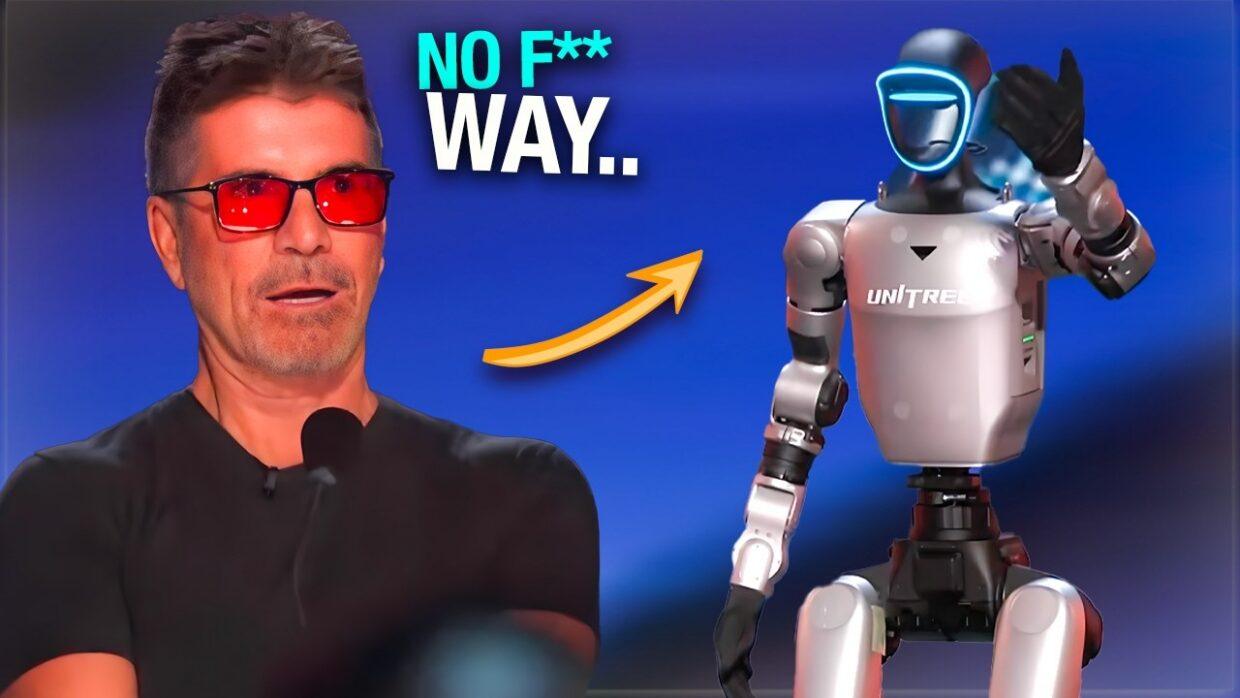
“Hello.” A young man in silver pants stepped into the bright lights and faced the judges. He smiled, soft-spoken, and introduced himself as a 26-year-old from Sichuan, China who goes by Flying Bug. Before the questions could go much further, a ripple of unease rolled across the panel. “Oh, no. It’s robot,” one judge blurted, half-dreading, half-delighted. Someone else whispered what many in the theater felt: “Scary.”
Moments later, chrome figures glided out from the wings — not one, but a full phalanx of humanoid robots. The room jolted. The performer touched a shoulder, and a machine snapped to life. “Look. He’s moving them with his hands,” a voice cried from the panel. In a heartbeat, the stage shifted from curiosity to spectacle: the human and his mechanical troupe launched into a tight, shimmering routine, arms and torsos ticking with uncanny precision.
Judges who had braced for clunkiness found themselves disarmed by grace. “They don’t look human, but they’re all staring at me right now,” one admitted. “I mean, that was insane. Nuts, but brilliant. Brilliant.” Another rarely impressed juror tried to make sense of what they were seeing: “I’ve never seen anything like this because usually those robots are, like, very weird. These ones have rhythm. Yeah. It was like watching people dance, and you are amazing. The way you dance is spectacular.”
There was even levity. Asked if his “metal friends” had names, the dancer didn’t miss a beat. “Yes. His name is Jackie… because he really love Kung Fu.” Requests to “have Jackie” were met with a cheerful wall of “No. No. No. No.” But by then the skepticism had broken. Another judge, both dazzled and a touch unsettled, summed it up: “I found this fascinating. I do find it a little bit freaky, but they all knew the choreography. If anyone was out of sync, it was you because they were all perfect. I loved it.”
The night the robots grew a personality
Then came a different kind of machine. A towering metallic figure, eyes glowing blue then flaring red, lumbered into the spotlight. “Hello there, London,” boomed a voice as the audience whooped. “Welcome to Britain’s Got Talent. The stage is yours.” This was Titan — part animatronic, part performer, all showman — and he arrived armed with jokes sharper than his jawline.
“I know what you’re all thinking. The Terminator let himself go a bit.”
He scanned the desk like a stand-up. On Simon Cowell, the robot delivered an eyebrow-raising nature doc parody: “Here, we have the letter spotted majestic Simon Cowell. This creature lives an honest and basic existence and can often be seen jet skiing off the coast of Barbados…” He volleyed at Amanda Holden — “How do you stay looking so young?” — and teased his way through a “world famous mind reading trick” that, of course, ended with yet another vision of Simon.
The panel didn’t just laugh; they leaned in. One judge put it plainly: “I mean, it was extraordinary. One incredible surprise after another. I was wildly entertained from start to finish. It was brilliant.” Amanda echoed the verdict: “Brilliantly innovative, very funny. I mean, I didn’t know robots had a sense of humor.” Even Simon melted. “It was absolutely amazing. I mean, incredible… So funny, so cheeky. Can’t wait to see what you do again. So I’m gonna say yes.” “I am saying yes,” came another. A third chimed, “It’s a yes from me.” Titan didn’t just short-circuit expectations; he collected them and marched off with a promise: “You will be back. For real.”
The tinkerer and the partner who never calls in sick
Some acts arrive to thunder. Others build it from scratch. Daniel Simu, a soft-spoken engineer-performer from the Netherlands, rolled his creation onstage: a spindly, long-legged contraption he called Robin. Did he build it himself? “I built it myself.” Why a robot partner? He grinned. “I performed with humans for most of my life, but they’re flimsy. Sometimes they get injured, then they disappear, or they move to another country. But the new partner can’t get injured in things.” Then he confessed what would make most performers pack up and go home: “Actually, the last run through I did, both of the arms broke off. This is no joke… Like, just half an hour ago. But I think we can pull it through.”
He did more than that. Piece by piece, Daniel assembled, balanced, and danced with Robin, coaxing personality from wires and joints. The act veered from tension to comedy to genuine wonder. “Oh my gosh,” someone gasped. “That was incredibly surprising.” Another juror cracked that it felt like wrangling a stubborn stroller — “I’m glad it was relatable,” Daniel shot back — but the overall tone was awe. “I think this is not easy to do all this choreography,” said one. “You did a great job, and it was fun, and I loved it.” Another confessed, “This, I thought, was hilarious.” And the kicker: “I started to believe that the robot was like a human even though it doesn’t look like a human.”
The conversation turned to the future. “If we went further, loads of these robots dancing with you at the same time. Is that the dream?” a judge asked. “Yes,” Daniel said. “That’s my million dollars, I can make it happen.” “You are so interesting and so unique and so surprising,” came the response. “I can’t wait to see more. I’m gonna start with your first yes.” Not everyone was sold — “I think you are at the beginning stages of something that could potentially be interesting. So for me, it’s a no.” — but the momentum was clear. “I think this is one of the funniest things I’ve seen all year. It’s three yeses. You’re through!”
When a robot dog trips and the crowd leans closer
“What are those?” a childlike voice asked from the wings as a quartet of four-legged machines trotted into view, green lasers winking from their chassis. “It sounds like a doggy.” A judge beamed. “This is my favorite. Dog act. Dog agility.” The handlers lined up a tiny seesaw. One robot carefully stepped on — then slipped, tumbling to its side. A murmur. Laughter. And then a strange, human thing happened: compassion.
“Someone had an accident.”
“Yes,” a voice answered dryly. “You know that sometimes does happen.” The act pressed on. More robot dogs arrived and, with a determined playfulness, danced in loose unison. One dramatically collapsed, as if to “fall asleep,” and the audience, now fully invested, went with it. When the music stopped, a judge took a breath. “Can I be honest with you? I actually think — I don’t mean this in a cruel way — it was weirdly better that one of them died.” Gasps. Then a pivot. “No. It did because it showed how difficult this was. Fix him? Absolutely.” The team nodded. “Yes. You know, we have this saying at Boston Dynamics. We say build it. Eyes up. Break it.”
Against all odds, the mishap became the moment that clarified the craft. “That was super exciting and great, different,” one judge said. “I mean, we had, like, something bad feeling when he just passed out in front of us.” Another finished the thought: “But then that party kept going, which was really weird. Like, not like… amazing.” Then came the big-picture recognition that every act craves. “After twenty years, how can we see something we haven’t seen on this stage? This is something we have never seen on this stage.” A fellow judge agreed: “It’s kind of blown my mind a little bit because I’ve never seen anything like this before.” As the handlers and their canines-in-code bowed, the verdict rolled down the desk like a wave. “Howie, yes or no?” “Yes.” “No brainer. Yes. Yes. Yes.” Someone laughed, “Staring at me.” The ringmaster’s voice sealed it: “You got four yeses.”
From novelty to inevitability
Between segments, the theater throbbed with a new giddiness. Backstage, a host pointed at a robo-dog like a kid in a toy store. At the desk, a judge blurted the line that distilled the mood: “Look at this. This is incredible.” Another added what many were thinking as blue lights pulsed and servos purred: “It’s so life changing. I want one.” A skeptic pressed the question that follows any technological leap: “Do you really see this happening, like, having one of these, like, in their homes?” The answer was unblinking. “Yeah. We really, really believe that this is the future.”
That belief wasn’t blind hype; it had just been earned in real time. A dancer from Sichuan gave chrome bodies rhythm. A hulking comedian in steel charmed the world’s toughest panel into belly laughs. A builder from the Netherlands turned a repair into a routine and made a crowd care about a bundle of metal as if it had a heartbeat. And a kennel of robot dogs proved that even failure, handled with wit and nerve, can be a standing-ovation asset.
Of course, the night had the delightful human chaos that live television guarantees. In the wings, judges exchanged a dramatic kiss on the cheek. At one point a contestant popped a question — “I just wondered if you would marry me.” The answer landed like a cymbal crash: “No. Never.” A wardrobe malfunction struck with comic timing just as the cameras rolled — “My dress has come off” — and the panel recovered with the sort of gallows humor that keeps a primetime circus rolling.
But the through-line belonged to the machines, and to the people bold enough to stand beside them. Early in the evening, when the first chrome silhouettes appeared, the instinctive reaction was a mix of fear and fatigue: more gimmick than gift. By the final bows, even the staunchest cynics were reaching for superlatives. “Brilliantly innovative,” one judge said. “I didn’t know robots had a sense of humor.” Another found the verdict that carries both weight and wonder: “This is something we have never seen on this stage.”
It wasn’t that the robots were perfect. In fact, the evening worked because they weren’t. A stumble invited empathy. A misaligned arm became a punchline, then a plot point. Precision dazzled, but personality won. That alchemy — code meeting craft, novelty becoming narrative — is why an arena that has seen nearly everything could still be surprised. And it is why Simon Cowell, a man who has built a career on reading the crowd before the crowd knows itself, ended up grinning at circuitry and saying “yes.”
Which raises the bigger question that quietly threaded the night: What, exactly, counts as talent? If the answer is invention, timing, presence, storytelling, and the ability to make strangers feel something real, then the definition is expanding — fast. And if the answer is also collaboration, the future might look a lot like what this stage just showed us: humans and machines, not arguing about who’s in charge, but learning how to dance.
If you missed the chaos, the comedy, and the jaw-dropping control, it’s worth seeing it unfold for yourself. Watch the full performance showcase, hear the judges wrestle with their own surprise, and decide whether the next great star on these stages might have servos, nicknames like “Jackie,” and a standing reservation for a jet ski off Barbados.