




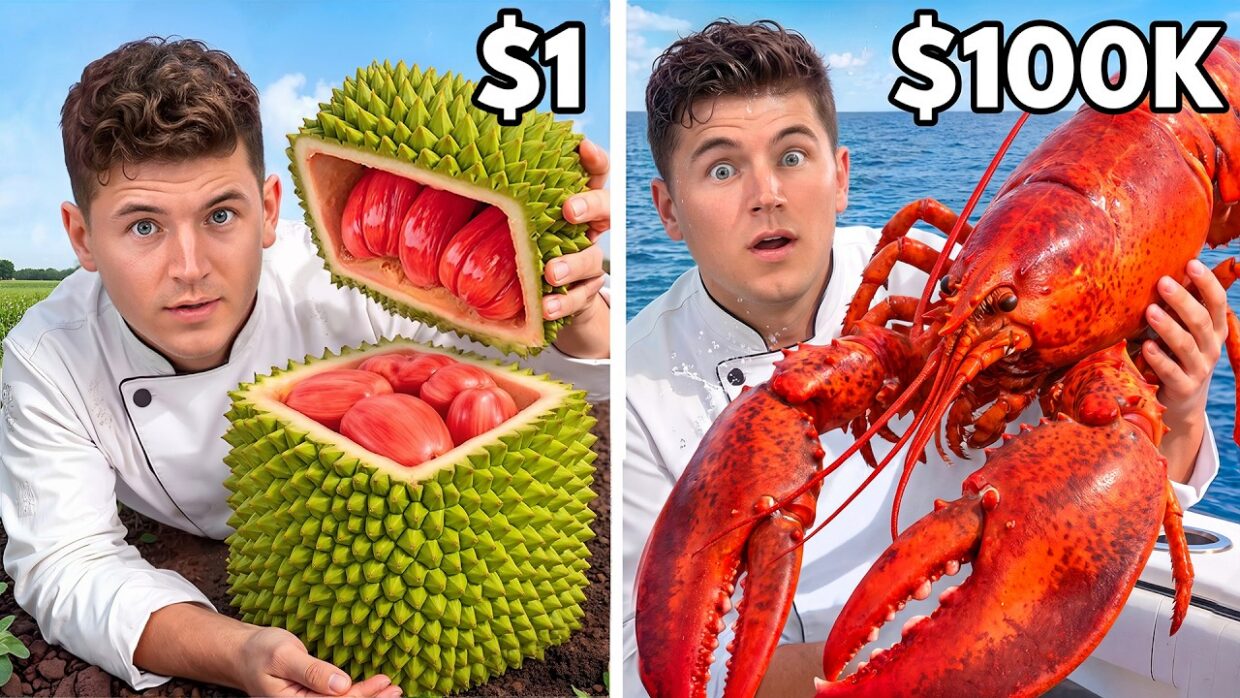
The feast begins with a promise: a tour of flavors most of us will never see, let alone taste. In this globe-trotting, price-scaling adventure, Nick and his co-conspirator Guga open crates, crack shells, and gamble on legends. They start at a single dollar and climb toward five and six figures, asking the same question at every stop: Is rarity actually worth the price?
A fuzzy fruit that tastes like dessert
At the $1 mark, the duo peel into pink velvet bananas from India—wild-growing, soft, and, as Nick notices, “fuzzy.” He marvels at the inky seeds crowding the pale flesh, then takes a bite. The notes land somewhere between nostalgia and novelty.
“Not bad. Kind of reminds me of, like, vanilla marshmallow. I get, like, a creamy sort of melon flavor.”
For a buck, the verdict is easy. Exotic isn’t just about price; sometimes it’s about finding a new texture in a familiar shape. Pink bananas clear the bar.
When chicken goes goth
The $5 plate arrives in midnight black. Silkie chicken—an inky Chinese breed with a genetic twist—gets dunked in buttermilk and charcoal powder before meeting hot oil. It looks wild and crunches like a dream. But taste doesn’t lie.
“It’s so crispy. It is, but it’s not as good as regular chicken.”
Novelty earns attention, not an automatic recommendation. This round, the pair pass. Not worth it.
Durian divides the room
At $10, the kitchen fills with one of the world’s most polarizing aromas. Durian—Malaysia’s “king of fruits”—is prized and banned in equal measure. It’s not allowed on public transit in parts of Southeast Asia. Nick slices along the seams, pulling back a membrane to reveal fleshy pods, and lays out the paradox.
“Durian is the most confusing fruit in the world. You either love it or you hate it.”
He has called its scent “everything bagel hot garbage,” yet describes the moment it clicked for him in Malaysia:
“Suddenly, it tasted like beautiful, soft, creamy vanilla custard and ripe tropical banana.”
Guga wants no part of it—“With a passion.” Nick can’t resist.
“It’s so good… I can’t stop eating it.”
They even try to broker peace.
“I’ll make you a deal. You taste this durian, we’ll say it’s not worth the money. You don’t, it’s worth the $10.”
Controversial? Absolutely. But when a fruit can redraw someone’s palate mid-bite, that’s an easy yes for Nick.
Cracking dinosaurs: giant eggs, fragile technique
For $25, the table fills with outsized promise: an ostrich egg and a deep-green emu egg from South Africa. They arrive swaddled—“they come in a diaper,” Nick laughs—because a single crack turns an entire breakfast into shards. He opens one to reveal a yolk the size of a fist, then does the unthinkable: attempts omurice, the notoriously finicky Japanese omelet, with dinosaur-scale eggs.
After weeks of failures, the flip finally lands.
“Money. I love the texture of the egg. It’s runny. It’s flaky.”
Rare eggs meet rare finesse. Worth every penny.
Flirting with danger: puffer fish, uni, and real wasabi
At $50, the adventure inches toward peril. In Japan, fugu carries a lethal reputation.
“Just one puffer fish has enough poison to take out 30 adults.”
They don’t eat the infamous species; instead, they prepare Atlantic puffer fish, rolling it into hand rolls alongside live-opened sea urchin and true wasabi, grated on sharkskin. It looks like an ocean jewel. It tastes like… not much.
“The puffer fish tastes like nothing. It’s like chewy.”
Between the hype and the hush, the judgment is blunt: not worth the money. As Guga jokes, better as a pet—they’re “so cute.” There’s also a cautionary tale tucked in the backstory: Nick wanted to bring home the Japanese puffer, but he learned “the last person who did that is now in jail.” Some souvenirs are best left where they belong.
The origin of chocolate, cracked open
The $100 round turns sweet and scientific. Fresh cacao pods from Ecuador arrive in sunset colors, ready for a karate-chop opening that reveals slick, foamy pulp around bitter seeds.
“These seeds here taste like a mix between lychee, mango, pineapple, and a little lemon.”
It’s a revelation to bite into chocolate before it becomes chocolate. But romance gives way to reason. If the goal is eating, not education, Nick admits the truth: cacao pods themselves aren’t the best value. “I’d rather just buy chocolate.”
Brazil’s viral wheel that melts like a dream
At $250, a cheese with a passport lands with ceremony. The wheel—identified here as queso figuera—traveled from Brazil thanks to a determined subscriber. The rind hits the nose hard.
“Smell like sticky feet.”
But the interior is a different planet.
“It smells nutty. It smells buttery… I think it’s the best smelling cheese I’ve ever smelled.”
It eats like a buttery bridge between Swiss and Gruyère, then turns into a molten waterfall when Nick makes an improvised fondue. They rip baguette through rivers of gold. Guga beams: “That cheese is amazing.” Pride radiates—“Brazil will be proud.” And the verdict?
“Yes. A 100%. Even more. I would pay even more.”
Rarity just earned its keep.
A sword you can cook with
Five hundred dollars buys a sight fishermen rarely allow on land: a whole swordfish with the sword still attached. They cut a clean ring, bury it in a crust of salt, and bake it until the dome hardens like armor. Then they do something everyone secretly wants to try: crack it open with the fish’s own sword.
What’s inside silences doubts. The flesh sluices with juice, flaking in translucent petals.
“That is delicious… It’s so juicy. I can’t believe how juicy it is.”
It’s the best swordfish they’ve ever had—and proof that sometimes the oldest techniques justify the price.
Honey from a cave, turned to glass
At $1,000, the treasure arrives in a bottle that looks like a museum piece: Elvish honey from a single cave in Turkey, 2,000 meters deep. Only 200 bottles emerge each year. Nick holds number 131, along with full honeycomb frames to show its origin story. The taste is quiet, complex, and strangely medicinal in the nicest way—“very smooth,” “a little bitter.” Then he spins the rare nectar into honeycomb candy. It puffs, cools, and shatters with a theatrical crack.
“Oh, it’s so good… The snap, the crunch, definitely worth the money.”
A rare ingredient becomes a rare memory.
Drowning a Tasmanian crab in butter
The $2,500 course is a quest fulfilled: a Tasmanian giant crab, among the biggest on Earth and almost never eaten outside Australia. Nick calls it the hardest ingredient he’s ever tracked down. They cook the “baby”—still massive—one way only: submerged in butter. The kitchen goes hazy with perfume.
“That smells so good. Smells like heaven.”
Cracked open, the orange tomalley—“the best part”—becomes the dip. They drag sweet, snowy claw meat through the coral richness.
“Get it all in there. Get all that orange stuff. Oh. That’s the best part of the crab right there.”
It’s messy, primal, and glorious. Some luxuries don’t need garnish; they need courage and an unreasonable amount of butter.
When price stops being a number
As the spending climbs, the table turns into a cabinet of curiosities. There are Japanese fruits treated like fine jewelry and transformed into trembling cakes. There’s pasta under a blizzard of truffles. There are nachos crowned with $25,000 caviar—proof that irreverence and extravagance can share a plate. And then there are lobsters in colors and patterns so rare that the trio assembled carries a six-figure valuation, a tableau that edges into the realm of priceless. The point isn’t to brag; it’s to ask, again and again, what makes a bite unforgettable.
Is rarity worth it?
Across the spread, a pattern emerges. Rarity earns its keep when it reveals something essential—a flavor you can’t find elsewhere, a technique that unlocks hidden tenderness, a story behind a bottle pulled from a cave once a year. That’s what happened with the salt-baked swordfish ring, the cave honey that cracked into amber glass, the giant crab steeped in butter, the Brazilian wheel that melted a continent’s pride into fondue, and even the humble durian, a fruit that forces your palate to choose a side.
But rarity stumbles when novelty outruns taste. Blackened silkie chicken looked like a stunt and ate like a compromise. Puffer fish, paired with uni and true wasabi, wasn’t dangerous so much as forgettable. Fresh cacao pods were thrilling to open and instructive to taste, yet the price of the lesson outpaced the pleasure of eating them as-is.
Nick and Guga don’t pretend their verdicts are universal; that’s the fun of it. “Worth it” is personal. For one eater, it’s the shock of a perfect omelet from an ostrich egg. For another, it’s the clean snap of cave honey candy or the comfort of swordfish flaking apart under salt. Rarity, it turns out, is the wrong finish line. What matters is resonance—the moment an ingredient rewires your expectations and refuses to be forgotten.
If you want to see that spectrum for yourself—from a fuzzy pink banana to seafood that belongs in a natural history museum—watch the full journey. There are blades used as knives, wheels cracked like drums, and more butter than is reasonable. And at every price point, there’s a simple, stubborn question waiting on the plate: Is it worth it?