




What makes a world record feel unbreakable isn’t just the number. It’s the nerve it takes to chase it, the planning that makes it possible, and the risk that makes it unforgettable. This video barrels through a gallery of such feats—some joyful, some tragic, many banned for good reason—and asks an unsettling question: when humans reach the edge of what’s possible, what happens next?
Speed, Shock, and the Blink of an Eye
Some records hinge on a single breath. A man steps up, lifts a jug, and before onlookers can process what’s happening, it’s over.
“Twenty one seconds, a new world record.”
It’s a reminder that speed can feel like magic. The same is true with the fastest gunslinger ever timed. The legend of Bob Munden is told in knuckles and nerve—two balloons, two shots, in a sliver of time so small the brain barely registers it.
“Two balloons, two shots, and one thirtieth of a second.”
Speed, in moments like these, isn’t just measurement. It’s theater. Blink and you’ll miss the point: the best are not simply quick, they make the impossible look routine.
Endurance Without Moving
But some of the hardest records are slow burns. One man chose to do almost nothing—on camera. He stood motionless for thirty-eight hours while the internet watched time crawl.
“Thirty eight hours starts now, baby.”
By the end, the narrator deadpans what anyone could see.
“After thirty eight grueling hours of torture, he was finally able to walk away with the record and maybe a little brain damage.”
Then there’s the plank—a position notorious for humbling gym rats—that Josef Salek held for a length of time more suited to cross-country travel.
“Nine hours thirty eight minutes and forty seven seconds.”
These feats don’t thrill in a flash. They grind. They turn seconds into anvils and ask: how long can your mind hold your body together?
Scale: Families, Giants, and a Leap No One Has Matched
Some records swell with scale. In a remote corner of the world, Ziona Channa built a family that simply defies comparison.
“A father to 94 children and a husband to 39 wives.”
Add in the grandchildren and the tally soars to a number that swallows a neighborhood.
“The world’s largest family with 167 members.”
Scale changes what’s possible in sports, too. In Tokyo in 1991, Mike Powell sprinted down a runway and jumped farther than any human in history. Decades later, the mark still looks untouchable.
“That is history in the making. That’s a world record.”
And then there is size that hurts to hold: the human body stretched beyond its design. The story of Robert Rodlow—born ordinary, growing three times faster than other kids, towering at eight foot eleven inches when he died at just twenty-two—sits heavy. The record stands, but the cost is the point.
Falling Further, Surviving the Drop
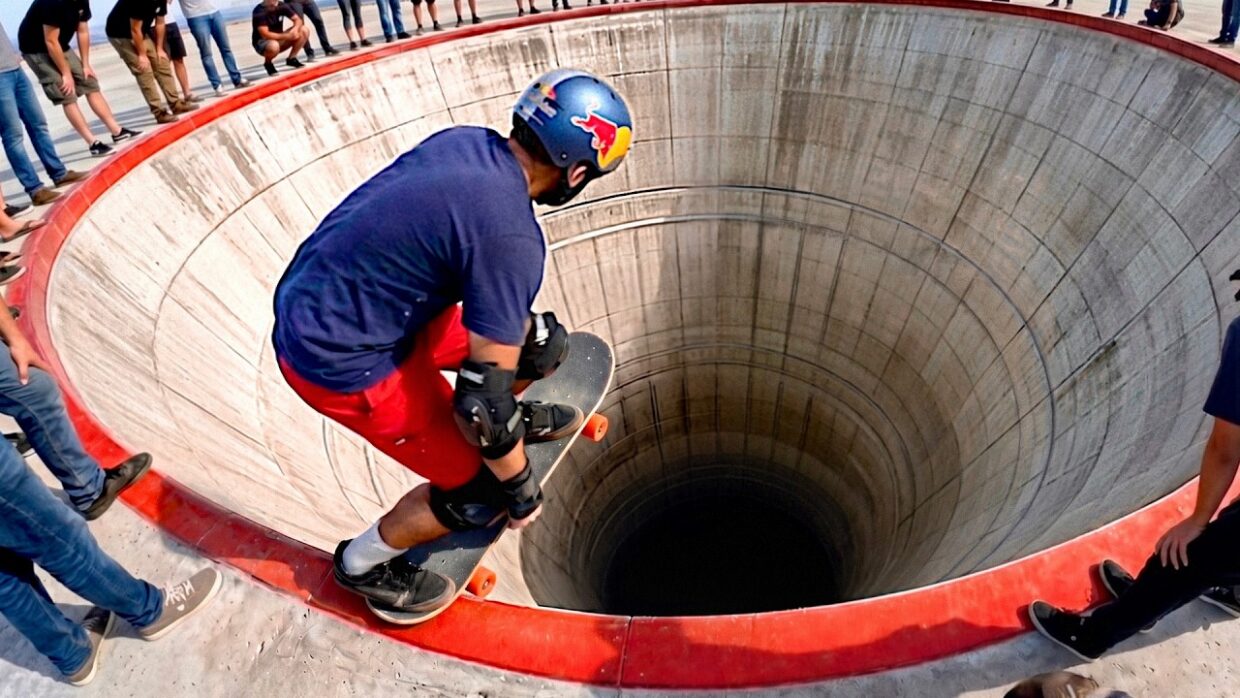
Gravity is the purest judge of risk. Professor Splash “face planted from 37 feet into just 12 inches of water,” a calculation so tight it reads like a dare to physics. Skiers tamed a mountain by literally remaking it—moving 150,000 cubic yards of snow to carve a 2,800-foot runway—just to stretch the longest jump in history. World champion Sandro Diaz stared down a 22-story building shaped like a quarter pipe and decided to skate it anyway.
Water becomes a wall at speed. Kayaker Tyler Bratt ran 189 feet of freefall off a waterfall, vanishing into white chaos. SeaWorld San Diego once hosted a high-dive contest from 172 feet—“five dimes and five records in a single day”—a flurry of courage that no one has replicated since.
And then there’s sky. In 2012, Felix Baumgartner stepped from the edge of space and broke the sound barrier with his body. Most thought the record would hold. Two years later, a quiet computer scientist floated higher and fell faster.
“This time from a 135,000 feet. And the craziest part, you probably didn’t even know what happened.”
Skydiver Luke Aikins took the logic to its precipice. He decided to jump from 25,000 feet and aim for a net—no parachute, no plan B.
“He wanted to raw dog a jump out of a plane from 25,000 feet and land straight into a net. Yeah. No parachute, no backup, nothing.”
Minutes before takeoff, he got the only approval that mattered: permission to do it his way. He hit 150 miles per hour, lined up a square of mesh against a spinning planet, and lived.
Power and Pain
Records of raw force can be blunt as a hammer. “This man literally deadlifted over half a ton. Of Iceland. 510 kilograms.” The line lands with a thud. Twenty-two pounds heavier than the last mark, the heaviest lift ever. The weight of it resists metaphor. It is what it is: a mountain, raised an inch.
Other tests measure how much pain a body can invite and still keep its nerve. Beekeeper Gao Bingua turned himself into a living hive.
“The heaviest mantle of bees at 240 pounds, and the most bee stings in a single day at over 2,000.”
Watching, you can almost feel each sting as a data point. Together they sketch a strange portrait of mastery: control through surrender.
When Rules Break Back
Every so often, a record rewrites a rulebook. During the 2022 NASCAR Cup Series, Ross Chastain needed a miracle on the final lap. He found it in concrete, keeping the throttle pinned and using the wall as a guide rail. The move slingshotted him from tenth to fifth, into the championship bracket, and into legend.
“Ross Chastain used the wall all the way around this racetrack… He went from tenth to fifth place on that last lap.”
It also triggered an immediate reckoning. The sport banned the tactic. Some records close doors behind them, sealing the path they took.
Cleveland tried to open its sky. Balloonfest was meant to be a civic smile—more than a million balloons released at once, money raised for charity, a city remade in color.
“Over 1,500,000 balloons going up in the air at this very, moment.”
But wind is an unforgiving editor. Balloons flooded highways and choked the airport. On Lake Erie, search crews faced a terrible mess of lookalike orbs bobbing beside a desperate rescue attempt.
“Can you imagine trying to find somebody floating out here… with all these balloons on the water?”
Two people died. Lawsuits followed. The record, and others like it, were banned. Not all firsts deserve an encore.
Daredevils, Legends, and the Line Between
Some names feel built for marquee lights. Dennis Rasoli balanced danger and showmanship on towering unicycles and pavement so risky that his greatest act still sits outside the Guinness canon. Robbie Knievel carried his family name over a void his father couldn’t manage, “flying 228 feet across the gorge” of the Grand Canyon and sticking the landing on live TV. Each success nods to a long ledger of crashes and near misses that make the triumphs glow brighter.
Longevity can seem like the gentlest record, but it is its own dare. The video lingers on a French woman it calls Jeanne Carmen, who “officially became the oldest human to ever live at a hundred and twenty two years and one hundred and sixty four days old.” The span itself is the feat: a life long enough to watch inventions transform the world twice over.
Buried, Yet Alive
No chapter is stranger than the man who proved he could survive being trapped—by choosing to trap himself. In 1968, Mike Meaney climbed into a coffin, “was lowered six feet under,” and stayed there.
“The longest voluntary burial and the longest time spent in an underground coffin at sixty one days.”
When asked if he wanted to come up, he waved off the invitation. He wanted a hundred days, maybe more. You can call it a stunt or obsession. Either way, it’s hard to shake: a record measured not in motion, but in the refusal to move at all.
Why These Records Endure
What ties these stories together isn’t just danger or audacity. It’s a pattern of human problem-solving under pressure. To ski farther, a crew moves a mountain. To skate a skyscraper, a team bolts an idea to concrete. To dive from the stratosphere, an engineer rewrites a checklist. To break a rule, a driver reads a track in a way no one else dared.
Many of these feats will never be tried again. Some can’t be. A wall ride in NASCAR is banned. A balloon release that shuts down a city is unthinkable. A dive from 172 feet remains a ghost that haunts the sport. A man as tall as Robert Rodlow, or as long-lived as the French woman in this story, may not appear for generations, if ever. Yet the point of these records isn’t only the number on a page. It’s the glimpse we get of the minds behind them—calculating, improvising, hurting, and, sometimes, healing after the curtain falls.
In the end, the video argues something simple and hard to forget: the boundary of the possible isn’t a line—it’s a horizon. We walk toward it, and it walks with us. Some days we get a step closer. Other days we’re reminded why the horizon keeps its distance.
If you want the full jolt of these stories—the gallop of the narration, the gasp before the landing, the eerie quiet after a triumph—watch the video. It’s a tour of human limits you won’t soon shake.