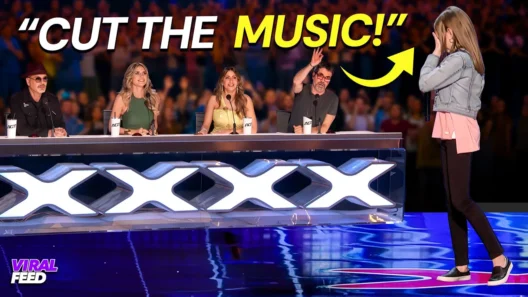
The stage at Britain’s Got Talent is a long, bright rectangle of light, and the four judges sit at a table that looks, from the audience’s perspective, like a very expensive dinner party. But tonight the table is a laboratory. Cards get turned face down. Watches get spun. Glasses shatter under a judge’s stare. And somewhere in the middle of it all, a magician in sunglasses is grooving to a beat he hasn’t played yet.
A Song Built From Silence
The first act opens with a line that could be a philosophy lecture or a magic trick, depending on your mood: “Music doesn’t start with sound. It starts with silence, with nothing.” The magician fans a deck, makes the cards vanish, and gets each judge to touch a card without looking. Then he hands a watch to KSI and tells him to spin the dial. “Fast or slow, it’s really up to you.” KSI stops. The time reads 9:47.
That number becomes the seed for everything that follows. Amanda picks 9. Alicia picks 47. The magician adds them, stumbles on the math (“Maths is not my strongest point”), and lands on 56. Simon scrolls a phone to song number 56 on a list of 100. He knows the song. He doesn’t say what it is.
What happens next is the part that makes the audience lean forward. The magician walks to a drum kit, picks up sticks, and plays a beat. Then a bass guitar. Then a piano. He’s building the song layer by layer on loop pedals, and he’s asking Simon to feel each instrument in his head. “Don’t just hear it. Feel it.” The melody comes last, and Amanda helps by humming along. The song resolves into “Don’t Stop Me Now,” and the four face-down cards on the table spell Q-U-E-E-N.
Butterflies and a Wooden Crate
The second act belongs to a magician whose roots are in street dancing. “My roots in magic actually started with dancing,” he tells the judges. “I used to perform as a busker out on the streets.” He breakdances into the routine, does a headspin, and then the stage goes red. Two assistants handcuff him, lower him into a wooden crate the size of a coffin, and drape it with cloth.
He escapes. The crate lifts, and a cloud of butterflies pours out across the stage. He’d been talking about Henry Vogt, a man who escaped in a wooden crate, and the parallel is deliberate. “The wings of hope carry us high,” he says. “If nothing ever change, there’ll be no butterflies.”
Four Minds, One Stage
The third act is the strangest. Four magicians walk out together as a group, and they’ve been on the show before. “In our audition, we showed you how you can create magic using nothing but playing cards,” one of them says. “In our semi final, we demonstrated how we can actually influence the choices that you guys made.” Tonight, they’re going for something they can’t fully control.
The experiments are small and unsettling. A judge places her finger next to a key in a magician’s palm and, by slowly rotating her finger, makes the key turn. “The faster you spin your finger, the faster the key actually rotates.” Another magician draws an X on his own hand with a Sharpie, rubs it off, and the X appears on the judge’s palm. A glass on the table shatters under Simon’s concentrated stare. And then there’s the name game: David writes a name on paper, turns it over, and the magicians walk him through flickering each letter like a neon sign. “Can I picture the person naked?” one of them asks, and David says yes. The letters light up on a screen behind them, spelling S-I-M-O-N.
The Match, the Card, the Impossible
The fourth magician arrives with almost nothing. A glass. A saucer. A matchbook. “I thought, what’s the smallest miracle I could perform?” he asks. He tears a match from the book, lights it, holds it to his lips, and blows. The flame goes out. The match is gone. He blows at Alicia’s hands, and the match reappears inside the matchbook she’s been holding in a fist the entire time.
Then Simon picks a card. Nine of clubs. The magician tells Simon to make it disappear. “Just tell me the moment that you’ve done it.” Simon does. The card vanishes from his hand and reappears inside the matchbook, which has now become the card itself. The smallest prop on stage has swallowed the largest trick.
The Phone That Wasn’t a Phone
The fifth act is the longest and the most layered. The magician carries a box of memories from his previous BGT appearances: the phone he turned into metal on his first audition, photos, a small glass he drank from to celebrate making the finals. “Don’t judge me,” he says.
He gets Amanda to pick a card, rips the corner off, and hides it. Then he does the phone trick. Her phone appears inside a glass of water. A long white rope pulls out of the glass, and the phone is attached to the end of it. The phone case peels away, and the phone is a card. The torn corner from earlier matches the card on her phone. The whole sequence is a single continuous illusion, and the audience can’t tell where one trick ends and the next begins.
Hope
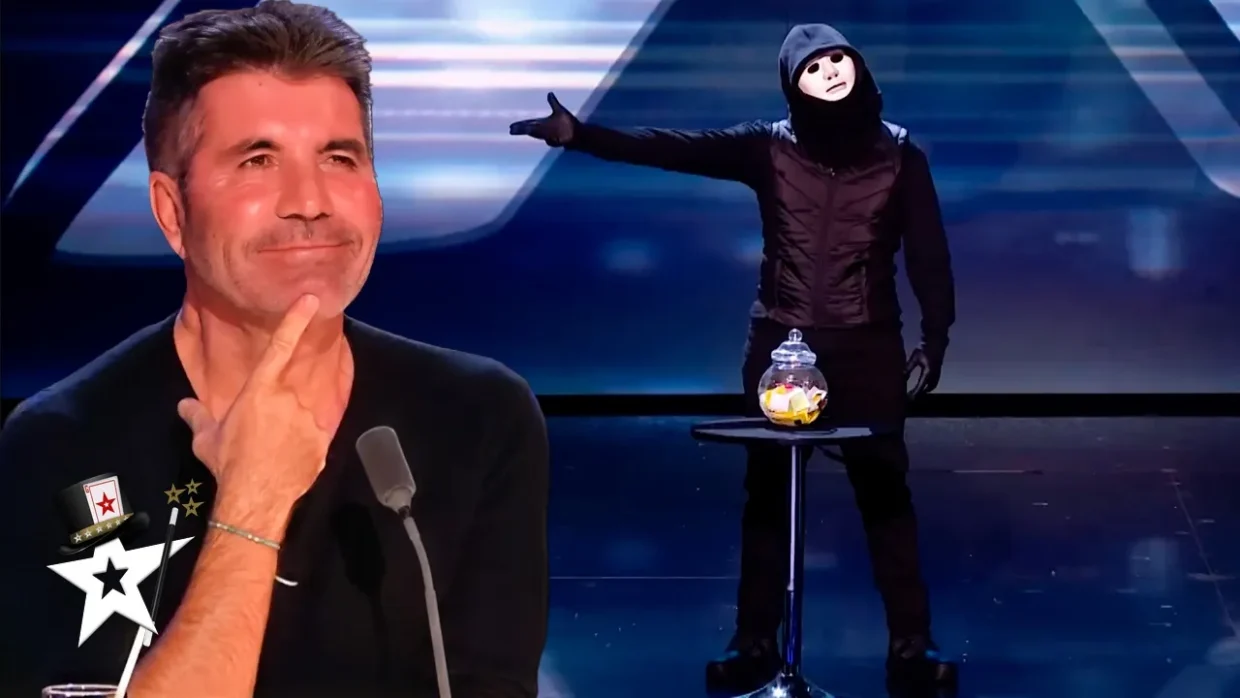
The final act is the quietest. A magician in a black hooded outfit stands before a large screen. He holds a jar of paper slips. The host draws one. The word is “Hope.” It appears on a judge’s phone. It appears on the screen. It appears on a small paper slip. A video plays: a baby sleeping in a crib, the word “Hope” on a book beside it. The judges are crying.
“Magic for me is not just an option, but a metaphor for transformation,” the magician says. “The hope that a tiny idea, an impossible dream, can have power and affect real change.”
What Ties It Together
Seven acts. Different stages, different props, different tricks. But the through-line is the same: the magician needs the audience. The watch only works because KSI spun the dial. The song only works because Simon felt the melody. The key only turns because Alicia moved her finger. The phone only becomes a card because Amanda held it in her fist.
That’s the real trick. Not the vanishing match or the butterfly crate or the shattered glass. The trick is that four strangers at a table become co-authors of an illusion they can’t explain. The magician sets the stage. The judges build the magic.
Watch the full 36 minutes. The first act alone is worth the time, but the last five, the baby in the crib, the word “Hope” on every screen in the room, will stay with you longer than any card trick.