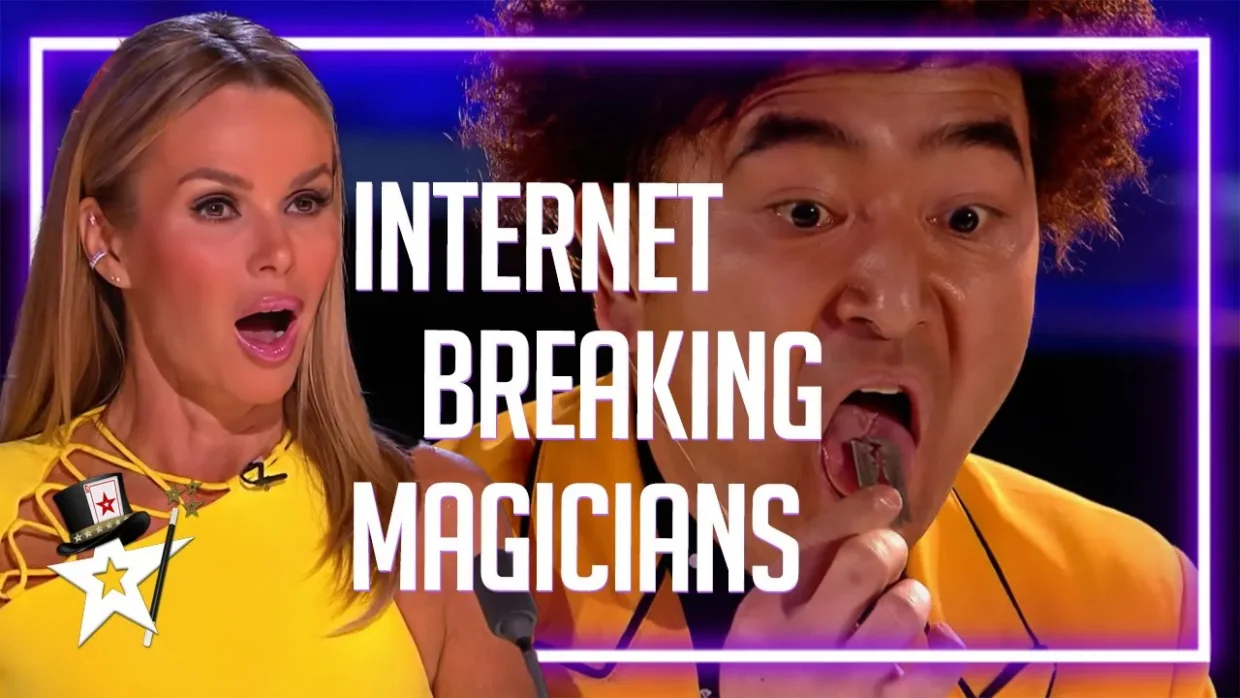
He holds up a razor blade. A real one, he insists. “Please be careful. Don’t touch here.” The audience member cuts a strip of paper with it, hands it back, and the magician swallows it. Then another. Then another. “Delicious,” he says, and the crowd goes quiet in that specific way that means they are not sure whether to applaud or call a doctor. “Why is he keep eating things?” someone mutters. “He’ll never eat dinner after this.”
That is the energy of this Got Talent magic compilation. Fifty minutes of acts that range from the visceral to the cerebral to the genuinely strange, and the through-line is that none of them play it safe. The magicians here are not shuffling cards behind a curtain. They are swallowing steel, letting algorithms do their bidding, performing with an invisible companion, and cutting water with a chopstick while Simon Cowell watches from the judges’ table like a man who has seen it all but is still not sure what he is looking at.
The AI Magician
The act that redefines the genre walks out and introduces himself as “Mastermind.” “I am the result of artificial intelligence creating the perfect modern day magician,” he says. The judges do not know whether to laugh. He asks Howie to hand his phone to Sofia, then tells Howie to focus on his passcode. “I will attempt to break through and unlock it.” The phone opens. Sofia points the camera at her own hands. Simon removes his glasses, Mel holds them in her palm, and Simon slides his finger across the phone screen while the glasses appear to float. “There are no magnets or threads,” he says, which is the kind of reassurance that makes you check for magnets and threads.
Then comes the bit that actually works. He tells Howie to use the AI assistant on his phone and type a three-word command. While Howie types, he asks a random row of the audience to each think of a positive word. They shout them out one by one: “Many. Achievement. Start. Through. Endurance. Resilience. Manifest. Inspiration. Nurture. Dreams.” Howie reads back the sentence the AI generated. “Many achievements start through endurance and resilience, manifest inspiration, and nurture dream.” The row of strangers had each chosen a word independently, and the machine stitched them into a sentence before they spoke. “It’s right there. I swear to you,” the magician says, and the room goes still.
The Chocolate Cube
A different magician walks out with two coins, one silver and one copper. “I’ve been doing magic for ten years now, and I’ve only been doing it professionally for the past three years. And it’s all thanks to these coins right here.” He borrows a hand from the audience, has them close a fist around one coin, and the silver becomes copper in the magician’s palm while the copper appears in the audience member’s. Clean, quick, no fuss. Then he pulls out a Rubik’s cube. “Do you guys know what the most important thing to creating magic is? It’s actually your imagination.” He hands the cube to a volunteer named Alan, who mixes it up. The magician covers it with both hands. When he lifts them, the cube is solved on all six sides. “Not only that, though,” he says, and turns the solved cube back into a bar of real chocolate. Alan takes a bite. “Real chocolate,” the magician confirms. The audience is not sure whether they are watching a magic show or a very aggressive candy commercial. The coins, he explains, are the origin story. Everything else is the imagination.
The Friend Nobody Can See
Some acts in this compilation are about objects. This one is about absence. A performer walks out and announces, “Some kids have an imaginary friend. Some people think it’s fun, but it’s not.” He begins talking to someone standing to his left. The audience sees nothing. “My imaginary friend likes to play,” he says. “Come if you want to play.” He gestures. An invisible hand, apparently, reaches back. “She likes you. She wants to play with you. She doesn’t like being rejected.” The bit builds from playful to almost unsettling, because the performer commits fully to the presence of someone who is not there, and the audience is forced to decide whether they are watching a magic trick or a very confident piece of theater. The invisible friend becomes a character with preferences, moods, and a relationship to the performer that feels more real than most of the people on stage.
Cutting Water, Swallowing Steel
The chopstick act is the one Simon Cowell flags immediately. “Simon, do you know this one? Chopstick.” Simon nods. “One, two, three.” The performer holds a chopstick over a glass of water and, with a flick, the water appears to split. “You are cutting water,” Simon says, half in disbelief. The performer is not a polished stage magician. He is loud, physical, and a little chaotic. He pulls a woman named Alicia up for a ring trick, fumbles the patter, and the audience loves him for it. “My last trick is for ladies,” he announces, and the room shifts. When the judges give their verdict, one of them says, “You are the funniest person we’ve seen and the most magical person we’ve seen, all combined in one.” Another adds, “My son is gonna love you.” The performer, still processing, says, “I can dream. I said, thank you so much. I can’t explain that in my emotion. I never expected that.”
The Card Trick That Is Mostly a Stand-Up Set
One act is a card trick in the way that a long walk is a sprint. The magician walks out, does a quick staircase bit, then settles into a card routine that is really a comedy monologue. He snaps his fingers. “I’d like you to think of any card in the pack.” A man in the audience says “Ace of Spades.” The magician pulls the Ace of Spades. “That shot you all up for a minute, didn’t it?” He then attempts a second card trick with a woman named Lily. It goes wrong. “What a bloody hell,” he says, and the audience roars. He gives himself five guesses. He misses all five. “I think, I hope, I pray that one of these five cards is the chosen card.” The woman touches one. He turns it over. Ace of Spades. “That’s all the same one you thought of, the Ace of Spades again. Coincidence.” The trick is not the point. The point is that he is funny, self-aware, and completely unbothered by the fact that he just failed in front of four judges and a studio audience. “Good help. Good luck. Bye bye. Thank you very much. Watch yourself.”
The Ones That Hit Different
Not every act in this compilation is a laugh. One performer emails the producers ahead of his audition about “abject horror,” and the act that follows is a slow, deliberate piece that makes the audience lean forward. Another magician’s daughter says the exact word he circled on a board, and the room goes quiet in a way that has nothing to do with trick mechanics. A judge later says, “Never thought a magic act would move me like that.” The contrast with the razor blade and the chopstick is the point. Magic on Got Talent is not one genre. It is a dozen different people walking out with a different reason for being there, and the format is wide enough to hold all of them.
Watch the full video and you will see the razor blade go down, the AI sentence land, the invisible friend reject a stranger, the water split, the Ace of Spades appear for the second time, and a daughter say the word her father circled. Fifty minutes, a dozen acts, and not one of them does the same trick twice. The next time you scroll past a card shuffle on your feed, this is the version that earns the attention.