A city plan that starts with child labor
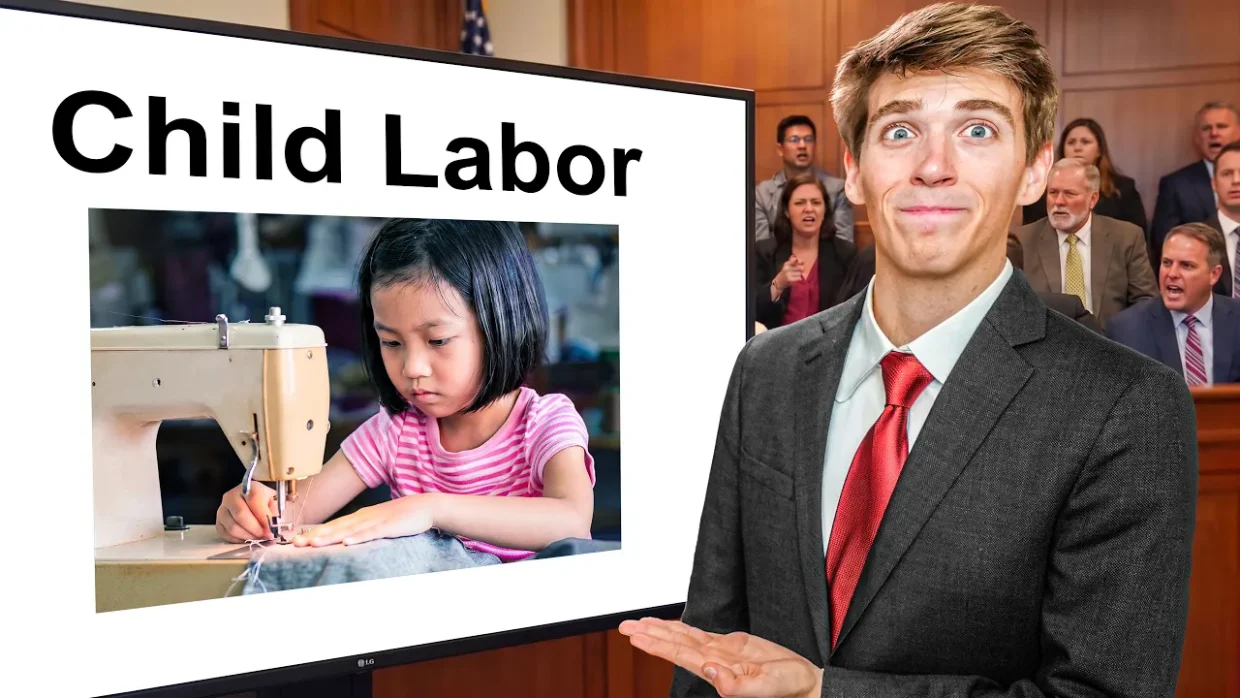
The first slide is a trap. A presenter opens with a calm line: “This is our plan to change your city for the better.” Then comes the pitch: “Allow children to start working at the age of seven.” The room reacts before the joke can land. “Are you serious?” one stranger asks. “These strangers think they’re here to approve new plans for this city,” the narrator explains. “But the catch is we made this presentation, and the only goal is to make the strangers turn against the presenters.” The plan is not a real proposal. It is a pressure test. The presenters are trying to make ordinary people reject bad ideas so hard that the other team looks reasonable by comparison.
The parking lot becomes a health test
The next plan turns a public health statistic into a parking rule. “The United States currently faces a widespread public health crisis,” one presenter says. “In our city, twenty seven point six percent of adults are classified as obese.” The solution is “long walk parking spots,” a mandatory section at the back of every lot for people who are told they need to walk more. “If caught using normal people parking spots, you will be weighed and receive a $150 fine,” the pitch continues. The crowd hears the scale before it sees the slide. One woman says she is “kinda going through the fitness grind,” and the presenters use her answer against her. “I command you to always park farther,” one says. “Or you have to pay us each a $150 fine.” The joke lands because the rule sounds like something a city could actually pass after a long meeting.
A tower with no walls
The homelessness pitch is the one that makes the room lean in. “Our city faces a severe homelessness crisis,” the presenter says. “We can solve this and give homeless residents a second chance.” The plan is the Hope Tower, a structure described as “the world’s tallest structure equal to three Eiffel Towers.” It moves tents off the streets and into one building. It gives residents an address. It offers “free AC, I guess. And water when it rains.” The problem is the design. “It is open,” the presenter admits. “I think they’re gonna die,” one stranger says. “We haven’t thought of that yet,” another answers. “Maybe we put some walls.” “It’s so negative,” the presenter replies. The crowd hears the logic: if the tower is tall enough, it can hold more people, including residents from neighboring cities. “We’ll become the world’s homelessness hub,” one says. “Homeless capital,” another finishes. The line that cuts through the joke is “These are people and not pests, and they aren’t meant to be corralled.”
Faith, housing, and the metal detector
The affordable housing pitch starts with a tax argument. “Housing costs are too high, but we can fix it,” the presenter says. “Houses of worship pay zero property tax and sit empty six days a week.” The plan is to build housing directly on that land and combine every faith under one roof in the Mega Faith Center. “Picture it, every faith under one roof together for the first time,” the pitch says. The crowd immediately worries about compatibility. “I’m not talking about a target for a bomb,” one presenter says. “If that’s a problem, we can make them go through a metal detector.” Another points out that “certain religions don’t get along.” “I think the two to the right are in a full blown war right now,” one says. The room laughs, but the underlying idea is not lost: put every congregation in one building, and the city saves land while creating a new kind of civic monument.
The patrol, the tunnel, and the anthem
The safety pitch is the most blunt. “We have a safety problem in this city,” the presenter says. “Traditional policing is expensive, complicated, and requires months of training.” The answer is the homeless patrol, a group of newly deputized residents equipped with “zip ties, pepper spray.” “They’re available. They’re motivated to work, and they’re available on every corner,” the pitch says. The crowd hears the double meaning. One woman says, “So now you give her a home and a job. That’s fabulous.” The next safety idea is a bulletproof tunnel through rough neighborhoods. “In rough neighborhoods, 24% of violence involves people passing through,” the presenter says. “Let’s lower that to 0% with our new safe tunnel initiative.” The tunnel is “built with military grade fully bulletproof polycarbonate,” and “police at both ends guarantee no infiltrators.” One stranger calls it “a dystopian world.” The final pitch is an anthem. “Every country has an anthem, but our cities have nothing,” the presenter says. The song opens with “Welcome to Long Beach. Everyone nice as a peach.” It continues with lines about “large families all because we use no rubbers” and “beautiful pussies, very tight.” The crowd winces, but the presenters keep the tone upbeat. “All hail,” the song ends.
The flag, the vote, and the punishment
The second team gets its turn, and the room is already tired. The first plan is a new California flag. “Our state flag is over a 100 years old and feels outdated,” the presenter says. The team says it received a $3,000,000 grant for designers and paid one man $500,000 to make a new flag. The changes are small: he moved the star, flipped the bear, and dropped the word Republic. “It looks the same,” one stranger says. “I really like this one,” another says, and the room splits. “The design looks really dated. It’s overall boring,” one says. “What do you say is worth 500,000?” another asks. The presenters defend the work by saying it took three months. The crowd is not convinced. By the end, the vote is simple. Strangers raise their hands if they support the plans. The first team gets four. The second team has to beat that number or face the mystery punishment. The video turns on that final count, and the plans are only the setup. Watch the full video to see how the crowd reacts when the presenters keep pushing, when the jokes get sharper, and when the hand count decides which team has to pay the price.