If you have ever looked at your birth chart and felt like you were reading a foreign language, you are in the right place. This guide explains your big three, the twelve houses and the planets in plain English — and a free printable worksheet is included so you can fill in your own chart as you learn.
What’s inside the printable
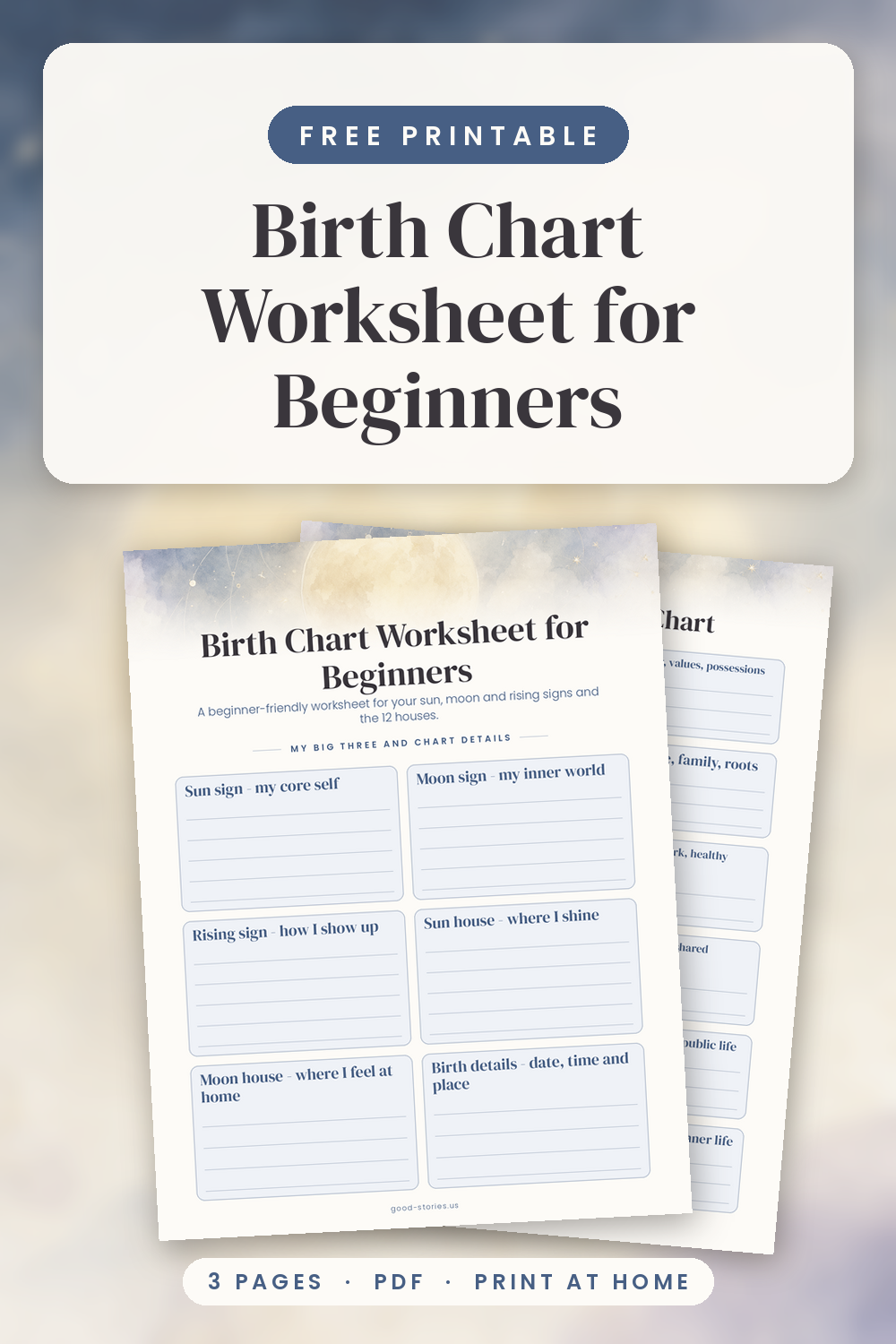
The download is a three-page PDF designed to be filled in by hand. Here is exactly what you will find inside:
- Page 1: six fill-in boxes for your sun, moon and rising signs, your sun and moon houses, and your birth date, time and place.
- Page 2: twelve labeled house boxes with writing lines to record what each house represents in your chart.
- Page 3: four reflection prompts with writing lines for journaling about your chart.
What a birth chart actually is
A birth chart is a map of the sky at the exact moment and place you were born. Astrologers take your birth date, birth time and birth city, then plot where the sun, moon and planets appeared from that spot on Earth.
Traditionally, a chart is a self-reflection tool — a way to think about your personality, patterns and relationships — rather than a way to predict events. Think of it as a mirror rather than a fortune teller.
If you do not have your chart yet, many astrology websites will generate a free copy using your birth date, birth time and birth city. If you only know your date, you can still read your sun sign and most planet placements; the rising sign and houses just become less certain.
The big three: sun, moon and rising
If you have heard people talk about their big three, this is what they mean. Each placement describes a different layer of you.
Sun sign — your core identity: your central purpose, the qualities you are growing into and the part of you that feels most like you.
Moon sign — your inner world: how you feel, what soothes you and how you process emotions when nobody is watching.
Rising sign — how you show up. Also called the ascendant, this describes first impressions, your outward style and how you begin new things.
One practical note: your rising sign depends on an accurate birth time, because the zodiac moves roughly one degree every four minutes. If your birth time is unknown, check your birth certificate or ask a family member. Until then, focus on your sun and moon signs, which only need the date.
The twelve houses in plain English
The twelve houses divide the chart into areas of everyday life, moving outward from you: self, resources, home, relationships, the wider world, then rest. Here is a beginner-friendly shorthand:
- 1st house — self, identity and first impressions.
- 2nd house — money, values and possessions.
- 3rd house — communication, siblings and learning.
- 4th house — home, family and roots.
- 5th house — creativity, play and romance.
- 6th house — routines, work and healthy habits.
- 7th house — partnerships and close relationships.
- 8th house — change, trust and shared resources.
- 9th house — beliefs, travel and big questions.
- 10th house — career, goals and public life.
- 11th house — friendships, community and hopes.
- 12th house — rest, dreams and inner life.
Many readers take a planet in a house to mean that the planet’s themes play out in that area of life — Mercury in the third house, for example, is often read as curiosity and talkativeness in learning. Start with the houses that hold your sun and moon.
The planets and what they represent
Each planet adds a different flavour to the chart. The sun and moon are technically luminaries rather than planets, but astrology treats them together with the rest. Here is what each is traditionally associated with:
- Mercury — communication, learning and how you think and speak.
- Venus — love, values, beauty and what you enjoy.
- Mars — drive, courage and how you take action.
- Jupiter — growth, opportunity and generosity.
- Saturn — structure, responsibility and long-term lessons.
- Uranus — change, originality and surprises.
- Neptune — imagination, compassion and dreams.
- Pluto — transformation, depth and personal power.
You do not need to memorise all of this at once. Find which sign and house each planet sits in, then read one planet at a time — Saturn is often described as the chart’s teacher, Jupiter as the one that opens doors.
Elements, modalities and ruling planets
Once you know the signs, two simple frameworks make patterns easier to spot: the four elements and the three modalities.
The four elements: fire — Aries, Leo and Sagittarius, for energy and enthusiasm; earth — Taurus, Virgo and Capricorn, for practicality and steadiness; air — Gemini, Libra and Aquarius, for ideas and communication; and water — Cancer, Scorpio and Pisces, for feeling and intuition.
The three modalities: cardinal signs (Aries, Cancer, Libra, Capricorn) start things and initiate; fixed signs (Taurus, Leo, Scorpio, Aquarius) sustain and steady; mutable signs (Gemini, Virgo, Sagittarius, Pisces) adapt and change.
Each sign also has a traditional ruling planet. Aries is ruled by Mars, Taurus by Venus, Gemini by Mercury, Cancer by the Moon, Leo by the Sun, Virgo by Mercury, Libra by Venus, Scorpio by Pluto (traditionally Mars), Sagittarius by Jupiter, Capricorn by Saturn, Aquarius by Uranus (traditionally Saturn) and Pisces by Neptune (traditionally Jupiter).
How to use your printable
The worksheet is designed to make all of this hands-on. A few practical tips before you print:
- Print it on US Letter paper — that is the size the file was designed for.
- On A4 paper, choose “Fit to page” in your printer settings so nothing is cut off.
- Fill in page 1 with your big three, your sun and moon houses and your birth details; looking each one up as you go is part of the learning.
- Use page 2 for the twelve houses — one or two a day is plenty.
- Use page 3 as a monthly reflection and revisit the prompts after a few weeks.
- Keep the finished pages in a journal or planner, or pin them near your desk.
Learning to read your birth chart does not require years of study or an encyclopedic memory. Start with your big three, get curious about the houses, and let the printable do the organising for you. Download the worksheet, take your time, and enjoy getting to know your chart one page at a time.