The moon keeps a rhythm that is easy to notice once you pay attention: it grows a little fuller each night, then begins to shrink again. A moon journal is a gentle way to keep company with that rhythm, with about ten minutes on the new moon and ten on the full moon. This beginner’s guide explains how the lunar cycle works, and a free printable with three journal pages is included below.
What’s inside the printable
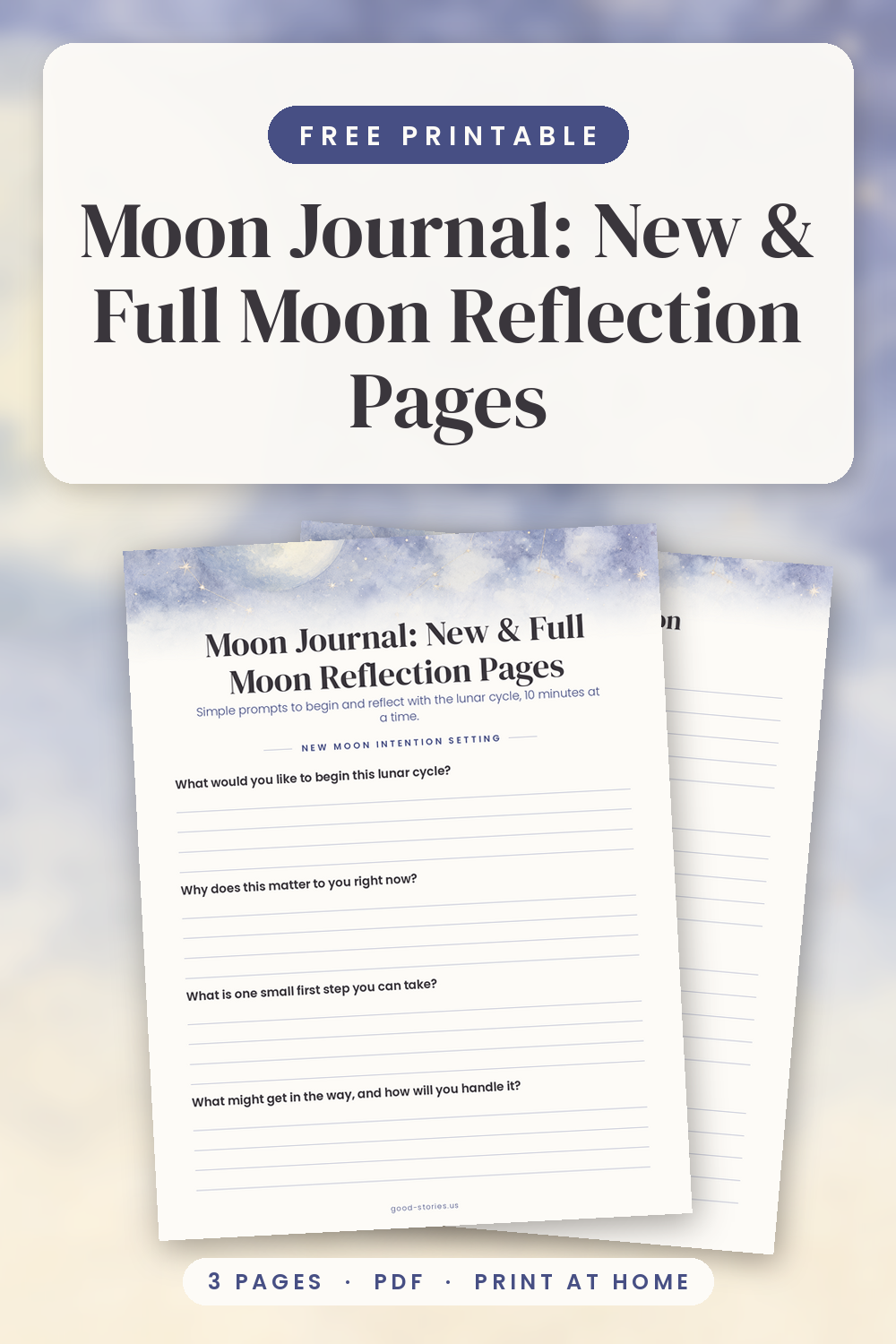
- Page 1: New moon intention-setting prompts, each followed by writing lines.
- Page 2: Full moon reflection prompts, each followed by writing lines.
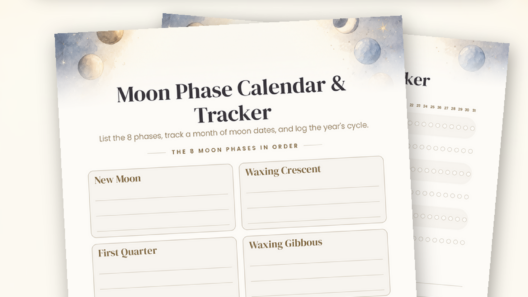
- Page 3: The 8 moon phases in order as boxes with lines to note what each phase traditionally invites.
The Lunar Cycle and the 8 Moon Phases in Order
A complete lunar cycle takes about 29.5 days and moves through eight named phases. The first four happen while the moon is waxing, which simply means growing toward full: new moon, waxing crescent, first quarter, and waxing gibbous. The next four happen while it is waning, or shrinking back toward dark: full moon, waning gibbous, third quarter, and waning crescent. If you glance upward a few evenings in a row, you can usually tell roughly where you are in the cycle by the shape you see.
You do not need to track every phase to keep a moon journal. Many people anchor the practice to two moments: the new moon and the full moon. Those points divide the month into two natural halves, which is why most beginner journals, including the printable here, are built around them.
New Moon: A Fresh Start and Intention Prompts
The new moon is traditionally associated with new beginnings. Some traditions treat it as a quiet starting line, a moment when the sky is dark and nothing has happened yet. Many journalers lean into that symbolism as a fresh start for the month ahead, though it is worth saying plainly that the moon is not directing your life; the value comes from what you choose to notice and write down.
If you would like to try it, set aside about ten minutes. The prompts on page one of the printable are: What would you like to begin this lunar cycle? Why does this matter to you right now? What is one small first step you can take? What might get in the way, and how will you handle it? The last question matters most. A fresh start sticks better when you have already named the obstacle.
First Quarter to Full Moon: Noticing What Is Growing
Between the new moon and the full moon, the moon grows brighter each night; the first quarter marks roughly the halfway point of that climb. This stretch is a natural time to check in on whatever you set in motion: what is moving, what is stalled, and what needs attention. Nothing mystical is required; it is simply a built-in reminder to look at your notes before the month runs away with you.
The full moon is a traditional time for gratitude and reflection. In journaling circles, people often use it to review the cycle so far rather than to predict what is coming; it is not a forecast of events, good or bad. It is a chance to pause at the brightest point of the month and take stock. Page two of the printable gives you prompts for exactly that.
Waning Phases and the Last Quarter: Releasing and Resting
After the full moon, the light begins to shrink. The waning gibbous, third quarter, and waning crescent lead back toward darkness. Many journalers use this half of the cycle to release and rest: finishing what is done, letting go of what is not working, and easing up rather than pushing. The moon is not doing anything to your plans; the changing sky is simply a visible cue for a check-in.
Prompts for this stretch, if you would like to add your own: What feels complete and ready to release? What can you stop carrying? What do you want to carry into the next cycle? That last question closes the loop, because it points you back toward the next new moon and the next set of intentions.
Starting a Simple Practice with Your Journal
Consistency matters far more than ceremony here. A simple rhythm works best: journal on the new moon and the full moon, about ten minutes each, and let the rest of the month take care of itself. Keep the pages private. This is not a performance, and no one is grading your answers. If a month goes by and you miss both dates, no harm done; just pick up with the next cycle.
A few small habits help. Keep the printed pages somewhere you will see them, next to your bed or on a desk. Write in plain language instead of trying to sound profound, and date every entry so you can read back later and see how your intentions unfolded. That record, more than any phase of the moon, is what makes the practice useful.
How to Use Your Printable
Print the three pages on US Letter paper. If you use A4, select Fit to page in your printer settings so nothing gets cut off. There is no wrong way to fill them in; the lines are there to make writing easier, not to constrain you.
- Keep page one and page two together as a monthly pair: intentions at the new moon, reflections at the full one.
- Use page three as a reference for the 8 phases, and jot a word or two in each box as you notice the sky.
- Print a few copies ahead of time so a new cycle never catches you without a page.
- Slip finished pages into a folder or binder to build a record you can reread.
The moon will keep its rhythm whether or not you write anything down. But if you would like a gentle reason to pause twice a month and check in with yourself, a moon journal is a lovely place to start. Download the free printable, print your pages, and see where the next cycle takes you.