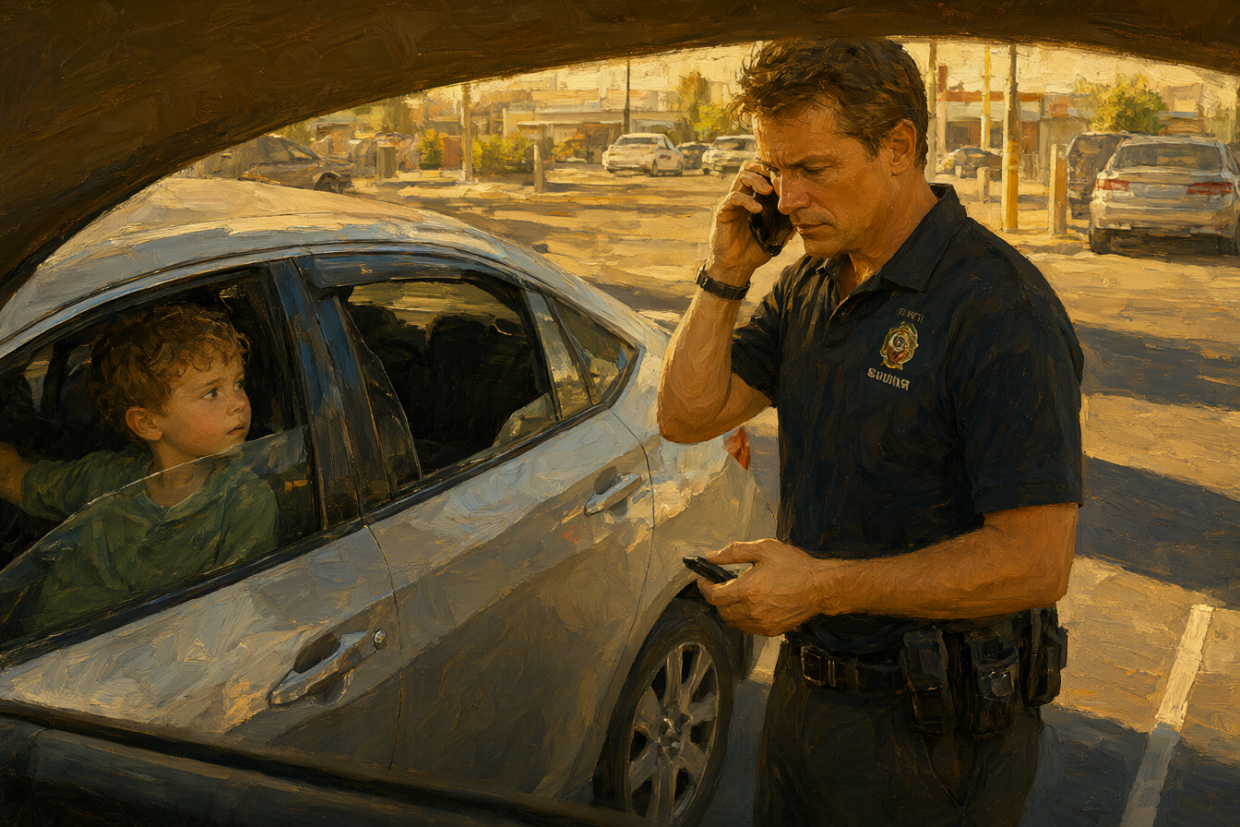
Martinez hands Michael the citation and a business card.
“Court date is printed on the ticket. You’ll want to get a lawyer,” Martinez said.
“This will ruin everything. My job, my reputation,” Michael said.
“You should have thought about that before leaving your son unattended,” Brown said.
The officers return to their patrol cars. Michael sits in her damaged Honda, staring at the citation. The grocery bags remain scattered on the asphalt, milk carton leaking white across the dark pavement.
Steven drives past on his way home. Through his rearview mirror, he sees Michael still sitting in her car, not moving.
His radio crackles with another call. House fire on Elm Street. Steven responds, but he can’t stop thinking about Noah’s frightened face pressed against that window.
Three hours later, Steven stops by the hospital during his dinner break. Noah is awake and coloring in a children’s book. A social worker sits nearby, taking notes.
“Hey Noah, how are you feeling?” Steven asked.
“Better. The doctor gave me juice,” Noah said.
The social worker, Mitchell, introduces herself.
“Are you the paramedic who found him?” Mitchell asked.
“Off-duty, but yes. How’s he doing medically?” Steven asked.
“Full recovery expected. But we’re keeping him overnight for observation,” Mitchell said.
“And the mother?” Steven asked.
“She’s meeting with our family services coordinator. This isn’t her first incident with Child Protective Services,” Mitchell said.
Steven feels his stomach drop. Noah wasn’t Michael’s first endangerment case.
“Two years ago, neighbors reported Noah wandering outside alone at night. Case was closed after mandatory parenting classes,” Mitchell said.
“So this is a pattern,” Steven said.
“Unfortunately, yes. We’re recommending supervised visitation until she completes additional safety training,” Mitchell said.
Noah looks up from his coloring book.
“Is my mommy in trouble?” Noah asked.
“Your mommy needs to learn better ways to keep you safe,” Mitchell said.
Steven sits beside Noah’s bed.
“You did good today, buddy. You stayed calm and helped the nice officers,” Steven said.
“Will you visit me again?” Noah asked.
“I’ll check on you tomorrow,” Steven said.
The next morning, Steven returns to find Noah’s bed empty. Mitchell explains that he’s been placed with his grandmother temporarily while Michael attends court-mandated counseling.
Steven drives past the grocery store on his way to work. The parking space where Michael’s Honda sat is empty, but he can still see Noah’s small handprints on the window in his mind.
His radio dispatcher assigns him to a medical call. Elderly man with chest pains. Steven responds, knowing that every emergency call matters, but some stick with you longer than others.
The following week, Steven receives a call from Martinez.
“Thought you’d want to know. Michael pled no contest. Twelve months probation, mandatory counseling, parenting classes,” Martinez said.
“What about Noah?” Steven asked.
“Supervised visitation for now. Grandmother has temporary custody,” Martinez said.
“Good. That kid deserves better,” Steven said.
“The footage from the store was damning. She was laughing on that video call while her kid was cooking in the car,” Martinez said.
“Who was she talking to?” Steven asked.
“Her sister. Complaining about losing her second job. Went on for twelve straight minutes,” Martinez said.
Steven hangs up and stares at his phone. Michael lost track of time because she was venting about financial stress. Meanwhile, her son was fighting to stay conscious in a superheated car.
Two months pass. Steven’s driving past the courthouse when he spots Michael on the steps. She looks thinner, exhausted. A woman beside her—older, same eyes—must be Noah’s grandmother.
He almost keeps driving. But he pulls over.
“How’d it go?” Steven asked.
Michael turns, recognizing him immediately.
“Twelve months probation. Mandatory counseling. Parenting classes. Community service,” Michael said.
She doesn’t sound defeated. She sounds like someone who slept badly for sixty nights and finally stopped arguing with herself about why.
“I was on the phone with my sister. About losing the second job. I panicked and just stopped thinking about anything else,” Michael said.
“That’s the part that scares me. The stopping,” Steven said.
“I know,” Michael said.
A pause. The grandmother watches them but doesn’t interrupt.
“He asks about you. The elephant man, he calls you,” Michael said.
Steven’s throat tightens.
“I’m getting him back next week. Supervised, but he’s coming home,” Michael said.
“You understand what could have happened that day?” Steven asked.
“Every night. I see his face in that window. I hear what the doctor said about his temperature,” Michael said.
“Then make sure it never happens again,” Steven said.
“I won’t. I swear on everything,” Michael said.
The grandmother steps forward.
Grandmother: I’m Elena. Noah’s been with me since that day.
“How’s he doing?” Steven asked.
“Nightmares for the first month. Wouldn’t get in a car without asking how long we’d be gone. But he’s better now,” Elena said.
“Kids are resilient,” Steven said.
“He drew you a picture. It’s in my car,” Elena said.
She returns with a crayon drawing. A stick figure man holding a small stick figure boy. A stuffed elephant between them.
“Tell him I said thank you,” Steven said.
“You saved my grandson’s life. We won’t forget that,” Elena said.
Michael wipes her eyes.
“I don’t expect you to forgive me. But I want you to know I’m different now. The counseling helped me see how I was prioritizing everything except what mattered,” Michael said.
“Actions prove that. Not words,” Steven said.
“I know,” Michael said.
Steven gets back in his truck. Nothing is fixed. The trust doesn’t just return because a judge signs a paper. But she’s still standing on those courthouse steps, not running from it.
That counts for something.
His radio crackles. Another call. Structure fire on Maple Avenue. He pulls back into traffic.
Three weeks later, Steven’s at the grocery store—the same one—when he sees Noah in a shopping cart. Elena pushes while Michael walks beside them, holding Noah’s hand.
Noah spots Steven first.
“The elephant man!” Noah said.
Steven walks over. Noah’s smiling, healthy, animated.
“Hey buddy. How are you?” Steven asked.
“Good! Grandma got me a new coloring book,” Noah said.
“That’s great,” Steven said.
“We’re doing supervised shopping trips. Part of the reunification plan,” Michael said.
“She’s doing well. Following every rule,” Elena said.
“That’s what Noah needs,” Steven said.
“I wanted to say something. I enrolled in a parenting support group. Other parents who made mistakes. It’s helping,” Michael said.
“Good. Keep going,” Steven said.
“Are you going to visit me again?” Noah asked.
“Maybe sometime,” Steven said.
“I still have the elephant. He keeps me safe,” Noah said.
“I’m glad,” Steven said.
They continue shopping. Steven watches them turn down the cereal aisle—Michael attentive, Elena supervising, Noah chattering about cartoon characters.
It’s not perfect. The court supervision will last months. The broken trust will take years to rebuild. But Noah is safe, Michael is trying, and that’s more than Steven had hoped for two months ago.
He finishes his own shopping and heads to the parking lot. The space where Michael’s Honda sat that day is occupied by a minivan now. A mother unloads groceries while two kids wait inside, windows down, mother checking on them every thirty seconds.
Some people learn. Some don’t. Steven’s job is to be there when they don’t.
His phone buzzes. Text from Martinez.
“Heard you ran into them at the store. Thought you’d want to know—CPS report came back positive. Michael’s making real progress. Unsupervised visits start next month.”
Steven texts back: “Good. Kid deserves his mom back.”
He drives home as the sun sets. The bank thermometer reads 73 degrees now. Comfortable. Safe.
He thinks about Noah’s drawing, still sitting on his passenger seat. The stick figures holding hands. The elephant between them.
Sometimes the system works. Sometimes people change. Sometimes a three-year-old gets a second chance at having the parent he deserves.
Steven pulls into his driveway and sits for a moment. Twenty-three years as a paramedic taught him to notice things others miss. But it also taught him to recognize when someone is genuinely trying to do better.
Michael has a long road ahead. Court dates, supervised visits, parenting classes, counseling sessions. But she’s walking that road instead of running from it.
That’s the difference between a mistake and a pattern. A mistake teaches you. A pattern defines you.
Steven grabs Noah’s drawing and heads inside. He’ll put it on his refrigerator, next to the other reminders of why he does this job.
Because sometimes, on the worst days, you get to be the person who makes sure a three-year-old doesn’t become a statistic.
And sometimes, months later, you get to see that same three-year-old smiling in a shopping cart, safe and loved and learning to trust again.
That’s enough.
The end