If you have ever laid out a tarot spread and felt your stomach drop when a card landed upside down, this guide is for you. It explains three traditional ways readers approach reversals, so an upside-down card becomes a prompt for reflection instead of a scare. A free printable tarot reversals cheat sheet and practice worksheet are included, ready to print and keep beside your deck.
This printable is not a substitute for professional help.
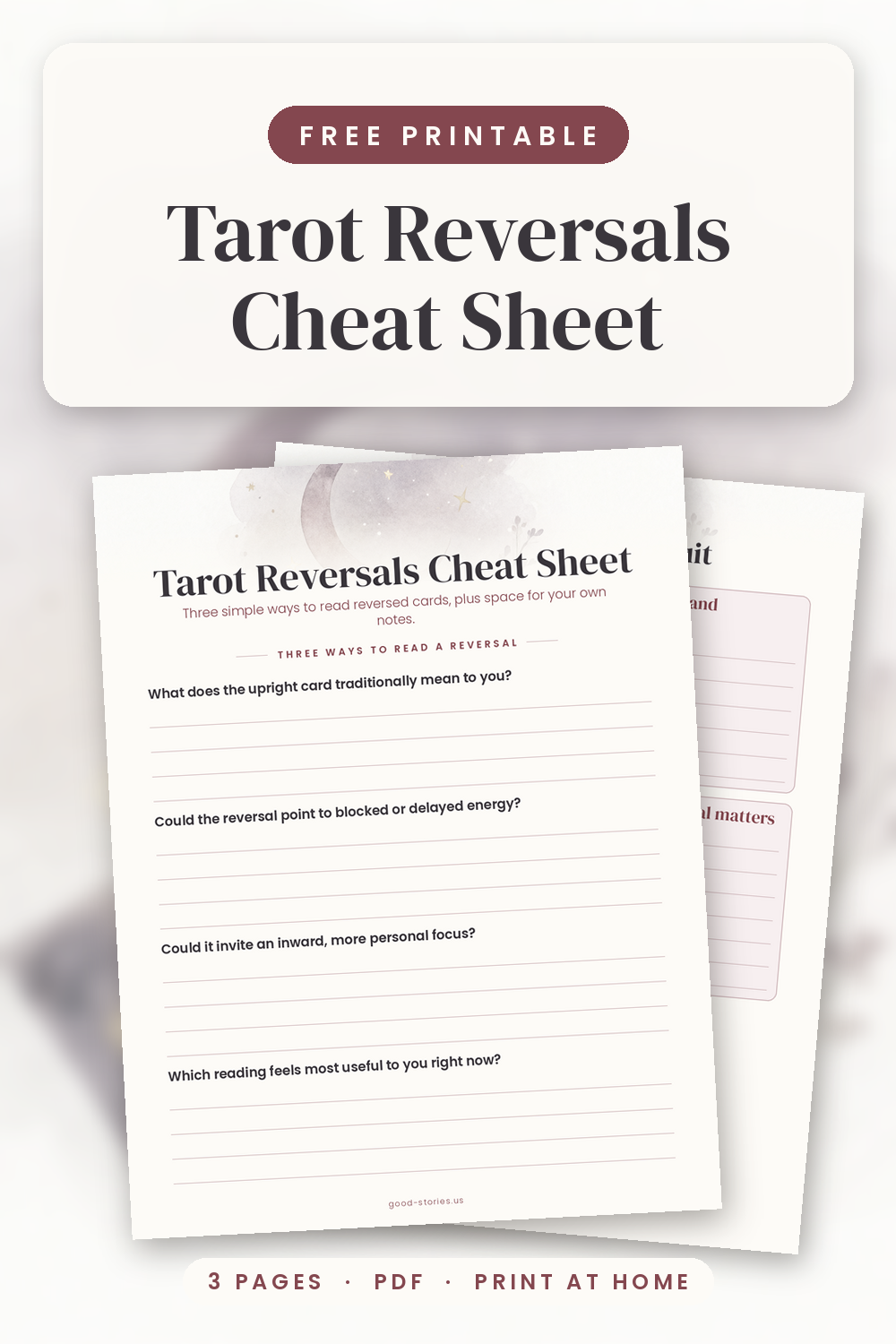
What’s inside the printable
The download is three pages, and each page has one job.
- Page 1: a three-question reflection sheet for reading one reversed card, covering the upright meaning, blocked or delayed energy, an inward focus, and the reading that feels most useful.
- Page 2: two-column note boxes for reversal notes by the four suits and the Major Arcana.
- Page 3: reading log lines for the card and its position, the upright meaning, and how a reversed reading shifts that meaning.
What a Reversed Tarot Card Actually Is
A standard tarot deck holds 78 cards. Twenty-two of them are the Major Arcana, numbered 0 through 21, and the other 56 are the Minor Arcana, divided across four suits: Wands, Cups, Swords, and Pentacles. A reversal is simply a card that lands upside down in a draw. The deck has not changed and no extra card has appeared; the card in front of you is the same one you would recognize upright. What changes is how you choose to read it, and that choice belongs to you.
Three Traditional Ways Readers Treat Reversals
Most reversal advice comes down to three traditional approaches. None of them is the correct one, and many readers mix them depending on the question.
- Blocked or delayed energy: the card’s theme is present but stuck, held back, or slow to arrive. A reversed Two of Wands might point to plans waiting on a decision rather than plans moving forward.
- An inward or more personal focus: the card turns toward your inner life instead of the world around you. A reversed Emperor can invite you to look at how you lead yourself before you lead anyone else.
- A softer shade of the upright meaning: the same theme at a lower volume, or with a gentler tone. The reversed Sun does not have to mean disaster; it may simply describe a quieter kind of contentment.
Plenty of experienced readers use none of these and keep every card upright, and that is a legitimate practice rather than a shortcut. The point of a reversal is to give you something useful to think with, so pick the approach that keeps your reading clear.
How the Reversal Worksheet Works
Page one of the printable starts with the upright meaning you already know, because that is the anchor for everything else. From there you test the three traditional readings against the card in front of you and note which one feels most useful right now. The worksheet does not decide for you; it lines the options up so you can compare them.
Page two moves from single cards to suits. The four suits and the Major Arcana each get a note box, which makes it easy to see how a reversed Wands card tends to behave differently from a reversed Cups card. Page three is a reading log for the card and its position, the upright meaning that came to mind, and the shift a reversal adds. Together the three pages take you from a single draw to a habit.
Reversals as a Journaling Prompt, Not a Prediction
A reversal works best as a question rather than a verdict. Instead of asking what an upside-down card says will happen, ask what it invites you to notice about the situation you are already in. That framing keeps the practice honest and keeps you in charge of your own decisions.
One row in the log per daily pull or spread position is enough. After a few weeks you will have your own vocabulary for these cards, written in your own words, which is worth more than any list of fixed meanings. Patterns show up quickly when you write things down.
Mistakes to Skip When Reading Reversals
A few habits make reversals harder than they need to be.
- Treating a reversal as automatically negative. An upside-down card is not a warning light; it is one of several ways to read the same card.
- Forcing a meaning that is not there. If none of the three approaches fits, the upright reading may be the honest answer.
- Losing the anchor. The suit and the card’s upright theme stay the foundation, and the reversal only adjusts how you frame them.
- Asking the cards to make a decision for you. Reversals are for reflection, not for outsourcing a choice you need to make yourself.
How to use your printable
The printable is sized for US Letter paper. If you print on A4, choose “Fit to page” in your printer dialog so nothing is trimmed at the edges.
- Print all three pages and keep them in a folder or tarot journal.
- Print page one on its own for a single-card reversal practice.
- Keep page two in your deck box as a quick suit reference.
- Use page three as a daily or weekly log; a pencil lets you reuse the same sheet.
- Print in grayscale if you want to save ink; the layouts stay readable.
Reversals stop being intimidating once you have a simple way to work through them. Print the sheets, draw a card, and give yourself a few quiet minutes to see what the upside-down version has to say. The deck has been waiting.