If you have ever looked at a birth chart and wondered what all those little planet symbols actually mean, this free printable astrology planets and signs cheat sheet is for you. It gathers the ten planets, the keywords that describe them and the traditional sign rulerships onto three calm pages, so you can stop juggling browser tabs and start noticing patterns. A free printable is included below, ready to print and keep beside your journal.
This printable is not a substitute for professional help.
What’s inside the printable
Every page is made to be easy to use the first time you open it, with plenty of room to write.
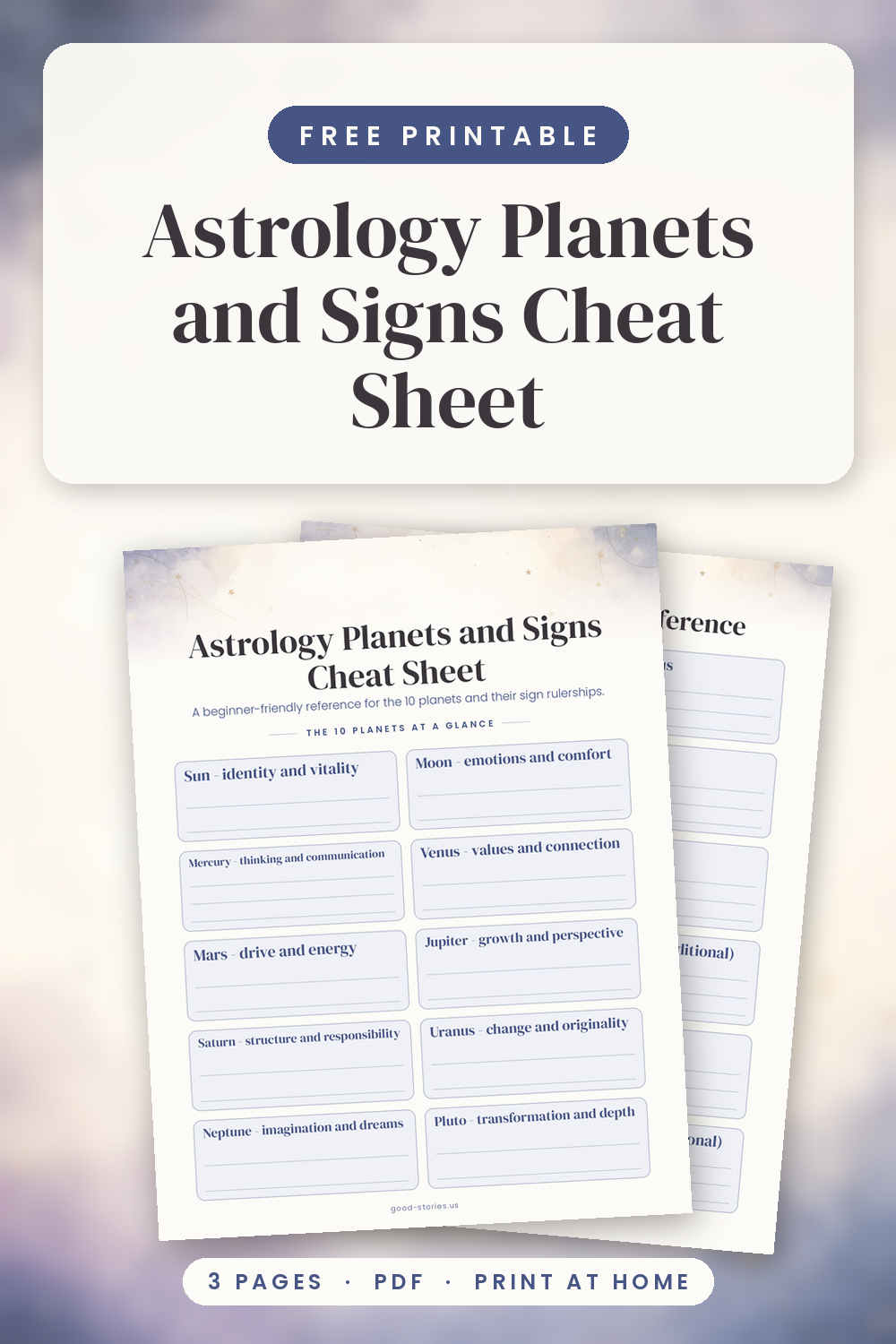
- Page 1: “The 10 Planets at a Glance” – ten boxes, each pairing a planet with a one-line keyword meaning, plus writing lines for notes.
- Page 2: “Sign Rulership Quick Reference” – twelve boxes pairing each zodiac sign with its traditional ruling planet, with writing lines for notes.
- Page 3: “My Planet Placements” – four reflection prompts with writing lines to note your own Sun, Moon and rising sign placements.
Meet the 10 planets in astrology
Astrology uses ten bodies: the Sun, the Moon and eight planets. Each one is linked with a broad theme, and learning those themes is the quickest way to make a chart feel readable. Think of them as the main characters in a story.
- Sun – identity and vitality
- Moon – emotions and comfort
- Mercury – thinking and communication
- Venus – values and connection
- Mars – drive and energy
- Jupiter – growth and perspective
- Saturn – structure and responsibility
- Uranus – change and originality
- Neptune – imagination and dreams
- Pluto – transformation and depth
You will meet these keywords again and again in books, apps and podcasts. They are not rigid definitions, just friendly starting points that give each placement a shape.
How a planet and a sign work together
A simple way to hold the difference in your head is this: the planet shows what, and the sign shows how. The planet is the topic. The sign is the style, mood and method.
Sun in Leo describes identity expressed warmly, visibly and with a little theatre. Sun in Capricorn describes identity expressed through patience, responsibility and steady effort. Same planet, same theme of self and vitality, two very different flavours.
That is also why two people can share a placement and still read differently. The planet names the conversation and the sign sets the tone. Once that clicks, phrases like Venus in Taurus or Mars in Gemini stop sounding like code and start sounding like useful shorthand.
Traditional rulerships, sign by sign
Each sign has a traditional ruling planet, a planet said to feel at home there. This is the list used in most older astrology texts, and it is the one on the printable:
- Aries – Mars
- Taurus – Venus
- Gemini – Mercury
- Cancer – Moon
- Leo – Sun
- Virgo – Mercury
- Libra – Venus
- Scorpio – Mars (traditional)
- Sagittarius – Jupiter
- Capricorn – Saturn
- Aquarius – Saturn (traditional)
- Pisces – Jupiter (traditional)
Modern astrology often adds Pluto as a ruler of Scorpio, Uranus as a ruler of Aquarius and Neptune as a ruler of Pisces. Many astrologers keep both systems, using the traditional ruler for the older layer of meaning and the modern ruler for a more contemporary reading. The printable sticks with the traditional pairings so you always have the classic answer at hand.
Fast movers and slow movers
Planets do not all travel at the same speed, and that changes how personal a placement feels. The Moon changes sign every couple of days, Mercury, Venus and Mars move on within weeks to a few months, and the Sun spends about a month in each sign. These are the placements that differ most from person to person.
Jupiter takes roughly a year per sign and Saturn about two and a half years. Uranus, Neptune and Pluto are far slower, staying years in a single sign, which means huge numbers of people share the same outer-planet sign. That does not make them unimportant. It simply means they describe a shared backdrop rather than a personal quirk.
Using the worksheet for reflection
Astrology is a tradition many people use for self-reflection and storytelling, not a way to predict events. The worksheet is built around that idea. Write down the sign each planet was in when you were born, add one keyword you want to remember for each planet, and then sit with a couple of the prompts. Page 3 asks which planet key word feels most like your decision style, what your Sun, Moon and rising signs are, and which placement you would like to understand better.
How to use your printable
The pages are set up as a US Letter document, so a few small choices will keep everything crisp and readable.
- Print on US Letter at 100% for the intended sizing.
- On A4 paper choose “Fit to page” so none of the boxes run off the edge.
- Keep page 2 beside you while you read a chart or listen to a podcast, and jot notes in the margins as pairings start to feel familiar.
- Tuck page 1 into your journal or planner as a bookmark you can glance at.
- Revisit page 3 every few months and compare your answers to see what has shifted.
Keep it simple: one page beside your chart, one keyword per planet, and a few honest notes. Over time the symbols turn into a familiar shorthand, and the worksheet becomes a small record of how your understanding grows.