Some weeks leave you with a head full of noise and no clear place to put it. A full moon journal gives you a calm, contained way to set down what you have been carrying, look at it honestly, and choose what you are ready to release. This guide walks you through a gentle fifteen-minute practice, and it includes a free printable with six prompts, a ritual checklist and a year of traditional moon names.
This printable is not a substitute for professional help.
What’s inside the printable
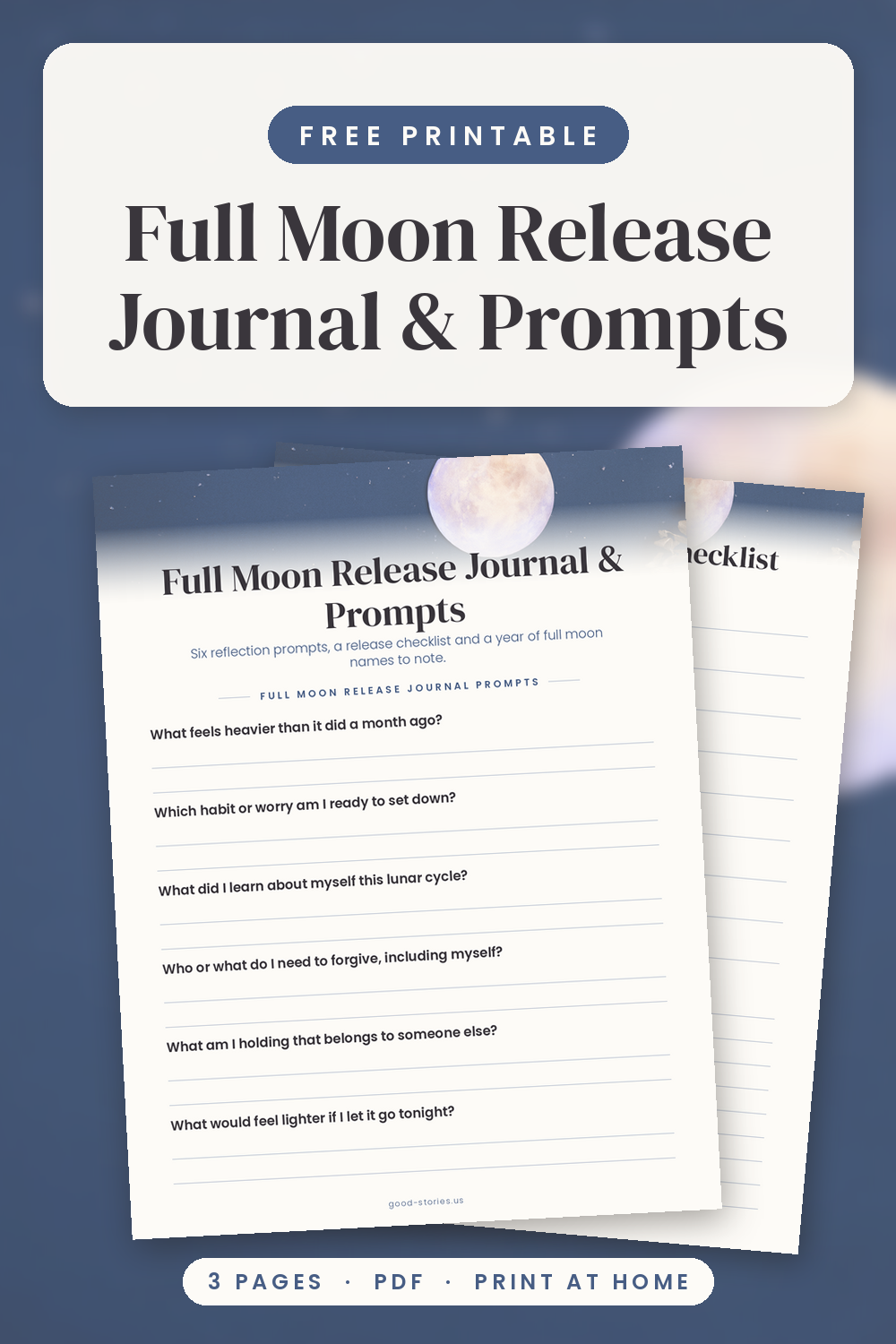
The printable is three pages, designed to be used together or one page at a time:
- Page 1: six full moon release journal prompts, each with writing lines.
- Page 2: a nine-step release ritual checklist with checkbox rows.
- Page 3: a two-column grid of the twelve traditional full moon names, with lines for dates and notes.
The lunar cycle in order, and where the full moon fits
The lunar cycle runs through eight phases: new moon, waxing crescent, first quarter, waxing gibbous, full moon, waning gibbous, last quarter and waning crescent. One new moon to the next takes roughly 29.5 days, so the full moon falls on a slightly different date each month.
Many people treat the full moon as a reflective checkpoint: a moment to look back at the month and notice what has grown, what has stalled and what no longer fits. That is a tradition and a rhythm, not a prediction. The moon does not decide your life; the pause helps you decide.
How to do a 15-minute release session
Set a timer for fifteen minutes and keep the session small on purpose. Small is what makes it repeatable.
Start by writing one item per line: a worry, a habit, a grudge, a half-finished project, a conversation you keep replaying. Do not fix anything yet. Do not explain or solve. The first pass is only a list, and a messy list is allowed.
When the timer ends, turn each line into a statement that begins with “I am ready to…” For example, “I keep checking my email at midnight” becomes “I am ready to leave my phone in the kitchen after ten.” Keep the statements plain and believable. You are not promising the universe anything; you are naming a direction.
The six prompts on the printable, and how to answer each one
Each prompt on page 1 is meant to be answered in one honest sentence. One sentence keeps the practice light and stops it from turning into another task.
- What feels heavier than it did a month ago? Name the first thing that comes to mind, even if it seems small.
- Which habit or worry am I ready to set down? Choose one, not five, so the decision stays clear.
- What did I learn about myself this lunar cycle? Look for a pattern, a limit or a preference you can trust next month.
- Who or what do I need to forgive, including myself? Here forgiveness means putting down the replay, not excusing what happened.
- What am I holding that belongs to someone else? Notice other people’s expectations, moods or unfinished business.
- What would feel lighter if I let it go tonight? Let the answer be practical: a drawer, a debt, a group chat, a grudge.
If a prompt opens something too heavy to carry alone, set the pen down and reach out to someone you trust or a professional.
A simple repeatable release ritual, step by step
The ritual is deliberately ordinary, so you can repeat it without gathering supplies. Dim the light, light one candle, and set the printable and a pen within reach. Read the prompts, write your sentences, then close the journal. That is the whole shape of it.
Page 2 turns that shape into a checklist you can follow in order: choose a quiet hour after sunset, write one worry on a small slip of paper, answer each prompt, circle the line that feels most true, say it once out loud, name a boundary for the month, clear one small space, thank the habit for what it taught you, then close the journal and blow out the candle. Keep the candle attended the whole time.
Using the year log: twelve traditional moon names to note
Page 3 is a simple year log. A year holds twelve or thirteen full moons, depending on the calendar, and the grid gives you room for each date and a line of notes. These names are common in North America, and other traditions use different ones.
- January: Wolf Moon, for the wolves heard in the deep cold of midwinter.
- February: Snow Moon, a name for the heaviest snowfall month.
- March: Worm Moon, marking the first thaw and earthworms returning to the soil.
- April: Pink Moon, named for the pink wildflowers that bloom in early spring.
- May: Flower Moon, for the flowers opening across the warming season.
- June: Strawberry Moon, a name tied to the short strawberry harvest.
- July: Buck Moon, for the new antlers growing on buck deer.
- August: Sturgeon Moon, named for the sturgeon caught in late summer.
- September: Harvest Moon, the moon that helped farmers work late by its light.
- October: Hunter’s Moon, a name for the bright moon after the harvest.
- November: Beaver Moon, when beavers once prepared their lodges for winter.
- December: Cold Moon, for the long nights and deep frost at the year’s end.
How to use your printable
Print on US Letter. On A4 paper, choose “Fit to page” in your print dialog so the margins and writing lines stay intact. A plain black-and-white print works well; these pages are made to be written on.
Keep all three pages in a thin binder and add a fresh set each month. Use page 2 on the full moon, page 1 on the new moon, and page 3 as a year-at-a-glance at the front. A photo of your circled line is a good thing to revisit before the next full moon.
The full moon is a good excuse to put down what you have been carrying, but the release is yours. Print the pages, set aside fifteen quiet minutes, and let one honest sentence be enough.