“Please let me finish,” Caroline said.
She continued. “To Marcus Hayes: You do not know me, not really. You know a man who sat on a bench and ate sandwiches and talked about nothing important. But you saw me. Every Tuesday for three years, you saw me. You shared your food when I had none. You brought me coffee when it was cold. You asked if I was okay. You never asked for my name, my money, or my time. You gave freely. That is more than I ever gave my children, and more than they ever gave me. You are a good man, Marcus. I want you to have the life you deserve. Use this wisely. Be better than I was. —William James Brennan.”
The silence that followed was suffocating.
Marcus’s eyes burned. He stared at the table, unable to look up.
Margaret’s voice was ice. “We’re contesting this.”
“You’re welcome to try,” Caroline said. “But the will is ironclad. It was written by Mr. Brennan, witnessed by two independent parties, notarized, and executed while he was of sound mind. I have medical documentation confirming his mental competency at the time of signing.”
“He was manipulated,” Robert said, pointing at Marcus. “This guy obviously—”
“Mr. Hayes had no knowledge of Mr. Brennan’s identity or financial status,” Caroline interrupted. “We have testimony from the witnesses confirming that Mr. Brennan drafted this will independently. There is no evidence of coercion or manipulation.”
Susan was crying now. “He was our father.”
“Yes,” Caroline said quietly. “He was.”
Margaret grabbed her purse. “We’ll see you in court.”
She stormed out. Robert and Susan followed.
The door slammed.
Marcus sat frozen, staring at his hands.
Caroline waited a moment, then spoke gently. “Mr. Hayes?”
He looked up.
“This is real,” she said. “The estate is yours. We’ll need to go through probate, but it should be finalized in six to eight months. In the meantime, I’ll need you to sign some paperwork.”
Marcus’s voice came out hoarse. “Why me?”
Caroline smiled sadly. “He told me once that you were the only person in three years who ever asked if he was okay. Not what he had. Not what he could give. Just if he was okay.” She slid a folder across the table. “He wanted you to have this.”
Marcus opened it.
Inside was a photo—William, younger, maybe in his sixties, standing in front of a house with a big front porch. On the back, in shaky handwriting: 428 Elmwood. It’s yours now. Take care of it.
Marcus’s throat closed.
“There’s one more thing,” Caroline said. She handed him a small envelope. “He left this for you personally.”
Marcus opened it with trembling hands.
The note inside was short.
Marcus—Thank you for seeing me when I was invisible. You gave me the only friendship I had in years. I hope this gives you the life you never got to choose. You deserve it.—William
Marcus folded the note carefully, his hands shaking, his eyes wet.
“Take your time,” Caroline said softly. “I’ll be in my office when you’re ready.”
She left.
Marcus sat alone in the conference room, holding the note, staring at the photo of a house he now owned, trying to process that three years of sandwiches on a bench had just changed his entire life.
He thought about William—quiet, lonely, feeding pigeons, always showing up.
He thought about the daughter’s face, the son’s anger, the younger woman’s tears.
He thought about the last thing William had said to him. You’re a good man, Marcus Hayes.
Marcus folded the note, slipped it into his pocket, and stood up.
He walked to the window and looked out at the city—the same city he’d mopped floors in for seven years, the same city where he’d sat on a bench and shared a sandwich with a stranger.
A stranger who’d seen him, too.
Marcus wiped his eyes, straightened his shoulders, and walked out to sign the paperwork.
Three months later, the Brennan children’s legal challenge was dismissed. The judge ruled the will valid and binding. Margaret, Robert, and Susan were ordered to pay court costs.
Marcus moved into the house on Elmwood Drive in January. It had a big front porch, just like the photo. He kept William’s furniture, his books, even the wool coat that had been too heavy for the weather.
He quit his job at Riverside and enrolled in night classes at the community college. Business administration. He wanted to manage the rental properties himself, do it right.
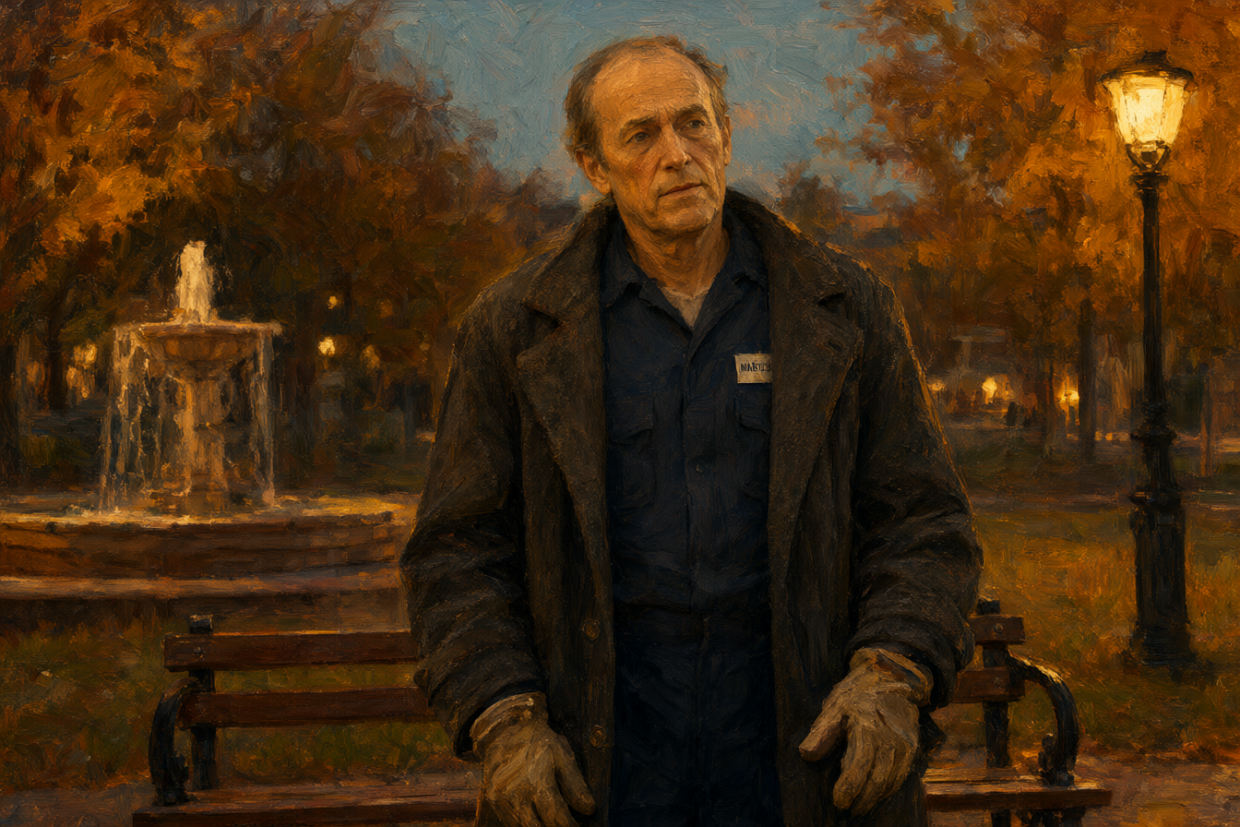
On Tuesdays, he still went to the park. He sat on the same bench, brought two sandwiches, and left one wrapped on the seat next to him.
Sometimes someone would sit down—a kid skateboarding home, an old woman walking her dog, a man who looked like he hadn’t eaten in days.
Marcus would offer the sandwich.
Most of them took it.
Some of them stayed.
And Marcus would sit with them, ask if they were okay, and listen.
Because William had taught him something in three years of silence and sandwiches: being seen matters more than being remembered.
And kindness, given freely, comes back in ways you can’t predict.
Marcus never forgot that.
The end