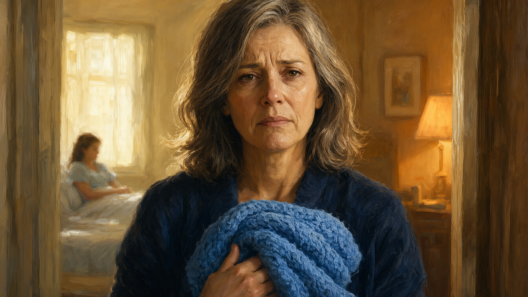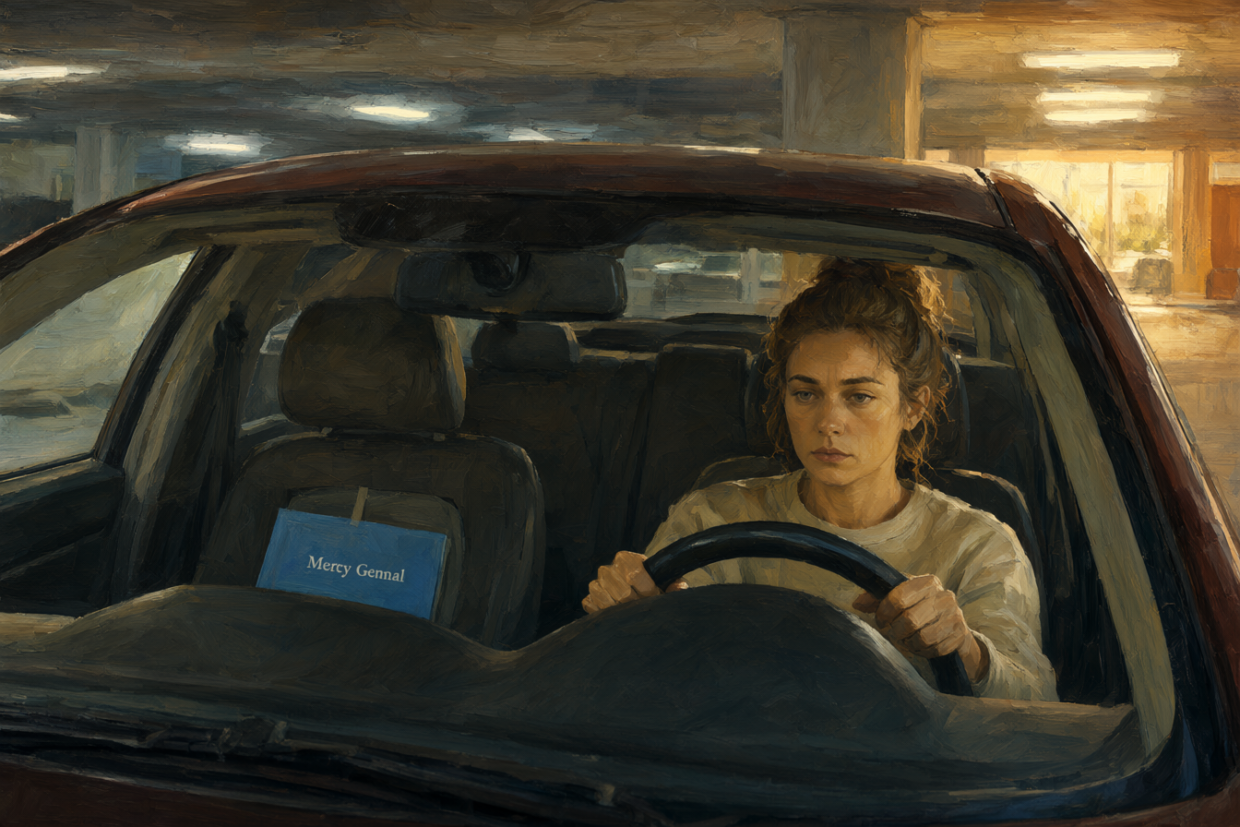
Mom parked outside the grocery store at 2:15 PM… But the temperature gauge in her car read 89 degrees.
The notification pinged on my phone at 2:47 PM while I was sitting in AP Chemistry.
“Find My Friends: Mom is at Mercy General Hospital.”
I stared at the screen, then refreshed it. The blue dot pulsed steadily on the map, three miles west of where she’d told me she’d be. The grocery store sat in the opposite direction, its location marked by the pin I’d saved months ago.
My hands went cold.
Mom had texted me at 2:10 PM: “Running to store, back by 3:30, start homework please.”
I screenshotted the location, my stomach twisting. The bell rang but I barely heard it.
By the time I got home at 3:45, Mom’s car was in the driveway. I walked in to find her unpacking grocery bags in the kitchen, humming something soft and distracted. She wore the same yoga pants and Northwestern sweatshirt from this morning, her hair in the same ponytail.
“Hey sweetie.” She smiled, but it didn’t reach her eyes. “How was school?”
“Fine.” I dropped my backpack. “How was the store?”
“Oh, you know. Crowded.” She pulled out a carton of milk, a box of pasta, canned tomatoes. “Everyone had the same idea on a Wednesday afternoon.”
I moved closer. “Which store did you go to?”
“The usual one. Mariano’s on Oak Street.” She didn’t look at me, kept unpacking. “Why?”
“Just wondering.” I watched her hands. They trembled slightly as she folded the paper bags. “Did you get everything you needed?”
“Most of it. They were out of that bread you like.” She finally met my eyes. “I’ll try again tomorrow.”
I nodded slowly. Pulled out my phone, opened the screenshot. “Mom.”
She glanced at the screen. Something flickered across her face—fear, maybe, or resignation—before the smile returned. “What’s that?”
“Your location at 2:47 PM.” I turned the phone toward her. “You were at Mercy General.”
The kitchen went quiet except for the hum of the refrigerator.
Mom set down the can she was holding. Her shoulders dropped half an inch. “Chloe—”
“You told me you were going to the grocery store.” My voice came out steadier than I felt. “You’ve been telling me that every Wednesday for six weeks.”
She closed her eyes. “I can explain.”
“Then explain.” I crossed my arms. “Because I checked. Mariano’s doesn’t even open until three on Wednesdays. They changed their hours in January.”
Mom pulled out a kitchen chair and sat down heavily. For a long moment she just stared at her hands, turning her wedding ring around and around on her finger.
“I didn’t want you to worry,” she said finally.
“About what?”
She took a breath. “I’ve been going to appointments. At the hospital. Since February.”
The floor seemed to tilt. “What kind of appointments?”
“Oncology.” The word came out flat. “I found a lump in January. Had a biopsy in early February. They confirmed it was malignant three weeks ago.”
I couldn’t breathe. “Cancer.”
“Stage two breast cancer.” She looked up at me, and now I could see how tired she looked, how the smile had been a mask. “I’ve been doing radiation every Wednesday. That’s why I’m always gone from two to four.”
“Why didn’t you tell me?” My voice cracked.
“Because you’re seventeen, Chloe. You’re applying to colleges. You have SATs and AP exams and you shouldn’t have to—” Her voice broke. “You shouldn’t have to deal with this.”
“I’m not a child.” Tears burned my eyes. “You can’t just lie to me about having cancer.”
“I wasn’t lying. I was protecting you.”
“By pretending to go grocery shopping?” I gestured at the bags on the counter. “Where did this food even come from?”
“I stopped at the store on my way home from treatment.” She stood up, moved toward me. “I thought if I kept everything normal, if I just—”
“Normal?” I stepped back. “Mom, nothing about this is normal. How long were you planning to hide it?”
She flinched. “I wasn’t hiding it. I was going to tell you after finals. After you heard back from Northwestern. I didn’t want this to affect your—”
“My what? My applications? My grades?” Anger flared hot in my chest. “You think I care about any of that more than I care about you?”
“That’s not what I meant.”
“Then what did you mean?” I was shouting now. “Because from where I’m standing, it looks like you didn’t trust me enough to handle the truth.”
“Chloe, please—”
“How bad is it?” I cut her off. “Stage two. What does that mean?”
Mom’s face crumpled. “It means they caught it relatively early. The tumor is two centimeters. It hasn’t spread to my lymph nodes yet, but there’s a chance—”
“A chance of what?”
“A chance it could metastasize if we don’t treat it aggressively.” She wiped her eyes. “That’s why I’m doing radiation now. After that, they’ll do surgery. Remove the tumor and possibly some surrounding tissue. Then chemotherapy, probably six months of it.”
The room spun. I grabbed the counter to steady myself. “Six months.”
“Maybe less. Maybe more. It depends on how I respond.” She reached for my hand. “But Dr. Patterson says my prognosis is good. Really good. The five-year survival rate for stage two is over ninety percent.”
“Ninety percent.” I repeated the number like it meant something. Like it could make the fear go away.
“I’m going to be okay, sweetheart.” Mom squeezed my hand. “I promise.”
“You can’t promise that.” My voice came out small. “You don’t know.”
She pulled me into a hug and I let her, pressing my face against her shoulder like I was seven years old again. She smelled like the lavender detergent she always used, and underneath that, something clinical and sharp. Hospital smell.
“I know I should have told you sooner,” she whispered. “I’m sorry.”
I pulled back. “What about Dad?”
Her expression hardened. “What about him?”
“Does he know?”
“I called him in March. He said—” She stopped, jaw tight. “He said he’d help with medical bills if I needed it, but he’s in Seattle now with Vanessa and the baby, and it’s complicated.”
“Complicated.” I tasted bile. “He knows you have cancer and he said it’s complicated?”
“Chloe—”
“No.” I shook my head. “That’s not okay. None of this is okay.”
Mom sat back down, suddenly looking every one of her forty-three years. “I know.”
I paced to the window and back. “What else haven’t you told me?”
“Nothing. I swear.”
“How do I know that?” I spun to face her. “You’ve been lying for two months.”
“I haven’t been lying. I’ve been—”
“Protecting me. Right.” I laughed bitterly. “By making me think everything was fine while you were getting radiation treatments alone.”
“I wasn’t alone. Aunt Diane came to the first few appointments.”
“Aunt Diane knows?” The betrayal stung fresh. “Who else?”
“Just her. And Dr. Patterson’s team.” Mom stood up again, moved toward me carefully. “I wanted to tell you. Every single day I wanted to tell you. But you were so stressed about school, and I thought—”
“You thought wrong.” I met her eyes. “I want to know everything. All of it. No more protecting me.”
She nodded slowly. “Okay.”
“When’s your next appointment?”
“Next Wednesday. Two PM.”
“I’m coming with you.”
“Chloe, you have school—”
“I’m coming with you,” I repeated firmly. “And every appointment after that. No arguments.”
Mom’s eyes filled with tears again. “You don’t have to—”
“Yes, I do.” I grabbed her hand. “You’re my mom. I’m not letting you do this alone.”
She pulled me into another hug, tighter this time. “I love you so much.”
“I love you too.” I held on, feeling her heartbeat against my cheek. Steady. Strong. Alive. “But if you ever lie to me again about something this important, I’m going to be really mad.”
She laughed wetly. “Noted.”
We stood there in the kitchen for a long time, grocery bags still half-unpacked on the counter, the afternoon light slanting golden through the windows. Eventually Mom pulled back and wiped her eyes.
“I should finish putting this stuff away,” she said.
“I’ll help.” I grabbed the pasta box. “And then you’re going to tell me everything Dr. Patterson said. All the medical terms, all the statistics, everything.”
“It’s a lot of information—”
“I can handle it.” I met her eyes. “I need to handle it.”
She nodded. “Okay.”
We worked in silence for a few minutes, putting away groceries. Then Mom said quietly, “I really am sorry, Chloe. I thought I was doing the right thing.”
“I know.” I closed the refrigerator. “But the right thing is trusting me. Even when it’s scary.”
“Especially when it’s scary,” she agreed.
My phone buzzed. A text from my best friend Emma: “Study group at 6?”
I looked at Mom. “Can I skip study group tonight? I want to stay home.”
“You don’t have to—”