“I want to.” I texted Emma back: “Can’t make it, family stuff, sorry.”
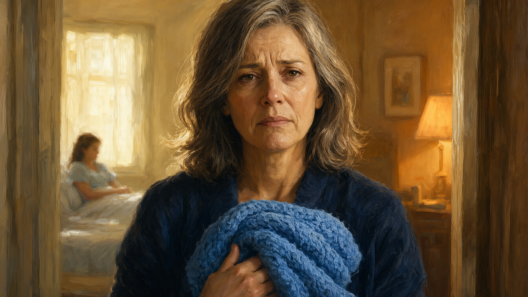
Mom watched me, something soft and sad in her expression. “Thank you.”
“Don’t thank me.” I leaned against the counter. “Just promise me no more secrets.”
“No more secrets,” she echoed.
“And I’m going to call Aunt Diane later. She should have told me.”
Mom winced. “I made her promise not to. Don’t be mad at her.”
“I’m mad at both of you.” But the anger was already fading, replaced by something heavier. Fear. Grief. Love. “But mostly I’m just scared.”
“Me too,” Mom admitted. “Every single day.”
“Then we’ll be scared together.” I grabbed two mugs from the cabinet. “Tea?”
“Please.”
I filled the kettle and set it on the stove. Outside the window, the neighborhood looked exactly the same as it had this morning—same houses, same trees, same sky. But everything had changed.
Mom pulled out her phone. “Do you want to see the treatment plan? Dr. Patterson gave me a folder with all the details.”
“Yes.” I sat down across from her. “Show me everything.”
She opened a blue folder and spread papers across the table. Radiation schedules, surgical options, chemotherapy protocols. The words blurred together at first—adjuvant therapy, lumpectomy, sentinel node biopsy—but I forced myself to focus.
“This is the timeline,” Mom said, pointing to a chart. “Six weeks of radiation, which I’m halfway through now. Then surgery in May. Recovery for four to six weeks. Then chemo starting in July, probably through December.”
“And after that?”
“Hormone therapy for five years. Daily pills. And regular monitoring.” She traced a finger down the page. “Mammograms every six months, blood work every three months.”
“Five years,” I repeated.
“It sounds like a long time, but it’s standard for hormone-receptor-positive cancers.” She looked up. “Which is actually good news. It means the cancer responds to hormone therapy, which gives us more treatment options.”
I nodded, trying to absorb it all. “What’s the surgery like?”
“They’ll remove the tumor and a margin of healthy tissue around it. They’ll also test some lymph nodes to make sure the cancer hasn’t spread.” She paused. “There’s a chance I might need a mastectomy instead of a lumpectomy, depending on what they find.”
“Which would you choose?”
“Honestly? I don’t know yet.” She closed the folder. “Dr. Patterson says we can make that decision after we see how the radiation goes. The tumor’s already shrinking, which is encouraging.”
The kettle whistled. I got up to make the tea, grateful for something to do with my hands. “Does it hurt? The radiation?”
“Not during the treatment itself. But my skin gets irritated afterward. Like a bad sunburn.” She accepted the mug I handed her. “And I’m tired. Really tired, all the time.”
“Is that why you’ve been going to bed so early?”
“Yeah.” She sipped her tea. “I didn’t want you to notice.”
“I noticed.” I sat back down. “I thought you were just stressed about work.”
“Work has been stressful too,” she admitted. “I haven’t told them yet. I’m using vacation days for the appointments.”
“Why haven’t you told them?”
“Because I’m up for a promotion in June, and I don’t want—” She stopped. “I know how that sounds.”
“Like you’re putting work before your health?”
“Like I’m trying to keep some part of my life normal.” She set down the mug. “I’m good at my job, Chloe. I’ve worked hard for this promotion. I don’t want cancer to take that away too.”
I understood that, even if I didn’t like it. “When will you tell them?”
“After the surgery. I’ll have to take medical leave for recovery anyway.” She rubbed her temples. “I’m just trying to get through one thing at a time.”
“What can I do?” The question came out desperate. “To help. What can I do?”
Mom reached across the table and took my hand. “You’re already doing it. Being here. Letting me talk about it.”
“That’s not enough.”
“It’s more than enough.” She squeezed my fingers. “I mean it, Chloe. Just having you know the truth, not having to pretend anymore—it’s a relief.”
I squeezed back. “I’m still coming to your appointments.”
“I know.” She smiled, and this time it looked real. “I’d like that, actually. It gets lonely in the waiting room.”
We drank our tea in silence. Outside, a neighbor’s dog barked. A car drove past. Normal sounds on a day that felt anything but normal.
“Can I ask you something?” I said finally.
“Anything.”
“Are you scared you’re going to die?”
Mom didn’t answer right away. When she did, her voice was quiet. “Sometimes. Late at night, mostly. When I can’t sleep and my mind goes to worst-case scenarios.” She looked at me. “But then I remember the statistics. Stage two, caught early, good prognosis. And I remember I have you, and Aunt Diane, and a whole team of doctors who know what they’re doing. So mostly I’m just scared of the treatment. Of how sick the chemo might make me. Of losing my hair and my energy and my—” She stopped. “My sense of control, I guess.”
“You don’t have to control everything,” I said.
“I know.” She laughed softly. “But I’m your mother. Controlling everything is kind of my job.”
“Not anymore.” I stood up and hugged her from behind, resting my chin on her shoulder. “From now on, we’re doing this together. Okay?”
“Okay,” she whispered.
That night, after dinner, I called Aunt Diane. She answered on the second ring.
“Chloe? Is everything—”
“Mom told me,” I cut her off. “About the cancer.”
Silence. Then: “Oh, honey. I’m so sorry. I wanted to tell you, but your mom made me promise—”
“I know. She explained.” I sat on my bed, pulling my knees to my chest. “I’m not mad. I just wish someone had told me sooner.”
“Me too.” Diane’s voice was thick. “How are you holding up?”
“I don’t know.” Tears pricked my eyes again. “Scared. Angry. Confused. All of it.”
“That’s normal. All of those feelings are completely normal.”
“Is she going to be okay?” The question I’d been holding back all afternoon finally spilled out. “Tell me the truth. Is she going to be okay?”
Diane was quiet for a moment. “I think so. I really do. The doctors are optimistic, and your mom is strong. Stronger than she gives herself credit for.”
“But you don’t know for sure.”
“No,” Diane admitted. “I don’t know for sure. Nobody does. But I believe she’s going to fight this with everything she has, and I believe she’s going to win.”
I wiped my eyes. “I’m going to her appointments now. Starting next Wednesday.”
“Good. That’s really good, Chloe. She needs you there, even if she won’t admit it.”
“Will you come too? Sometimes?”
“Of course. Whenever you want me there, I’ll be there.”
We talked for another twenty minutes—about treatment plans, about how to help Mom through chemo, about what to expect in the coming months. By the time we hung up, I felt steadier. Not okay, but steadier.
Mom knocked on my door around nine. “Can I come in?”
“Yeah.”
She sat on the edge of my bed. “I know today was a lot.”
“It was.” I closed my laptop. “But I’m glad I know now.”
“Me too.” She picked at the corner of my quilt. “I’ve been thinking. About what you said earlier. About trust.”
I waited.
“You’re right. I should have trusted you with this from the beginning.” She looked up. “I’ve been treating you like you’re still a little kid who needs to be protected from scary things. But you’re not. You’re seventeen. You’re practically an adult. And you deserved to know the truth.”
“Thank you,” I said quietly.
“So from now on, I promise—no more hiding. No more protecting you from things I think are too hard. We’re partners in this. Okay?”
“Okay.” I hugged her. “Partners.”
She kissed the top of my head. “Get some sleep. School tomorrow.”
“Mom?”
“Yeah?”
“I love you.”
“I love you too, sweetheart. So much.”
After she left, I lay in bed staring at the ceiling. My phone buzzed—Emma, asking if everything was okay. I typed out a response: “Family stuff, but I’m fine. Tell you tomorrow.”
Then I opened my laptop and started researching. Breast cancer. Stage two. Radiation therapy. Chemotherapy side effects. Five-year survival rates. I read until my eyes burned, until the statistics and treatment protocols blurred together, until I felt like I understood at least a fraction of what Mom was facing.
At midnight, I finally closed the laptop. Tomorrow I’d go to school. I’d take notes in AP Chem and pretend to care about polynomial equations. I’d smile at Emma and tell her some edited version of the truth. I’d come home and help Mom with dinner and ask about her radiation appointment.
And next Wednesday, I’d go with her to the hospital. I’d sit in the waiting room while she got treatment. I’d hold her hand if she needed it.
Because that’s what partners do.
They show up. They stay. They face the scary things together.
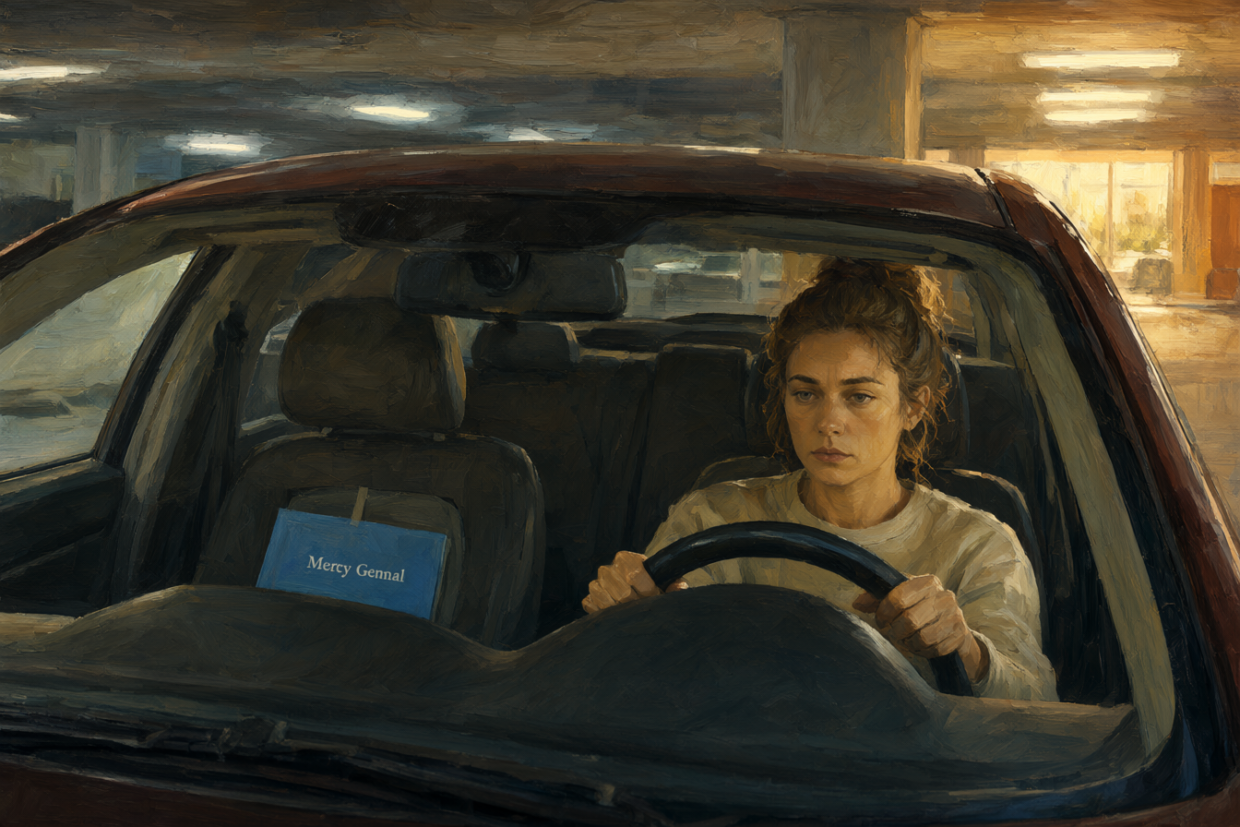
Even when the temperature gauge reads 89 degrees and the grocery store was just a lie to keep the truth at bay.
The end