If cardinal, fixed, and mutable keep getting mixed up in your astrology notes, a simple sorting exercise can help you learn which signs belong together. This free printable zodiac signs modalities worksheet gives you a place to practice all twelve signs, with a separate answer key to check when you are ready.
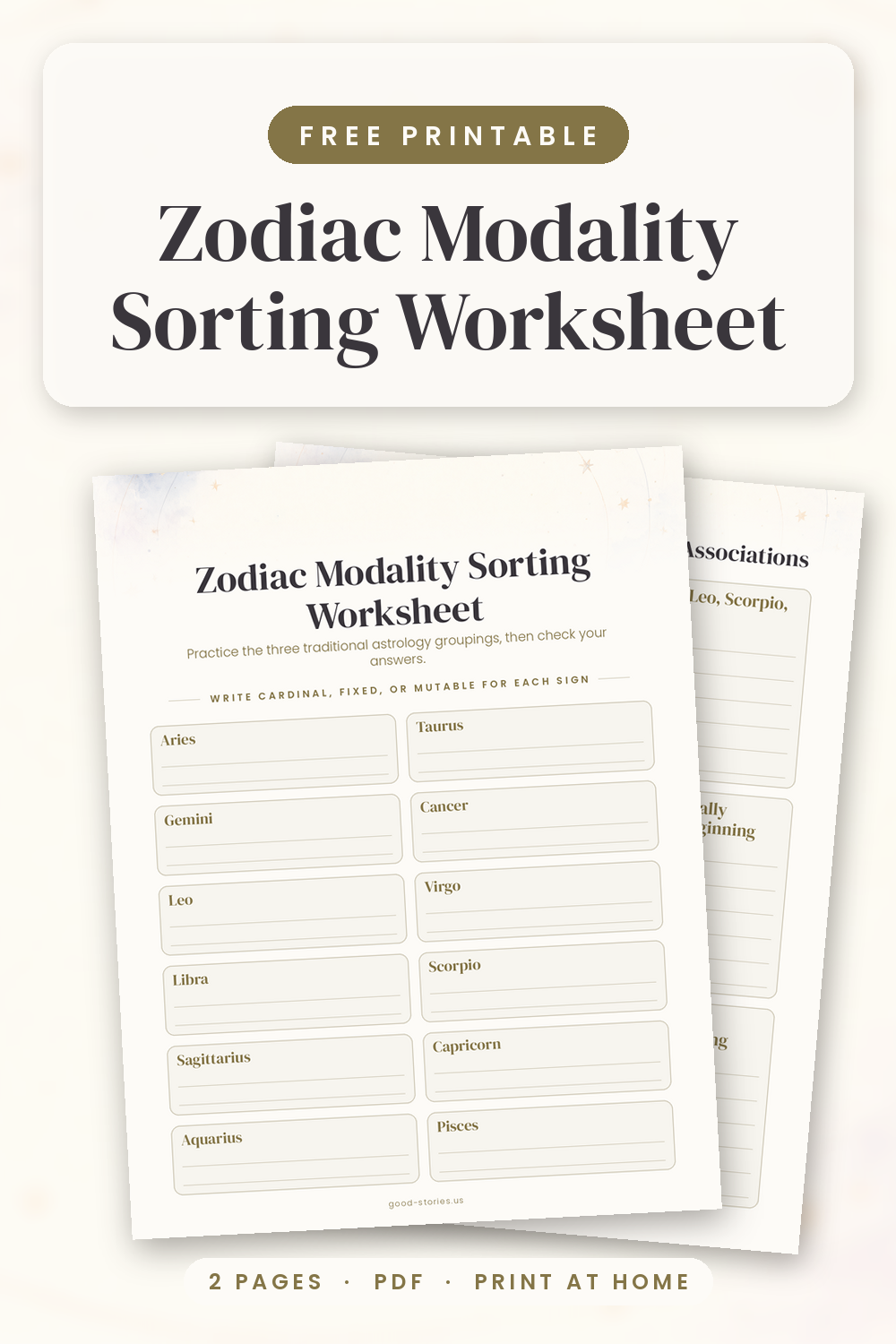
What’s inside the printable
The PDF contains two US Letter pages. Keep them together for reference, or set the second page aside while you complete the exercise. Here is exactly what you will find:
- Page 1: Twelve labeled writing boxes, one per zodiac sign, for recording its modality.
- Page 2: The complete answer key in three boxes and three traditional association boxes with space for notes.
The first page is your practice space; the second gives you the groupings and brief association notes. You can use the same pair of pages for a first attempt, a quick review, or a conversation with someone who is also learning astrology.
What modalities mean in traditional astrology
Modalities are three traditional astrology groupings: cardinal, fixed, and mutable. Each zodiac sign belongs to one of these groups. Learning the categories gives you a manageable way to organize twelve sign names into three sets of four.
Treat this as learning a symbolic framework for reflection rather than a method of prediction. A modality label does not establish how someone will behave, what they can achieve, or what will happen next. You can explore the vocabulary without using it to make decisions about another person.
For this worksheet, keep the task narrow: recognize each sign and recall its group. You do not need birth details or a chart to complete the sorting exercise. Start with the names on the page and build familiarity one group at a time.
Learn the cardinal, fixed, and mutable sign groups
Read these three groups slowly before you try the worksheet. Saying the names aloud or copying each group into your own notes can make the lists easier to revisit.
- Cardinal: Aries, Cancer, Libra, Capricorn.
- Fixed: Taurus, Leo, Scorpio, Aquarius.
- Mutable: Gemini, Virgo, Sagittarius, Pisces.
Notice that each list contains four signs. That gives you a useful checking habit: after sorting all twelve, count how many times you wrote each modality. Four entries in each group is a helpful consistency check, although the answer key is still needed to confirm that each individual sign is correct.
If one group feels unfamiliar, practice that group on its own before returning to the full page. There is no need to memorize every name in a single sitting. A short review that you understand is more useful than rushing through a list.
Try the twelve-sign sorting exercise before checking
Place the exercise page in front of you and turn the answer key face down. Write cardinal, fixed, or mutable in the labeled box for each sign. If you cannot remember one, leave it blank for a moment and continue with the signs you recognize.
Once you have made a first pass, return to the empty boxes. Try recalling the complete group rather than guessing from a sign’s reputation. For example, remembering the cardinal list gives you four answers at once. The goal is to learn the grouping, so you can also choose to consult your notes during an early practice round.
Then compare your answers with page two. Correct any mix-ups and read the relevant group again. You might use a different pencil mark beside the signs you want to review later. The worksheet is a learning aid, so an uncertain answer simply shows you where another brief practice session could help.
Use beginning, sustaining, and adapting as symbolic cues
Traditional astrology associates cardinal with beginning, fixed with sustaining, and mutable with adapting. These three words can serve as memory cues alongside the sign lists. They describe symbolic associations within astrology, not fixed personality rules.
In the notes space on the answer-key page, you could write a familiar example of each idea: starting a project, continuing a routine, or adjusting a plan. These everyday examples help distinguish the words without claiming that a particular sign must act in a particular way.
Avoid turning the associations into judgments such as assuming someone cannot change because their sign is fixed. People are more complex than a category. If you use the ideas for personal reflection, keep the questions open: when do you find it easy to begin, keep going, or adapt?
How to use your printable
Print the PDF on US Letter paper. If you are printing on A4, choose “Fit to page” in your print settings so the worksheet fits the paper. Check the print preview before printing both pages, especially if your printer uses a different default paper size.
Use page one for a quiet study session and keep page two nearby as a reference. You can also work through the signs with a friend, compare your attempts, and then check the answer key together. Keep any discussion focused on learning the categories and exploring their traditional meanings.
For another practice round, print a fresh exercise page and try sorting the signs again before opening your notes. Save the PDF somewhere easy to find so you can return whenever the three groups need a refresher.
Take your time with the lists and let the answer key support your learning. With the two pages beside you, you have a simple way to practice the zodiac modalities and revisit their symbolic associations whenever you like.