On a night when the stage kept redefining what it could hold—voices, machines, mischief, and a sudden downpour of gold—America’s Got Talent proved why it remains TV’s most unpredictable showcase. The episode swung between pure heart and joyful chaos, with acts built on grit, community, and the kind of ambition that either soars or explodes on contact. Both happened—sometimes in the same minute.
A dream in a first language—and a second home
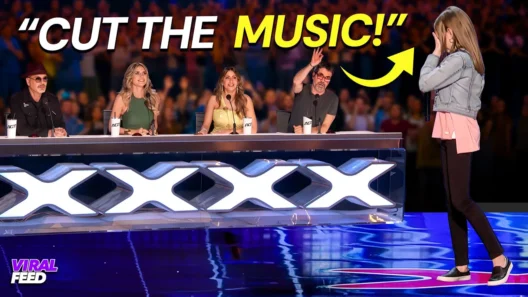
She walked onstage shaking, whispering to no one in particular that it felt unreal. “I’m 17 years old,” she said. Then, almost as if apologizing for her nerves: “I’m from Spain.” This was Betty’s first time in America, her brother cheering from the wings. “I am so nervous right now,” she admitted. “I’ve been always watching this show and dreaming one day I could be here.”
What followed was that rare audition where the room seems to inhale and hold it. Betty sang with a tone that was both glass-clear and stormy with feeling, flipping between English and Spanish without losing a thread. When she finished, her hands came up to her face like she could hide inside that joy.
The judges were quick and unanimous. “To me, you have one of those recorded voices,” one said. “If I was to hear you on the radio, I would know it was you immediately.” Another called her sound “very unique… kinda like Halsey and Adele all rolled into one.” Simon took a long look and said what the whole room felt: “You’re 17… you’re nervous, and then you kinda gave us, like, a masterclass of how to sing a song. And you’re not copying people. You’ve just got your own thing going.”
Backstage afterward, she rambled out the kind of gratitude that makes you believe in the work behind it. “This has been my dream for, like, my whole life. I can’t believe that I’m here,” she said, shaking her head. “Those things they said to me… they’re gonna stay in my heart forever.”
Bay Area blueprints: when a hometown builds a stage
Then came a surge of hometown pride. “I’m LaRussell from Vallejo, California,” the next headliner said, waving a hand at a bustling posse. He’d brought “Bay Area kids that look like me and feel like me and sound like me” to share the moment. Offstage, he talked about early mornings at UPS and nights spent turning a backyard into a music platform when no labels were calling. “What we was doing at home… is so special and necessary,” he said. “Every time we get on the stage, we get to kinda lighten that load.”
Their performance was loud with color and crisscrossing skill. It wasn’t perfectly tight—how could it be, with so many moving parts and people?—but it radiated why they came. “What is there not to like?” a judge laughed. “The energy, the outfits, the song. I loved it.” Another was blunt: “It wasn’t the best audition. It wasn’t perfect. But you know what? You’ve got real camaraderie… you all seem like friends and family.” Simon heard the mission in it. “What you’ve done, which is hard, is to bring all ages together, all with individual talents. Every one of you pops, but then together, you became as one. That’s exactly the kind of act I was praying would come on the show this year.” The panel rolled out the yeses, with Howie, Mel, and Sofia all greenlighting the crew. Community—messy, musical, honest—moved on.
When a sign becomes a sword—and then a no
Some auditions live or die by eccentricity. “I work in marketing for my family’s business,” said a young man named Ryan before launching into a kinetic routine with a sign that whirled like a boomerang and blurred like a propeller. “I don’t know what it’s called,” one judge admitted mid-giggle, “but it was nuts… ridiculous, and I really liked it.” Another cracked, “It was like something on New Year’s Eve that someone’s drunk a bottle of tequila… a mad fight with themselves.” The panel split: a single yes against a pair of noes, and then the final nail. Fun, they agreed, but not a million-dollar act. Ryan grinned good-naturedly, tipped his sign, and exited to the kind of applause that whispers keep going even when a door closes.
Terry Crews becomes a human domino
And then the stage turned into a science experiment with a heartbeat. “This is a chain reaction machine,” said Steve Price, alongside his partner Mark Robbins. They’d spent a week living inside this build—“twelve, fourteen hour days”—and somehow convinced Terry Crews to be part of the first push. “It just takes one thing to go wrong,” a voice warned as the crew cinched harnesses and steadied fulcrums. “Placed wrong, and they are screwed.”
Countdown. Silence. Release. A pendulum whispered into motion. Marbles became cue balls became seesaws. “Here comes the hot dog,” someone muttered as a frankfurter-on-a-stick knocked a bell that startled Terry into his next beat. The wheel wobbled. The crowd gasped. For a heartbeat the mechanism lost steam—“He’s, like, losing momentum”—and then, miraculously, it found its breath again. A whistle pinged. A banner popped. The last flourish clicked into place, and the arena let go in a roar.
The critique turned into a small play. “I can tell that that was so much work,” Sofia said. “I would have liked a little bit of commentary so I could follow along.” Simon arched an eyebrow. “If you’re above the age of four, you could understand it.” And then, almost as if in rebuttal to the universe of gravity, he called it “brilliant… so clever,” adding, “I think people are gonna love watching this.” A yes from him, a no from Mel. The vote teetered as surely as their levers had. Regardless, the point was made: sometimes the stage is a clock you build so we can feel time.
Comedy, chaos, and the new look roast
Between big swings, the episode flirted with absolute silliness, and it was glorious. One comic marched out with a single mission: roast. Simon’s new look did not escape unscathed, earning the kind of zingers that make a man smirk, fold his arms, and pretend not to enjoy it. Elsewhere, a hapless storyteller detailed “boat or fish?” confusion that somehow ended with a wrong restroom and a sprint for dignity. The punchline hit because everyone’s been there, ashamed and laughing at the same time.
Then came a flub so honest it belonged in the sitcom hall of fame: “Fetch Sofia… Viagra?! I meant Vergara!” The panel fell apart; Simon buried a grin in his hand. The recovery was as funny as the mistake, and the audience rewarded the save like a triple axel landed after a wobble. Another comic swore he was “not getting on a school bus sober,” a line that detonated with parents who’ve stared down dawn carpools and stale Cheerios. One whirlwind impressionist flickered between “Barbara, Natalie, Miley—one woman” in a blur of voices and attitude. Even Simon conceded he was “not grumpy, just brutally honest,” which only made the jokes land cleaner. Comedy owned the middle of the night; every tag found an echo.
“Music, start.” And then: very slowly
Akira shuffled on with a lifetime of hunger tucked behind a small smile. “I love Hollywood… heroes, stars,” he’d said earlier. His parents wanted the usual path; he wanted this. “I am so honored to be here.” He kept his act a surprise, deflecting a volley of pre-show questions with cheerful patience. Finally, he bowed. “This is never shown show. Music, start.”
There’s a particular joy in watching someone turn time into a joke. A balloon. A prop. A whisper. “Slowly,” he commanded—in his own tempo—drawling the syllables until the audience took the joke and begged for more, “More slowly. Okay. Okay.” By the time the bit hit its final snap, the crowd was doubled over. “You are really, really funny. I love you,” one judge told him. “This is what AGT is all about,” Simon added, delighted. The vote split only once; Akira walked away with a pocket full of yeses and a calling card that said patience can be punchline if the performer sells it with his entire being.
The soldier who sang—and the room that stood
Late in the hour, a voice from the wings floated in before the man did. “My name is Isaac Atkins,” he said when he reached his mark. “I’m 23… from Lewiston, Maine. And I’m a sergeant in the U.S. Army.” Simon paused, hearing something familiar in the tone. The setup ended there. The rest was song.
The performance was clean and steady, the kind of vocal that rescues a lyric from cliché and gives it back its blood. Halfway through, the crowd stopped being an audience and became witnesses. When it ended, there was that charged beat you only get a few times a season. Brothers-in-arms on the stage and off found one another in the noise. And then the moment broke like thunder: the Golden Buzzer. Confetti fell in sheets; a judge shouted that singular promise: “We will see you in the live shows.” A fellow service member clapped him into a hug so big it looked like it could carry him all the way to the quarterfinals. Whatever happens next, that scene clicks into the show’s highlight reel: bravery meeting opportunity and recognizing itself.
Magic inches from the bell
Magic made a case for Vegas with a routine that threaded itself through the judges’ desk like contraband delight. Cards didn’t just change; they confessed. Objects didn’t just vanish; they arranged themselves into answers no one saw coming. “That’s a 10,” a judge cried out, then corrected himself, “No—that’s an 11.” The ovation was swift, the verdict swifter. “It was spectacular—four yeses.” Even the magicians looked a little shocked, as if the trick had saved one last surprise for them, too.
Elsewhere, an industrial-strength stunt had everyone eyeing the gold-trimmed safety button. Events escalated; the nerves did, too. A hush fell as a producer’s hand hovered. “Press the golden emergency stop button,” someone urged when one apparatus lurched a degree off safe. The pause was brief, the relief loud. It didn’t make the highlight reel because of disaster; it made it because the show’s steel spine is paired with a conscience. Thrills matter; so does going home in one piece.
Dance like you brought a city with you
There was a troupe so large it felt like a pop-up metropolis. “How many of you are there?” a judge laughed. “Twenty-three?” The crowd whooped just hearing the number. Their group name pinballed between members as if the right answer depended on whoever was closest to a mic. “Come here,” the panel waved, beckoning their leader to the fore. The performance was hydraulic—formations slammed into place, lines snapped like slingshots, and solos flashed without derailing the group. The power was less in their synchronization than in their ability to let individuals spark and then rejoin the current. The verdict was celebratory; the night added one more thing it does very well: turn a crowd into a choir.
When honesty cuts, and why it heals
It wouldn’t be AGT without a handful of critiques sharp enough to sting and smart enough to help. “I could see you two working together,” Simon told one duo before teeing up a withering image: a New Year’s tequila bender turning into a wrestling match with yourself. He wasn’t wrong; it was both hilarious and true. Another artist, workmanlike and eager, got a blunt thumbs-down. The room winced for him and clapped anyway. As the night unfurled, Simon summarized his role in the rhythm: “I’m not grumpy, just brutally honest.” Coming from a judge who seconds earlier had told a machine-art team that anyone “above the age of four” could follow their plot, it registered as both warning and welcome. Honesty held the guardrails while the acts took the curves too fast on purpose.
One line that hung in the rafters
Somewhere between a drumbeat and a charge, one piece drew a line in the air you could see from the cheap seats: choose courage over quiet. It landed as a lyric and as a dare—“You’d choose violence over silence every time”—which here didn’t mean harm so much as refusal. Refusal to accept the script you’re handed. Refusal to lower your volume if your truth is loud. Whether in dance or spoken word, the sentiment fit the hour. Every audition on this night said a version of the same thing: speak up with what you’ve built.
A note on translation, and its punchline
It turns out the easiest way to break a room is to mangle a language and act surprised you did it. A comic leaned into that tension with a simple confession—“I can’t speak Spanish”—and then cracked it open with a twist that had bilinguals barking, “What?!” The humor didn’t pick a side; it shared the laugh. It paired neatly with Akira’s proud slow-play and with Betty’s bilingual ballad. The night kept saying the same thing: the border between languages doesn’t divide audiences. It hands them a bigger dance floor.
The way a crowd becomes a character
Even the audience got its close-up. Midway through, the cameras caught Simon turning from his chair to address the rafters. “This is my favorite audience,” he said. Then, with a grin: “Stay safe. You’re also alive.” It was an odd beat, a little meta, and exactly right. If the performers are the paint, the room is the canvas. Without that electricity, the experiments, big notes, and good-natured disasters don’t catch fire.
What we carry out of a wild night
What stuck, walking away, wasn’t a single discipline winning the night. It was how much risk fits inside a couple of hours when people come ready to be brave. A teenager crossed an ocean to hear strangers call her voice unmistakable. A community organizer from Vallejo lugged his city onto the stage so kids who never get the mic could learn what it feels like to be heard. Tinkerers turned physics into theater and asked the host to leap first. A comedian flubbed a name so hard it became immortal. A magician bent distance until it felt like we were all sitting at the same small table. A soldier sang, and the room stood tall while the sky rained gold.
Not everything worked. It never does. Some bits were beautiful messes; some machines stalled before their final click. But the count wasn’t the point. The room cheered as loudly for noes as for yeses because the project is bigger than a vote. It’s the practice of taking your shot while the lights are hot and your hands shake.
Betty said it best without meaning to, eyes wet, voice small and sure: “It’s not real.” It is, though. It’s as real as the countless hours tucked inside a two-minute set, as real as the brother who buys a plane ticket so you won’t be alone, as real as the crew who spends fourteen-hour days building a machine they can’t guarantee will work. It’s as real as a Golden Buzzer’s promise: not that you’ve arrived, but that you’ve been invited to try harder, louder, riskier, now that everyone’s watching.
And there’s more coming. The live shows are calling. If you want to feel the rush of that gold, the click of that wheel, and the run of a joke that nearly trips and then flies, watch the full episode. The best part of this season’s wild ride is that it’s only getting faster.