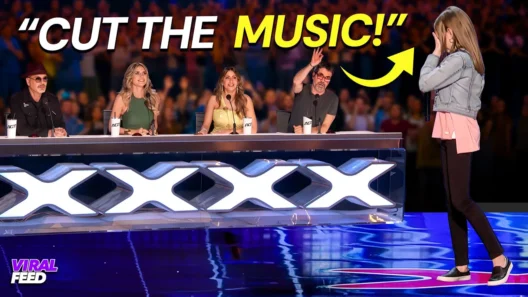
Every now and then a talent show stops being a contest and turns into a study of what the human voice can do. Not just the big note or the tidy joke, but the impossible: turning breath into drums, a nursery rhyme into a stadium anthem, or a whisper of courage into a life-changing moment. This video gathers those times when judges, hosts and crowds said, out loud, that they had never seen anything like it—and you believe them.
Freestyling a life in a minute
The night opens with a new American, a veteran of Manchester rain and now of U.S. paperwork. ‘A couple of months ago, I actually got my American citizenship,’ says Chris Turner, 35, grinning as he waves a tiny flag. He is not here to sing a ballad. ‘I am a freestyle rapper,’ he announces, promising to rap on five wild suggestions he’s never prepared.
He gets them: empanadas (‘Meat,’ a judge deadpans, when asked for a favorite filling), ‘sparkly pants,’ Howie Mandel’s ‘belly button’ (an ‘innie’), and then Simon Cowell, in the driest register possible: ‘I like my papayas ripe and juicy.’ Terry Crews ups the ante from the wings: ‘Quantum physics.’ Turner laughs. ‘I wish I hadn’t asked Terry now.’
The beat drops and he spins a map of the room into rhyme: lint in belly buttons, unders versus trousers, particle waves and ‘the cat’—Schrödinger by any other name—before sailing back to the fruit aisle where, in his telling, Simon shops for ‘ripe and juicy’ papayas. When the cheering fades, Simon boils it down: ‘It was original, and that’s what we love on this show.’ The panel piles on yeses.
From likes to live, and a spider that raps
Vincent Marcus arrives as a creation of the internet and admits it: ‘I do social media.’ But this is his first time in front of a real audience. His act is a daring choice—impressions of famous rappers, but set to ‘The Itsy Bitsy Spider.’ It shouldn’t work. It does. It’s buoyant and tight, and more important, it fills the room with that hum that only happens when the crowd recognizes a voice and laughs together at how spot-on it is.
After the applause, the judges say what a comment section never can. ‘Isn’t that nice to get actual feedback instead of just likes?’ one asks. Howie Mandel, high on the live-wire energy, tells him, ‘I think your life is gonna change because you are an amazing live performer.’ When the formalities end, the verdict is simple: ‘You have four yeses.’
One man, full orchestra
Then comes a quiet Frenchman with a stage name like a code: MB14. He explains the premise in a single line—’All you’re about to hear is made with my voice’—and presses go. What follows is a piece of living architecture: kick drum from a plosive, snare from the palate, bass from a hum, lead from a whistle, all looped and stacked until it sounds like a club, a movie chase, a rooftop at 3 a.m. The judges don’t move much; they listen.
When it ends, the reaction is less scream and more surrender. ‘Literally, I was hypnotized by your music,’ one says. ‘We’ve never had anyone like you on the show,’ another adds, and then the verdict that feels both obvious and hard-won: ‘This was phenomenal. Seriously phenomenal.’
The audience becomes the act
Not every vocal astonishment comes from a single throat. Astrid, a choir director from Australia, beams at the sea of faces and suggests something radical for an audition: ‘I think I might run the biggest choir in the world.’ She splits the house into sections by range: ‘High voices, you are going to sing blue… Voices in the middle, you’re going to sing green… Voices that are low, you are going to sing red.’ Then she grins: ‘Be brave. You are the act.’
The room becomes a living chord. Pockets of melody rise and fall as strangers figure out how their notes fit. It is messy, communal, and charming. The judges divide. ‘I loved it. I think that the world loves a sing along,’ says Howie. Sofia enjoys the moment but wonders, ‘I don’t see where it could get better… I don’t think it’s for AGT.’ Mel B is blunt: ‘This is your audition, not their audition.’
Simon sees something else entirely. ‘I’m really, really, really, really gonna disagree,’ he says. ‘Within about twenty seconds, every single person in this audience was singing the song… to allow the audience to win the show is brilliant.’ Where others saw a risk, he saw a conductor turning a theater into a choir—and proving that leadership can be a kind of voice, too.
Opera, impressions, and Siri sings the rainbow
Marissa Beddoes strides out with opera training and a plan to show how elastic a voice can be. ‘This die has six of some of my most favorite impressions that I do on it,’ she tells Heidi Klum, proposing a game. She starts ‘Somewhere Over the Rainbow’ in her own tone—pure, warm, grounded—then flips into pin-point impressions on cue, including a deadpan digital twist: ‘Siri?’ A monotone chimes in, clipped and dry: ‘Birds fly over the rainbow. Why then a y can’t I?’
The judges hear more than gimmickry. ‘Even before you started doing the impressions, you’re a very good singer,’ one says. Another calls her approach ‘original in the way you wanna present your impressions musically.’ The panel sees show business in it, too: ‘There is a gigantic gap in the market right now for somebody like this.’ The votes go the way the smiles do.
The shy kid, the bunny, and the switch that changes a life
Sometimes voice is not just sound, but character, heart, and nerve. A teenager named Darcy Lynn walks on with a fuzzy white bunny. ‘My name’s Tatunia,’ the puppet chirps through a pair of button eyes. The room laughs when they learn the bunny will sing. Then the bunny does, and the laughter turns into something else. The notes are steady and bright, the patter is quick, and the illusion holds: it truly feels like two performers, one human, one rabbit, both alive.
After the song, the adults struggle to explain what they just felt. ‘I believe that that rabbit is a real separate person,’ one judge says, marveling at the nuance. Another tells her, ‘You just changed your life tonight, young lady.’ Darcy admits why she started. ‘I used to be really shy, and I asked my mom for a puppet to help me.’ The reply from behind the desk is both prediction and blessing: ‘I’m gonna remember you in a week, in a month, in a year.’ Then comes the confetti moment words: ‘You are going straight to the live show.’ In one breath, voice became courage made visible.
Comedy, too, when the voice tells the truth
This collection doesn’t forget the comics, who bend voice into confession and complaint. One deadpans the kind of line that hits because it’s delivered like a secret you’re not supposed to say out loud: ‘You know what amazes me most about kids? How easy it is to make one.’ He tags it with a shrug of humility: ‘I can’t even put together a TV stand from IKEA.’ Another launches a consumer rant that has lived in many minds and few microphones: ‘$65 for one bra? What does it do?’
Stand-up is its own music—setups and punch lines, tone and timing, the way a single pause can make an arena lean forward. In a night of musical miracles, these bits remind you that clarity can shock, too. A true joke lands because the voice behind it is honest.
Why these moments stick
What ties all of this together is not just range, or even technical skill. It’s the feeling that the human voice, when pushed, can redraw the room in an instant. Chris Turner shows how words themselves can dance—how ‘papayas’ can share a verse with ‘quantum physics’ and still make sense. Vincent Marcus proves a nursery rhyme can carry the swagger of radio hits if the vocal DNA is right. MB14 turns lungs into a studio, sound by sound, until you forget you’re hearing only breath and bone.
Astrid flips the spotlight and invites a thousand people to find harmony together, reminding us that singing is a social act first. Marissa slides from aria to algorithm and back, mapping the line where technique meets play. And Darcy Lynn shows that voice is also character—one hand on a puppet, the other on your heart strings, and somehow a second presence appears, sings, argues, and winks.
The judges’ words carry extra weight because they are reacting in real time to the same surprise the audience feels. ‘It was original, and that’s what we love on this show,’ Simon says after the freestyle. ‘You are original, super talented, funny,’ he tells the impressionist. ‘We’ve never had anyone like you on the show,’ they marvel at the loop artist. And about the kid with the bunny: ‘You just changed your life tonight.’
In each case, the same truth keeps surfacing: the voice is more than sound. It’s a tool set, a story, a way of gathering people into the same moment. Whether it’s a whispered cue—’Be brave. You are the act’—or a belted money note, or the dry robotic chirp of ‘Siri,’ the right vocal choice can make an arena feel small and close, like a campfire.
That’s why these auditions live on. You don’t have to remember every lyric or setup to recall how they made you feel: hypnotized, delighted, a little stunned that something so simple—a breath turned into music—could feel that new. And that is the promise of this video: a guided tour of voices doing what we thought only machines, choirs, or cartoons could do. Press play and listen. Then ask yourself what your own voice might be capable of if you gave it the mic.