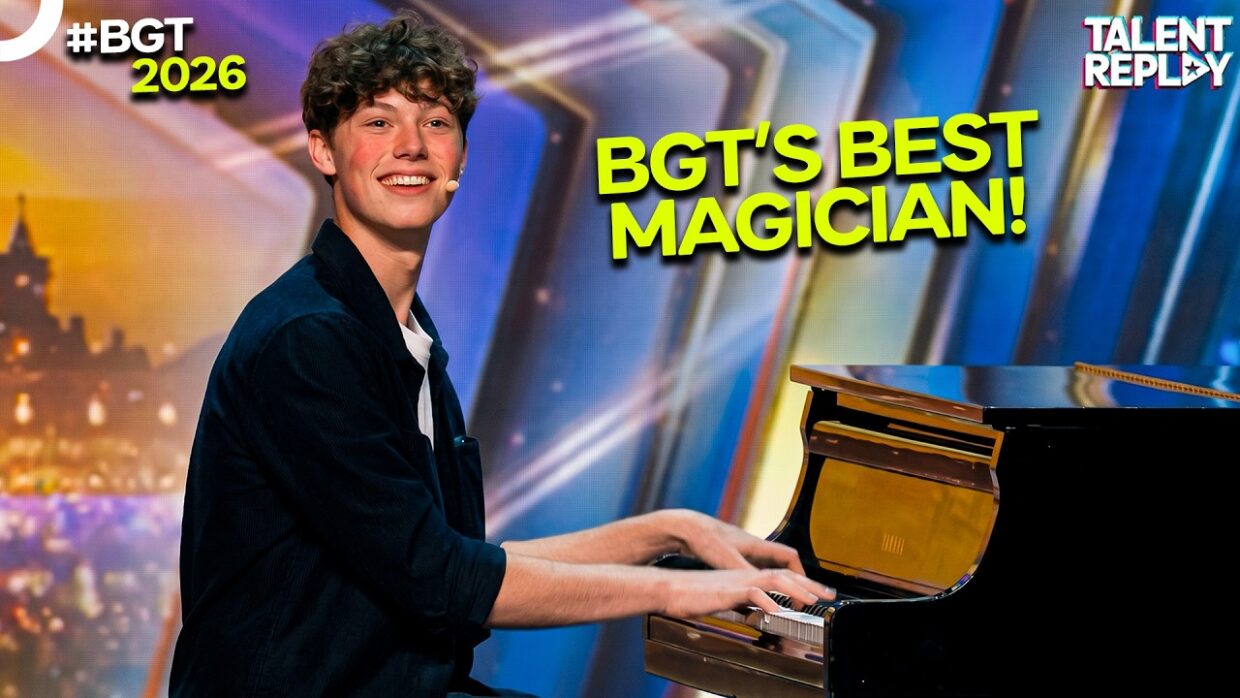
He walked on waving like a kid greeting neighbors, not a contender staring down a live television crowd. “I’m Rafferty Coop,” he said, smiling at the judges who were already smiling back. Sixteen then, six‑foot‑four and unmissable, he made his pitch simple: two passions, music and magic. The promise felt sweet and a bit audacious—until he proved it could lift a room.
Rafferty’s idea is part science claim, part showman’s dare: if music can travel through solid objects, could we see it? He asked Simon to hold out a hand and made sound feel tangible—something passing where it shouldn’t, something impossible happening right in front of us. The crowd laughed, then leaned in. A beat ticked. A silence snapped. He shattered a lull and—somehow—a glass. The rhythm gagged, then galloped.
“Rhythm is everything,” he told the judges, shaking a bright red egg shaker with the swagger of a studio pro. Rhythm was also misdirection: a moment later the shaker was gone, and when he poured into a water glass, an egg yolk drifted down like the punchline to a music theory joke.
Then he turned to a piano and a deck of cards. “There are 13 cards in a suit and 13 notes in an octave,” he said, grinning at KSI. Pick a pile. Read the values. Ace, three, five, eight, ten… queen. On the keys, Rafferty hit each as if they belonged together, which they did. The random sequence bloomed into a melody every pub and stadium knows by heart. Heads shot up. Someone mouthed it before anyone dared say it. Journey’s anthem arrived via playing cards and nerve. The room recognized itself in the tune and roared.
He wasn’t finished. On the backs of those very cards were letters. KSI began to turn them. The table turned, too—from a pile of numbers to a message the whole theater could read. It was cheeky, brilliant, and more than a little baffling. The callback landed: the song we’d all just heard was literally spelled out, a choir formed of cardboard and craft.
The celebration was instant. Confetti fluttered down like an early summer. Judges laughed and covered their faces, the way adults do when childlike wonder sneaks up on them. Compliments rained as fast as the gold.
“That was incredible,” one said. “You’re a bright light.”
That first night, his charm felt like the trick beneath all the tricks. He was funny. He was quick. More importantly, he had a thesis and kept proving it: music can make magic visible.
Back for a Live Crucible
Months later, he came back older by a year and tenfold in presence. “I’ve got this,” he confessed before performing. “Not because I believe it… but if you imagine you believe it, then you eventually do.” It was the kind of line that tells you what the show means to a person: not only a stage, but a mirror.
He began with the sound of nothing. “Music doesn’t start with sound,” he said. “It starts with silence.” A beat surfaced from his fingertips. A pattern formed. Bass thickened the air; harmony braided it. The stage, suddenly, felt like a studio we’d been invited inside.
Then the tempo shifted from studio to street. Each judge tapped a card from a shuffled spread and left it facedown on the table. Rafferty handed KSI a watch, face pressed to his palm. “Turn the dial as much as you want. Stop whenever.” Meanwhile, Amanda named a number between one and twelve. “Nine,” she said. Alicia gave the minutes. “Forty‑seven.” A time existed where none had a breath earlier. When Rafferty lifted the watch, the room saw the face: 9:47.
He pivoted to Simon with a list on a phone—one hundred favorite songs, all different, all there. Amanda’s nine plus Alicia’s forty‑seven made fifty‑six. Simon scrolled, found No. 56, and kept the title to himself. The phone went facedown. The audience, one beat behind, felt itself step into silence again—this time the delicious kind, the silence before a reveal.
Building a Hit from Thin Air
Three loop pedals blinked like runway lights. Rafferty asked Simon to focus on the drums in the secret song. He beatboxed a dry kick and snare, layered hi‑hats, caught the loop. “Hear it in your head. Feel it,” he urged. A bassline slid in, rubbery and right. Chords chimed. Then the melody—first as a hum, then as a shape on the keys, with Amanda smiling and, on his cue, “singing it in your head” with him. At the crest he pointed at Simon and called the title out loud: “Don’t Stop Me Now.”
The theater burst into the chorus as if someone had uncorked a bottle of Friday night. You didn’t need cameras to tell you how wide the grins were; you could hear it in the clapping, that involuntary rhythm a room makes when it knows a song by heart. And then, as the echo thinned, he added the last switch: “Who is ‘Don’t Stop Me Now’ by?” Simon answered automatically—“Queen”—and the judges flipped those earlier, untouched cards. Together they spelled the name back at him like a signature.
“You are special, bro,” KSI told him, still half‑laughing at the audacity.
“You’re exuberant and joyful,” Alicia added. “A shining light.”
Simon, as ever, kept a pin for balloons. “Didn’t love the singing,” he quipped—then conceded the point that mattered. Live, under pressure, this kid was not just holding his own; he was setting the tone. “As it stands, you are gonna make it through to the final,” he said, sounding like a man who understood momentum when he heard it.
The Ring, the Shoe, the Shoelace
In another sequence that felt like a street‑corner miracle smuggled into primetime, Rafferty borrowed a ring. It vanished in a breath, reappeared where no one was looking—planted brazenly under his own shoe. Laughter met disbelief as he tipped the mystery on its head again, threading the same ring onto a shoelace in a knot only a prankster or a prodigy would think to tie mid‑show. The trick wasn’t just about dexterity; it was about comic timing, a running theme in his work. He likes to let you think you’ve caught up, then moves the goalposts one step further back toward wonder.
What makes his act feel fresh isn’t that the effects are new to magic; it’s the way he scores them. Beats become misdirection. Harmony becomes a red herring. Melodies arrive like punch lines you didn’t know had been set up five minutes earlier. By the time a revelation lands—on a screen, a card back, a watch face—you realize you’ve been listening for the solution while he’s been showing it to you in plain sight.
A Theater That Wanted to Believe
Part of the pleasure of watching Rafferty perform is watching his belief win over the room. He never hides the nerves; he narrates them. “I still get nervous,” he admitted. “But if you imagine you believe it, then you eventually do.” The crowd met that honesty with something rare in talent television: patience. He used it to build, not stall, and when he asked them to feel the beat, they did. When he asked them to listen harder, they did that too.
After the live set, the judges lined up their verdicts like spotlights.
“I love how passionate you are,” Amanda said. “It kept it light. It kept it fun.”
“You’re a lovely boy,” Alicia told him. “A shining light on that stage.”
KSI, grinning: “To this day, I still don’t know how you do any of it… but, my god, you are special.”
Even the critique—about a melody line sung a hair too earnestly—worked like a compliment in disguise. Live shows are where polish and personality have to fuse. Rafferty’s polish is the machinery of the loops and sleights. His personality is the grin he can’t quite repress, the way he taps a table like a snare when he thinks no one’s watching, the way he turns a trick into a shared joke rather than a secret held over an audience.
He Said He Had It. He Did.
When the host called his name as the night’s winner, Rafferty didn’t try to be cool about it. He yelled, he hugged, he told the room what it had already guessed: “I am literally living a dream right now.” He thanked the mentors, the show, the viewers. Most of all, he thanked his family, the ones who cheered loud enough to be heard from the stage months earlier. Relief loosened his shoulders; joy did the rest.
What lingers isn’t any single method. It’s a worldview. Rafferty believes music and magic are a “universal language” that “connects us in the moments that truly matter.” On this stage, that sounds less like a slogan and more like a working theory. Notes can organize chaos. Rhythm can focus attention. A well‑timed chord can make a stadium sing, or a coin vanish, or a teenager stand a few inches taller than six‑foot‑four.
He knows, too, what audiences come for. They want to see something they can’t explain. They want to feel like kids again, finding the beat and then losing track of it on purpose. Rafferty’s show gave them that, and then gave them permission to sing along.
Next up is the final, where the tricks get bigger and the margins get smaller. If his semifinal was any indication, he’ll try something bolder, riskier, and more musical—because that’s his lane. Watch the video to see the full arc, from the first grin to the last chord. Listen for the beat he asks you to feel. And when the chorus hits, don’t be surprised if you find yourself clapping on two and four, smiling like you’ve believed this all along.