America’s Got Talent has always promised the unlikely: ordinary introductions that bloom into scenes you can’t quite explain. This showcase delivers on that promise again and again, trading in surprise, precision, and the thrill that only live risk can conjure. Across countries and seasons, artists step into the spotlight with an audacity that makes judges gasp, audiences lean forward, and the rest of us recalibrate what’s possible on a television stage.
Dancers, Drones, and a Different Planet
The opening surprise arrives from Japan with a declaration of purpose that’s both simple and sweeping: they came, as they say, “to share our performance with all of America.” The lights drop, the music swells, and a constellation of drones threads the air above a circle of dancers. The machines aren’t props; they’re partners—gliding, hovering, sketching invisible architecture as the performers below move with cool, sharp grace.
When the lights return, the panel is still catching up to what just flashed by. Simon Cowell calls it “really, really smart,” adding, “this is so current… this could be incredible going forward.” Heidi Klum admits the act sent her someplace else entirely:
“I just thought I was on a different planet. I kinda zoned out, forgot about everything, and just watched you beautiful girls dance under these drones.”
The moment is more than a technical flex. It’s a reminder that innovation isn’t cold; when choreographers fuse code with choreography, the result can feel alive—breathing, pulsing, and emotionally direct.
Choose Your Destination: A Stage Becomes a World
Two creators step forward next with a playful proposition. A calm, computerized voice asks for a destination—“Forest”—then an avatar—“Wolf.” In seconds, the stage becomes a sandbox for impossible physics. A bow appears, an arrow sings forward, and a performer plunges into virtual water as if gravity’s been rewritten in real time.
When the lights come up, the performers finally introduce themselves: Constantin and Yuri. Judges scramble for words. Howie Mandel lands on the only description that fits:
“What you’re able to do with the technology and the amount of creativity that goes into that, that was amazing.”
It’s less an illusion than an invitation. For a few minutes, the theater behaves like a game engine; story, gesture, and software render a shared hallucination that feels startlingly tactile.
The Bar, the Fall, and the Return
Then comes fear—the honest kind. A trio wheels out a slender beam the width of a shoulder and introduces themselves as the Russian Bar Trio. The flyer, Christine, tells a story that halts the room: years ago she fell, “got hurt really bad,” and believed it was over. Now she’s back. No wires. No net. Only two partners and the thin line between triumph and disaster.
The jumps escalate. A hush deepens. You can hear the thud of landings through the music. And when it ends—clean, square, impossibly high—the panel exhales in unison.
“You could have broken your neck,” Simon says. “But it was more than a comeback. I mean, it was a triumph.”
In the safety-obsessed age of television, the performance feels almost subversive. The risk isn’t cosmetic—there’s no escape hatch—and that is precisely what makes the artistry land so hard.
Wheels of Grace
Unicircle Flow roll in next with a contradiction they proceed to solve: how do you make unicycles dance? The answer arrives in waves. Patterns weave, pivot, and fold; the stage becomes a pinwheel. There is a stumble—live pressure and gravity reminding everyone what’s at stake—but the recovery is instant, and the choreography blooms larger for it.
Heidi puts words to the surprise:
“You all move with such grace that half of the time I even forgot that you all were on unicycles.”
Simon is blunt about the alchemy of danger and beauty: the momentary fall “made it even more exciting,” proof of how difficult the act is. He points them toward Las Vegas, toward bigger spaces and higher stakes, where such singular craft belongs.
A Dance Built to Change the World
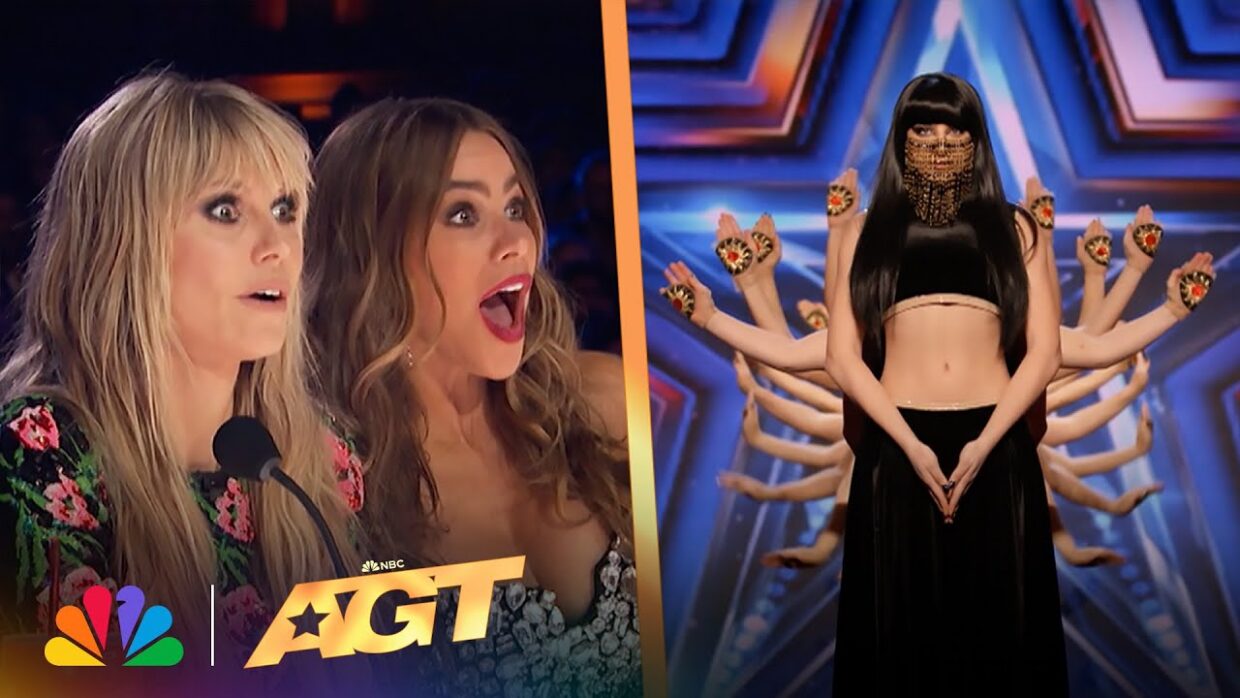
Then the stage quiets the way it does before a storm. A troop of women in black-and-gold patterns forms intricate shapes that breathe as one. Hands ripple, heads bow, and a single body appears to split into dozens. The effect is a living mural—then a serpent—then a storm. Every gesture is choreographed to the millimeter; every silence lands like a drum.
When it ends, the theater is not the same. Simon turns to host Terry Crews, voice tight with awe:
“Every single one of us in this room, I promise you, are gonna remember this moment… This is a performance that changes the world.”
Heidi doesn’t hedge. “I really think that you are Vegas ready. You don’t have to do anything else.” Howie finds language big enough for the feeling:
“Visually, audibly, and in every way is the best moment I have seen in AGT history.”
The group’s backstory—young women chasing a dream in the face of cultural limits—gives the precision a moral current. But onstage, the argument is purely artistic. Mastery, multiplied by unity, becomes a force you can’t talk over.
When Imagination Becomes Reality
Magic often lives or dies on presentation. Nicolas Ribs, a French magician with the calm of a watchmaker, builds his case with silence. He asks Terry Crews to “pick a card” and sign it. Then he lays the deck flat and lets images spill from a glowing surface as if the table itself were dreaming. The line between projection and object blurs. The card that should be lost is never lost. The impossible sits in plain view and asks you to explain it.
Heidi can’t. She doesn’t try:
“The combo of technology and reality is so mind blowing. It’s insane… Your skill set is beyond words.”
Sofia Vergara frames it as a pivot point for the genre: “You have brought a new style of magic to AGT.” And Simon, who admits he “forgot” Nicolas during auditions, corrects himself mid-sentence, laughing at his own mistake before landing on a verdict that’s both precise and rare:
“In terms of a live performance—magic—one of the best we’ve ever seen.”
The Village Magician Who Became a Pigeon
Another magician introduces himself with a shy smile. “My name is Hara,” he says, adding that he’s from a “very, very tiny village… in Japan.” What follows is a cascade of beauty so assured it feels like a dream guided by a gentle hand. Cloth becomes light. A suitcase opens into a storybook. And then—blink—you watch a man turn into a bird. Not suggested. Not allegorized. He is there, and then he is a pigeon, flapping across the air that everyone shares.
Howie, usually a skeptic, surprises himself:
“I wanna tell you how happy we are because that was just gorgeous… now I believe in magic? It was stunning.”
Heidi adds, “I feel like I’m already at your show in Vegas. It was that perfect.” Simon speaks for a theater of eyes that just saw the unseeable:
“The fact that you just turned into a pigeon in front of our eyes, that is unbelievable.”
If Nicolas makes the screen feel real, Hara makes reality feel like a screen.
Fashion at the Speed of Surprise
Some acts are puzzles; others are fireworks. Soss and Victoria arrive beaming like a couple who have practiced together for decades—which they have. “This year gonna be twenty years,” they say with pride. He designs the costumes. She wears them. Then, in a blur, he also removes them—only to reveal another, and another, and another. Colors pop. Patterns flip. Music punches each reveal with a wink.
“It keeps our relationship fresh, fun, and sexy,” they joke backstage, and onstage the chemistry sells it. “You really blew my mind,” the panel says. “It was quick, slick,” Simon adds, grinning that he “has no idea” how they did it, even as he ribs the dancing. The verdict is unmistakable: brilliant, baffling, and built for a crowd.
The Leopard Juggler Under a Rain of Light
Finally, a juggler pads out under the lights in a skin-tone suit patterned like a living sculpture. “I’m wearing a leopard,” he deadpans. “It’s actually clothes.” He grins, then gets to work—weight, breath, focus. Balls sketch arcs that seem to wait in the air for his hands to arrive. Then a new rhythm: from the rafters, more spheres drop on cue, as if the ceiling itself were a conspirator.
Heidi is on her feet. “It was a treat… I have no idea who is in our ceiling up there, but it was fantastic how these balls were just coming down.” The craft is old as the circus. The staging is entirely new, folding the building into the performance until architecture becomes a partner.
Why These Moments Matter
Taken together, these performances sketch a portrait of what AGT at its best can be: a stage where nerve meets design, where tradition negotiates with technology, where a small idea from a tiny village can fill a theater with wonder. It’s not just about novelty, though novelty is a rush. It’s about artists who take real risks—physical, creative, emotional—and meet them with preparation so exacting that the audience feels safe enough to gasp.
Listen closely and a pattern emerges. The judges reach for the same words again and again—“amazing,” “perfection,” “triumph”—not out of habit, but because the craft demands it. A dancer becomes part of a swarm. A magician invites a deck of cards to behave like a film. An acrobat looks at a narrow beam and chooses to fly. Even the missteps—an unicycle tilt, a breathless wobble on a landing—become proof of life. The danger is real, which makes the beauty more so.
And in the moments that last, the artists aren’t just showing off. They’re inviting us into a version of the world where attention is currency, where collaboration is strength, and where joy is a serious business. When Simon says a dance “changes the world,” he isn’t claiming magic powers. He’s naming an effect: for a few minutes, the room believes that something deeply difficult—unity, precision, unselfish focus—is not only possible, but inevitable. That belief doesn’t vanish when the confetti is swept up. It lingers.
If you crave that feeling—the shock of the new, the silence before a leap, the laughter that follows a perfect reveal—watch the full video. Let the drones draw you in, let the wolf run the forest, let the beam catch the flyer, and let the magicians argue you out of your certainty. The best acts don’t just entertain. They rewire what you’ll expect the next time the lights go down.