The magician who wasn’t there
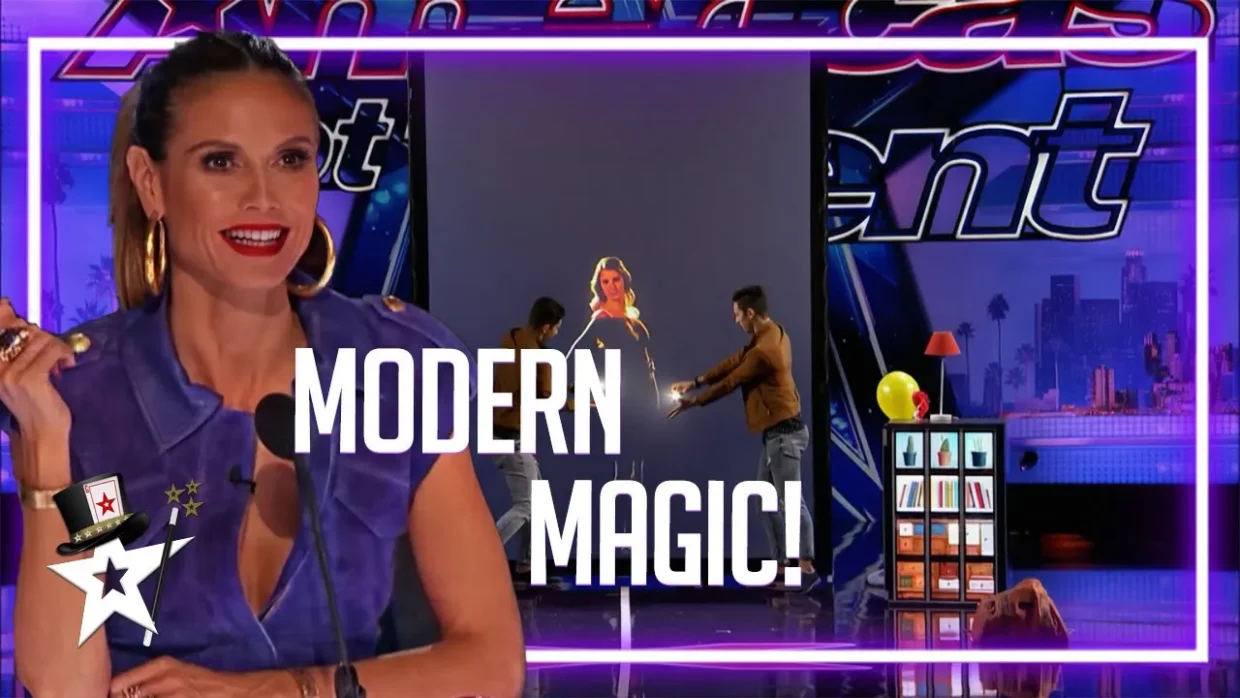
At roughly the twenty-minute mark of this forty-minute Got Talent compilation, the stage goes dark and a voice that doesn’t quite sound human announces itself: “I am the result of artificial intelligence creating the perfect modern day magician. I am Master Mine.” No bow. No wave. A synthetic greeting to the judges and America, then a command: “Howie, please pass your phone to Sofia.”
That’s the moment the video stops being a collection of card tricks and starts being an argument. The argument is that modern magic has outgrown the white tablecloth and the borrowed ring. It now runs on phone screens, WiFi networks, and a three-word prompt fed into an AI assistant. Master Mine doesn’t shuffle a deck. It tells Howie to focus on his passcode, then “breaks through” to unlock the phone. It directs Sofia to point the camera at Mel’s hands, slides Simon’s glasses across the screen with a fingertip, and asks the audience to think of a positive word while Howie types a command into his AI app.
The result is a sentence. “Many achievements start through endurance and resilience, manifest inspiration, and nurture dreams.” The row of audience members who were told to shout “stop” at a random point? Their words, spoken one by one down the row, are the exact words in that sentence. The AI didn’t predict them. It generated them from the words they chose. The coincidence is either a miracle or a very well-rehearsed bit, and the judges can’t tell which, which is the whole point.
WiFi as a parlor trick
Earlier in the compilation, a different magician does something that would sound like a tech demo at a conference. He asks Simon Cowell to think of a word that describes the magic he’s just seen. Simon writes it down, pockets the paper, closes his eyes. The magician pulls out his phone, navigates to Settings, then to WiFi. “You can see all the connections that are around us and also how strong they are.” He stares at the screen. Simon, eyes still shut, says the word: “Charming.”
The magician then tells the entire audience to unlock their phones and check the WiFi. They do. Something is there. “In this moment, we are all connected,” he says, and the room goes quiet in the way that only happens when four hundred people are simultaneously staring at their screens.
The cube, the chocolate, the bag
One act is built around a single question: “Do you like chocolate?” The volunteer, a man named Alan, says yes. The magician produces a Rubik’s cube, Alan mixes it, covers it with both hands, and the cube is gone. In its place: a bar of real chocolate. Alan bites it. “Real chocolate,” he confirms, chewing. Then the magician takes the chocolate and turns it back into a solved cube. All six sides. In Alan’s hands, which never left the object.
Later, another magician takes the cube trick further. He mixes a Rubik’s cube one-handed inside a bag, proves the bag is empty by letting the judges look inside, then hands the cube to Simon Cowell. “I’m gonna do something that’s never been done before on TV,” he says. Simon mixes the cube himself. The magician takes it, puts it back in the bag, and pulls out a cube that matches Simon’s scramble on all six sides. “43 quintillion different ways you can mix it up,” he had said earlier. The audience doesn’t do the math. They watch the colors line up, side by side by side, until all six faces are identical.
Hypnosis, movies, and a man on fire
A magician who performs “magic and hypnosis” builds an act around film. He prints a deck of cards, each one bearing a movie title: Taxi Driver, Wally, Love Actually, Frozen. The four judges each point to a card face-down. They know their movie. They’ve seen it. Then he hypnotizes them, one by one, into forgetting the title they just chose.
Amanda closes her eyes. “Focus 100% on the name and the title of the film.” She opens them. “Man on fire.” A man walks across the stage on fire. Simon’s movie is Skyfall, and the magician gets the audience to chant it before Simon can say it himself. Alicia’s is The Matrix. David’s is The Little Mermaid, and the magician produces something that links to it. David’s card, it turns out, was Magic Mike. The judges don’t know how they got there. That’s the trick.
For the women
One of the magicians opens with a line that lands harder than any trick: “Usually, when I perform magic, I always get asked this one question. Why did you become a magician? And the real reason is, it’s for the women.” He says it flat, almost embarrassed, then launches into a number-reading trick with Alicia Keys. She picks four. He says four. She names a suit. Hearts. He produces the four of hearts. The audience laughs because the setup was so disarmingly honest.
He also does a coin swap with Jay Park. Two coins, silver and copper, placed in Park’s flat palm. Park makes a fist. The magician touches the hand. When Park opens it, the coin has changed. “I now have the silver coin,” the magician says, holding it up. “Turn your hand over, and you have the copper coin.” Park checks. He does. Ten years of doing magic, three of them professional, and the whole thing comes down to two coins and a closed fist.
The kid in the trick
The compilation closes on a personal note. A magician talks about becoming a dad. His two-year-old daughter walks on stage. She becomes the object of the trick, the variable no one can control, the thing that makes the audience stop analyzing the method and just watch a kid do what kids do. “The most magical thing is becoming a dad,” he says, and the judges nod in the way they do when the performance has stopped being a performance.
Watch it
The full video runs about forty minutes and moves through at least six distinct acts, each one pushing the boundary of what “modern magic” means. The AI segment will either convince you or make you want to throw your phone at the screen. The WiFi trick works best when you’re holding a phone in your hand. The cube-and-chocolate bit is the one you’ll replay. The hypnosis act is the one where you’ll catch yourself forgetting what you were supposed to remember. The pacing shifts between acts, and the energy dips in the transitions, but the peaks are high enough to carry the whole thing. Watch it with your phone in your pocket. You might need it.
How did this story make you feel?