



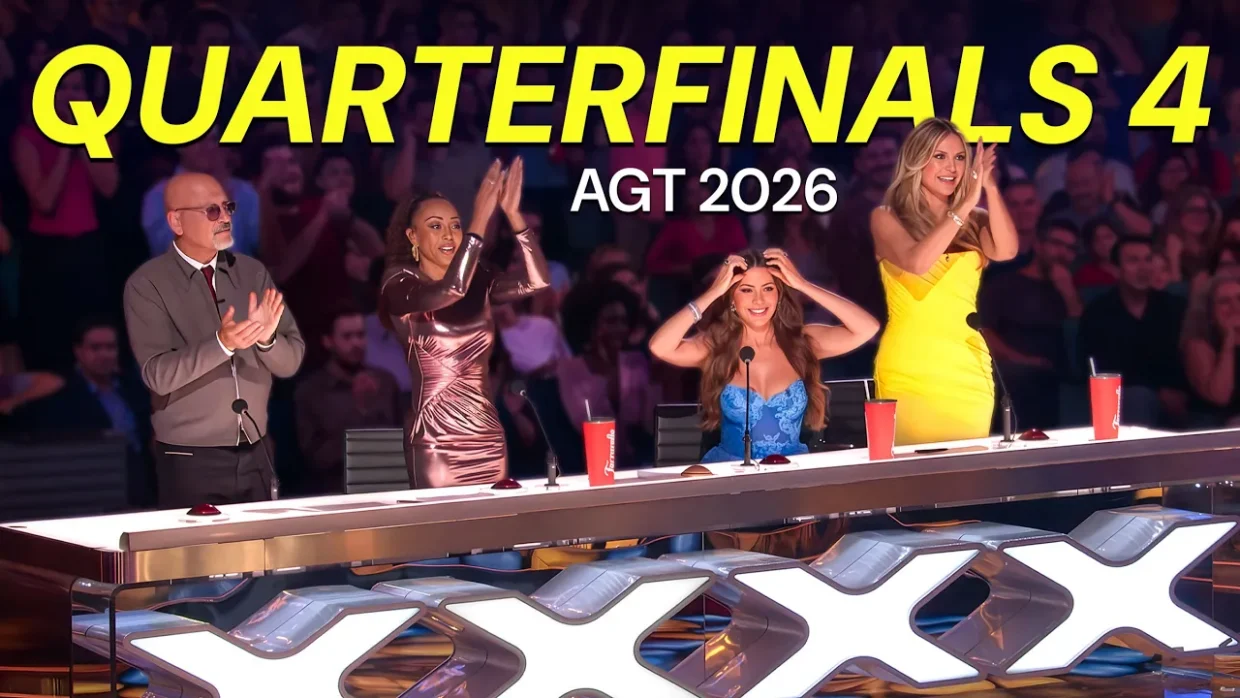
Mel B needed an answer before she could finish judging the martial arts act. Were the figures in white actual robots? The reply came straight back: “Yes.” Beside her, Sofia Vergara admitted that they were a little scary. Then she pressed the golden buzzer, and gold confetti fell across the stage.
The exchange captures the appeal of the video titled “Judges went WILD– Epic Talents SHAKE The Stage! | AGT 2026 Quarterfinals 4.” A human performer trades choreographed blows with a humanoid robot. A magician ends up dangling above the judges’ table. A singer earns a verdict that immediately requires Howie Mandel to explain exactly whom he means. Across roughly 71 minutes, the performers keep giving the panel reasons to lean forward, argue and occasionally check what they have seen.
Yet the judges’ loudest praise does not settle every contest. Vergara hesitates over one golden buzzer before awarding another. Mel B challenges a comic’s whole approach. The singers must persuade viewers to vote after the judges have finished talking.
The robots make the judges check their eyes
The martial arts team puts its human performer alongside white-suited humanoid robots, first in synchronized movement and then in a staged fight. The shared timing makes the premise clear enough to follow, but strange enough that Mel B asks for confirmation afterward.
“So the guys or ladies in white are actual robots?” she asks. Once she gets her answer, she checks that everyone else understands, too. Her question gives voice to the uncertainty the performers have created. Their routine depends on the audience recognizing a familiar fight sequence while watching bodies they do not expect to perform it.
Mandel reaches for a film comparison. He proposes a martial arts version of I, Robot and calls the performance the “most viral moment we’re gonna have this season.” That is a prediction made in the excitement of judging, but the reason for it is right there onstage: a human and a machine appear to meet as combat partners.
Vergara’s response combines unease with approval. “They are a little bit scary,” she says. She adds that she does not think the performers need what she is about to give them, then presses the buzzer. The gold confetti supplies the decision her unfinished sentence leaves open.
Young and Strange make mistakes part of the act
Young and Strange take a different route to disbelief. They begin with an argument about measuring the stage in feet rather than meters. One reassures the other that AGT can edit out the problem, only to hear that the show is live.
“Is it live? Wow. Blown it.”
That apparent incompetence sits alongside a precise sales pitch for their illusion. They describe a raised box with an open front and sides, on a brightly lit stage. Spectators, they say, will be able to see inside. No one can leave unseen. Raising the box also addresses the familiar suspicion of a trapdoor. These are the magicians’ claims about the conditions, delivered as part of the performance.
They then keep interrupting their own grandeur. A man appears atop the metal box amid smoke. During the routine, one magician demands, “Strange, where’s the bloody key?” Later, a magician hangs from a wire above the judges’ table, and the feet-versus-meters argument returns as a complaint about the safety line.
The callback gives the airborne spectacle a comic explanation. Having introduced the pair as men who cannot measure, the performers can make a technically demanding position look like the consequence of another workplace error.
From above the table comes an instruction to hit the buzzer, followed by a correction: “Not the red one. The gold one.” Heidi Klum, covered in confetti, offers her own hand-related joke before praising the changing occupants of the box. She can picture the act in Vegas.
Vergara wants to award a golden buzzer but says she cannot commit before seeing the other acts. Mandel disagrees. He praises the comedy, presentation and illusion, then singles out the repeated measuring joke. He has identified how the pair hold the routine together: each supposed failure becomes material for the next laugh.
The singers face a different kind of scrutiny
For the singers, the panel listens for control, identity and the ability to make a song feel personal. The early soloist addressed as Lara receives praise for a commanding stage presence and a flawless range. Asked whether she was nervous, she says she was excited and trying to stay grounded. Mandel tells her that no nerves showed.
Klum hears “Billie Eilish vibes.” Other comments stress that the singer is finding her own lane. The praise concerns how she carries herself and shapes the song as much as whether she reaches the notes.
The voice-and-guitar duo receives a less uniform verdict. Mandel says he could listen all night and notes that both performers’ mothers are in the audience. Klum praises their chemistry. Mel B, however, says the performance was not the best for pitch, even though she could see the emotion and likes the pair.
Their account of meeting gives that chemistry a history. One was working in a coffee shop after college when Nick’s mother invited him to spend time with Nick. They began making music together. With both mothers watching, Mandel’s comparison to a parents’ night has a specific, affectionate target.
Travis Garland gets the evening’s most forceful vocal endorsement. Mel B says she would not have chosen his song, but praises how he made it his own. Klum applauds his stage presence, while Vergara calls his voice one of the best in the competition that year.
“Out of any solo singing act, you are by far the best.”
Mandel makes that judgment about Garland, then narrows the category as the panel responds. He means solo singing, rather than a singer who also plays guitar. His insistence turns broad praise into a comparison with the other competitors. Garland thanks the judges and asks people at home to vote; he still needs their support to advance.
A good impression still needs a laugh
Cameron builds his comedy routine around celebrities in ordinary jobs. He opens by saying that impressions once got him fired from a call center, then imagines Robert De Niro at a day care center, Ryan Reynolds working in telemarketing and Keanu Reeves making sandwiches. These are comic premises, with each job chosen to give a recognizable voice something mundane to do.
For the final impression, Cameron asks Mandel to supply a job. Mandel chooses librarian. Markel relays the TikTok live audience’s choice of celebrity: Jim Carrey. Cameron combines the suggestions and begins, “Attention, ladies and gentle readers.”
The judges do not agree that the routine works. Mel B wanted a story and fuller physical characterizations. Sounding like someone, she argues, is only part of an impression. Klum respects the difficulty but wanted to laugh harder. Vergara preferred the audition and wonders whether Cameron used too many voices.
The criticism adds friction to a video full of cheering. Cameron offers several recognizable characters and an audience-selected finish, but the judges still ask whether those parts form a satisfying routine.
The spectacle gives way to decisions
Elsewhere, the performers push the action beyond a conventional stage routine. A parkour athlete flips backward from high scaffolding outside the venue, then later reveals his prosthetic left leg to the host. A woman fires flaming crossbow bolts at balloons around her partner and hangs upside down from a rotating aerial rig with a crossbow. A comic becomes entangled in microphone cord and collapses to the floor.
Another sequence brings the spectacle into the seats. An audience member holds a sign reading “Jay Shetty,” matching the name on Klum’s board. Shetty then stands and waves from row F. The recognition comes in two steps: the matching name, then the person himself among the spectators.
When advancement decisions arrive, the performers lose their practiced composure. Cesar Dias covers his face with both hands. Young and Strange embrace. Garland bows his head as the audience rises and cheers. After so much controlled movement, comic timing and vocal precision, their reactions are direct and unguarded.
Watch the full video to follow those performances through the judges’ disagreements and the advancement announcements. Young and Strange’s repeated measuring joke, Mel B’s question about the robots and Mandel’s carefully qualified praise for Garland all have room to develop before the performers learn what comes next.