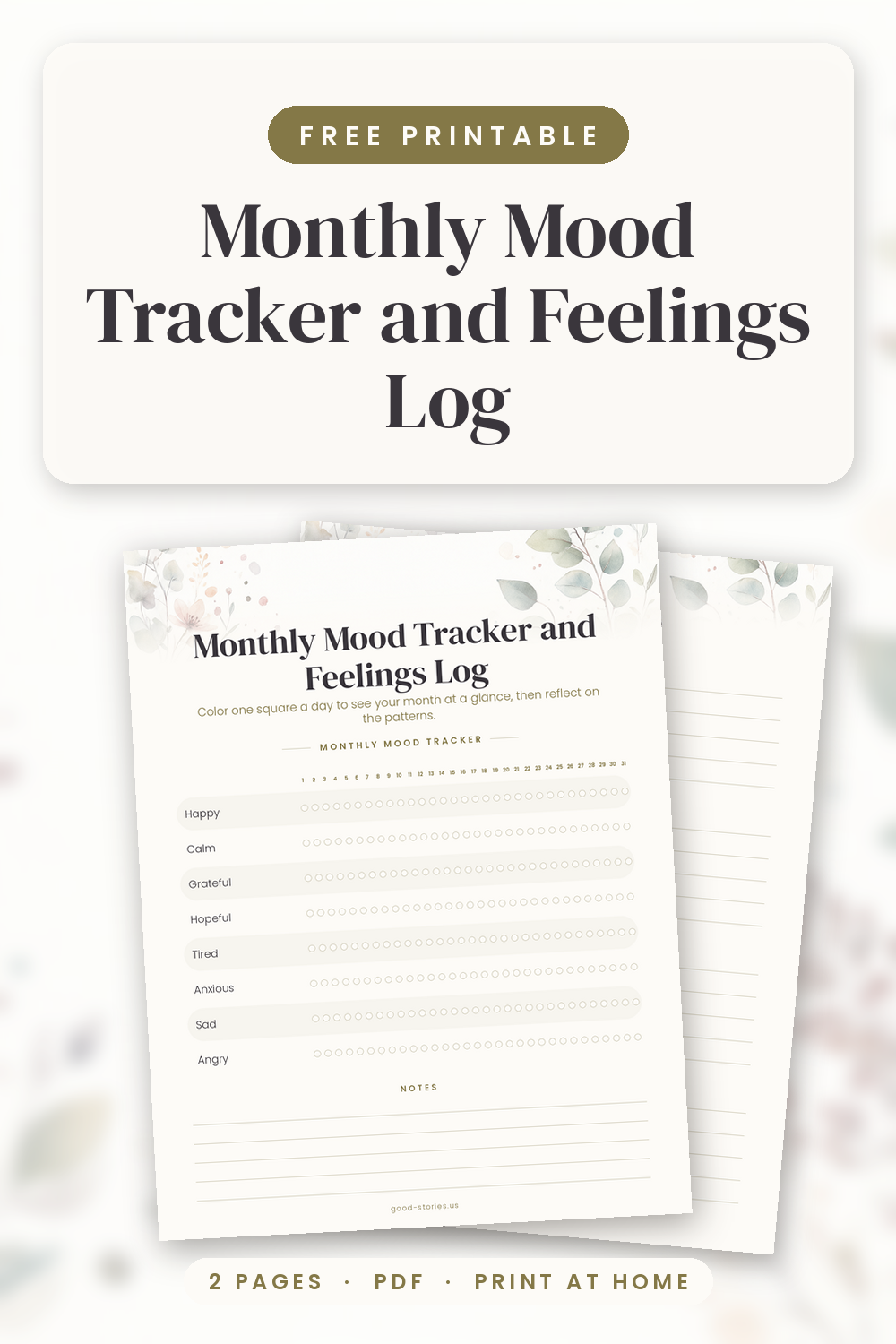
If your weeks blur together and you cannot quite remember how you have actually been feeling, a monthly mood tracker can help. This free printable gives you a color-in grid for the whole month plus a short reflection page, so your moods become easier to see at a glance. Print it, grab a few pens, and check in for a minute a day.
What’s inside the printable
- Page 1: a 31-day monthly mood tracker grid with eight color-in mood rows (Happy, Calm, Grateful, Hopeful, Tired, Anxious, Sad and Angry) to mark one square per day.
- Page 2: a Mood Reflections page with four lined prompts for a short weekly or end-of-month review.
Why Track Your Moods
Mood tracking is one of the simplest journaling habits you can start. Instead of writing paragraphs at the end of a long day, you color one small square and move on. Over a few weeks, those squares add up to a picture that is hard to see in the moment: which days lift you, which ones drain you, and how your energy shifts across the month.
Naming a feeling, even with just a color, can make it feel a little more manageable and a lot less vague. That is why so many people find a simple feelings log surprisingly grounding.
One important note: this printable is a personal record, not a medical tool. It is meant for everyday self-awareness and gentle reflection, not for diagnosis or treatment. If you are struggling with your mental health, please talk to a doctor or another qualified professional.
How to Fill the Monthly Grid
Before the month starts, choose one color for each mood row. Colored pencils, markers and highlighters all work; the only rule is to keep the same colors all month so the grid stays easy to read.
Each day, color one square in the row that best matches your main feeling. If a day felt mixed, mark two squares: anxious in the morning, calm by evening, for example. Two colors in one day is not a mistake. It is honest data.
Try to fill it in at roughly the same time each day, with your morning coffee, before bed, or right after dinner. It takes less than a minute. If you miss a day or two, do not start over. Just pick up where you left off. A tracker with a few gaps still tells a useful story.
Reading Your Month at a Glance
At the end of the month, step back and look at the whole page. You are not looking for a grade. You are looking for clusters and patterns.
Maybe Mondays are almost always tired. Maybe weekends lean calm and grateful. Maybe a hard week at work shows up as three anxious squares in a row. None of that is good or bad; it is information you can use.
Try comparing an easy week with a harder one. What was different? Sleep, food, time outside, time with people, workload? You do not need to solve anything right away. Noticing the difference is often enough to spark an idea.
It also helps to skip the judgment. A month with plenty of sad or angry squares is not a failed month. It is a month you showed up for honestly, and that counts.
The Five-Minute Reflection
Page 2 of the printable is a short reflection page with four lined prompts. Use it weekly, five quiet minutes on a Sunday works well, or save it for the end of the month.
The prompts ask the questions that matter most: what lifted your mood, which day was hardest and what helped, what pattern you notice, and one small thing to try next month. Short answers are perfect. A few words per line is plenty.
The goal is not a beautiful journal entry; it is a gentle pause that turns a month of colored squares into something you can learn from.
When you choose your one small experiment, keep it truly small. Not “be happier”, but “walk after lunch on hard days” or “call a friend on Sunday afternoons”. Small changes are easier to keep and easier to spot in next month’s grid.
Print and Set Up Tips
Print the tracker on letter size paper (8.5 x 11 inches) at 100% scale. Plain paper works fine, though a light cardstock feels nice if you plan to keep it on the fridge for a month.
Think about where the page will live. The fridge door, a clipboard by your desk, or the inside cover of your journal are all good spots. The key is seeing it every day. Keep a small cup of pens or pencils next to it so coloring a square takes seconds, not a search.
The habit sticks fastest when it rides on something you already do. Color your square while the coffee brews, while you wait for the kettle, or right after you brush your teeth. One minute attached to an existing routine is all it takes.
How to use your printable
The printable is designed for US Letter paper, but it works beautifully on A4 as well. On A4, choose “Fit to page” (sometimes called “Shrink to fit”) in your print dialog and check the preview so nothing gets clipped at the edges. It prints fine in black and white; colored pencils or highlighters do the rest.
A few ways to make it yours:
- Evening check-in: keep the page by your bed and color your square before lights out.
- Journal companion: use the grid as a quick visual index, then write longer entries on days that need them.
- Shared tracking: print one page per household member, kids often love choosing their own colors, and compare at the end of the month.
- Monthly ritual: pair the reflection page with a quiet cup of tea on the first day of the new month.
There is no wrong way to use it. The only rule is to keep it kind.
That is the whole idea: one square a day, one short reflection, and a clearer picture of your month. Download your free printable, pick your colors, and see what the next thirty days look like on paper. You might be surprised by what you notice, and by how good it feels to simply check in with yourself.