Learning the suit of cups meaning can feel easier when you slow down and look at two cards side by side. This beginner-friendly guide helps you separate what you see from what you interpret, with a free printable card comparison workbook to keep your observations together.
What’s inside the printable
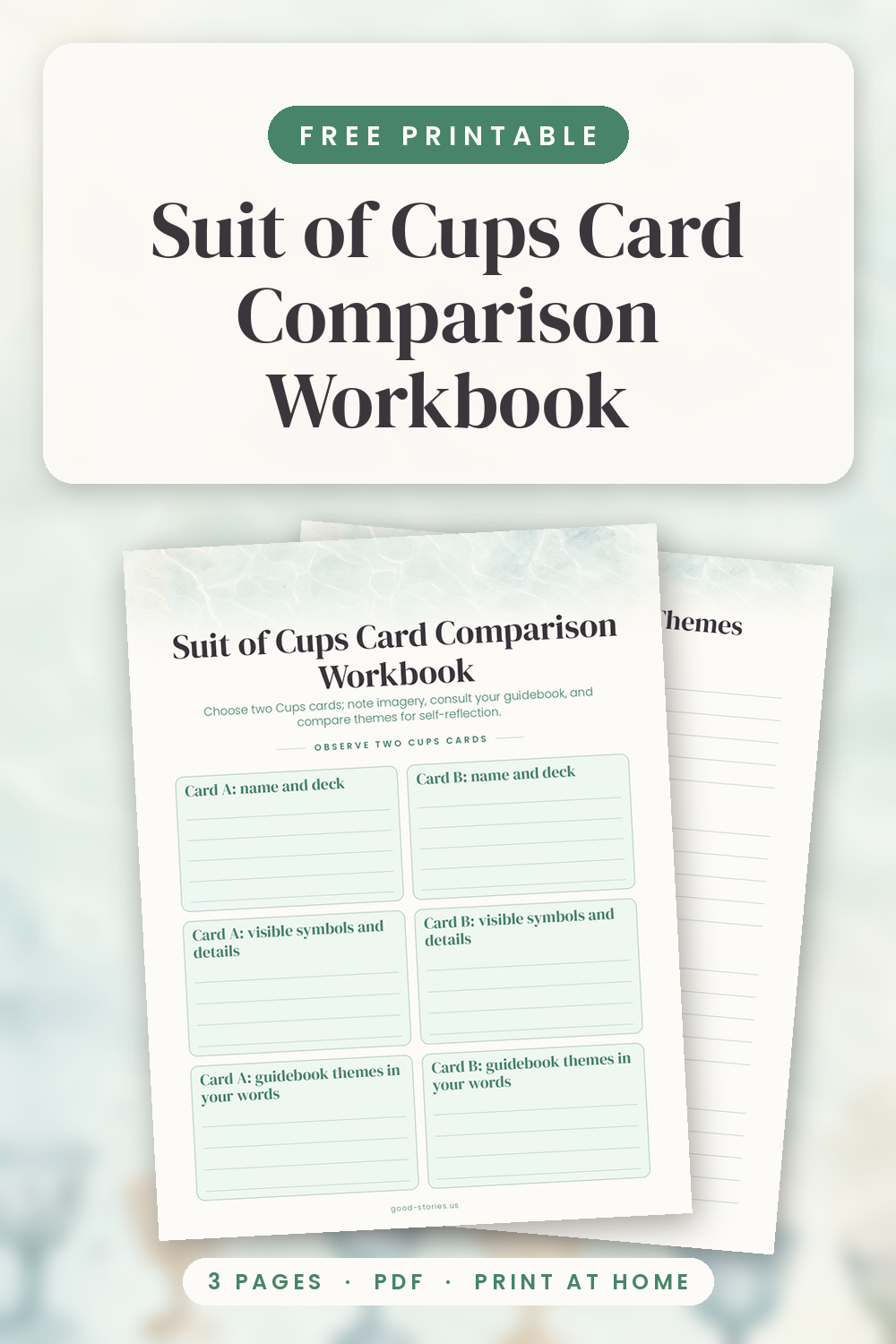
The Suit of Cups Card Comparison Workbook contains three US Letter pages. It supplies writing spaces and prompts; use your own tarot deck for the card imagery and its guidebook for the interpretations. The pages are:
- Page 1: Observe Two Cups Cards — six lined boxes for two card names, deck details, observed imagery, and guidebook themes.
- Page 2: Compare Symbols and Themes — four writing prompts comparing shared symbols, differences, themes, and alternative interpretations.
- Page 3: Reflect Without Predicting — four reflection prompts connecting observations to everyday experience, uncertainty, and further study.
Cups, water, and the language of emotion
In tarot traditions, Cups are commonly associated with water, emotions, intuition, and connection. Treat these associations as a symbolic vocabulary for self-reflection. They offer ways to think about an image, rather than evidence about what will happen or what another person secretly feels.
A cup might suggest receiving, holding, sharing, or offering something. Water might bring movement or stillness to mind. Those are possible interpretations, not fixed facts about every card. Your deck may use different pictures or emphasize different themes, so let its guidebook provide context before settling on a meaning.
You do not need to memorize a complete set of cups tarot meanings before beginning. Studying one pair gives you a manageable place to start. Keep the traditional associations nearby, but leave room for details that surprise you or do not fit your first impression.
Observe cups, gestures, and setting before interpreting
Start with the first page and write each card’s name and deck. Then describe visible details in ordinary language: how many cups appear, where they sit, whether water is present, and how any figures are positioned. Include gestures, spacing, and setting when those details appear in your deck.
Try writing “a figure holds a cup toward another figure” before writing “this means affection.” The first statement describes an image; the second gives it meaning. Separating the two helps you notice when an interpretation comes from the picture, your own associations, or the guidebook.
Repeat the observation process for the second card before comparing them. Next, read each guidebook entry and summarize its themes in your own words in the matching box. If a guidebook theme seems disconnected from the artwork, record that uncertainty rather than inventing a visual detail to explain it.
Compare two Cups cards with a clear purpose
Choose two Cups cards deliberately. You might select a pair with similar settings or cards whose guidebook descriptions seem different. A deliberate choice keeps this exercise focused on studying imagery and themes; you do not need to draw cards as an answer to a prediction question.
On the second page, compare your separate observations. What visual details do the cards share? What changes in their water, cups, figures, or surroundings? Be specific enough that you could return to your notes later and understand the comparison without relying on memory.
Then compare the guidebook themes. Two cards may both concern connection while emphasizing different aspects of it. Alternatively, similar-looking images may receive different explanations. Record overlaps and differences without deciding that one card is automatically better, worse, or a forecast of events.
Use the final comparison prompt to imagine another reader’s interpretation. Someone might notice distance where you noticed openness, for example. You can acknowledge that possibility without abandoning your own reading. The purpose is to practice flexible attention, not to establish a single correct personal message.
Use the three pages as a repeatable study process
Work through observation, comparison, and reflection in that order. Each stage builds on the one before it: the first gathers details, the second connects them, and the third asks what you want to explore. Keep your deck and guidebook beside the workbook throughout.
You can reuse the process with a new pair of Cups cards or revisit the same pair after more study. If your interpretation changes, compare your notes and identify what changed your mind. This makes minor arcana study more concrete without requiring you to finish the whole suit in one sitting.
Turn card observations into open-ended reflection
On the third page, connect one theme with something you notice in everyday experience. An open-ended question such as “What does this image make me notice about how I listen?” leaves space for thought. Avoid turning the comparison into a claim about another person’s motives or a guaranteed outcome.
Write down what remains uncertain, too. Perhaps the artwork feels ambiguous, or two guidebook themes seem difficult to reconcile. Your final prompt asks what you would like to study next. Tarot can serve as a reflective practice here, but these pages do not establish health, financial, or relationship facts.
How to use your printable
Download the PDF and print on US Letter paper. If you use A4, choose “Fit to page” in your print settings and check the preview before printing. Keep the three pages together so you can follow the full comparison process.
Use a pencil if you like revising notes, or date each set to track your studies. Bring the pages to a quiet desk session, work through one prompt at a time, or compare observations with a study partner while allowing different interpretations. Return to your own deck whenever a detail needs checking.
Begin with two Cups cards and a little curiosity. You can build a useful personal study record by observing carefully, consulting your guidebook, and keeping your reflections open to revision.