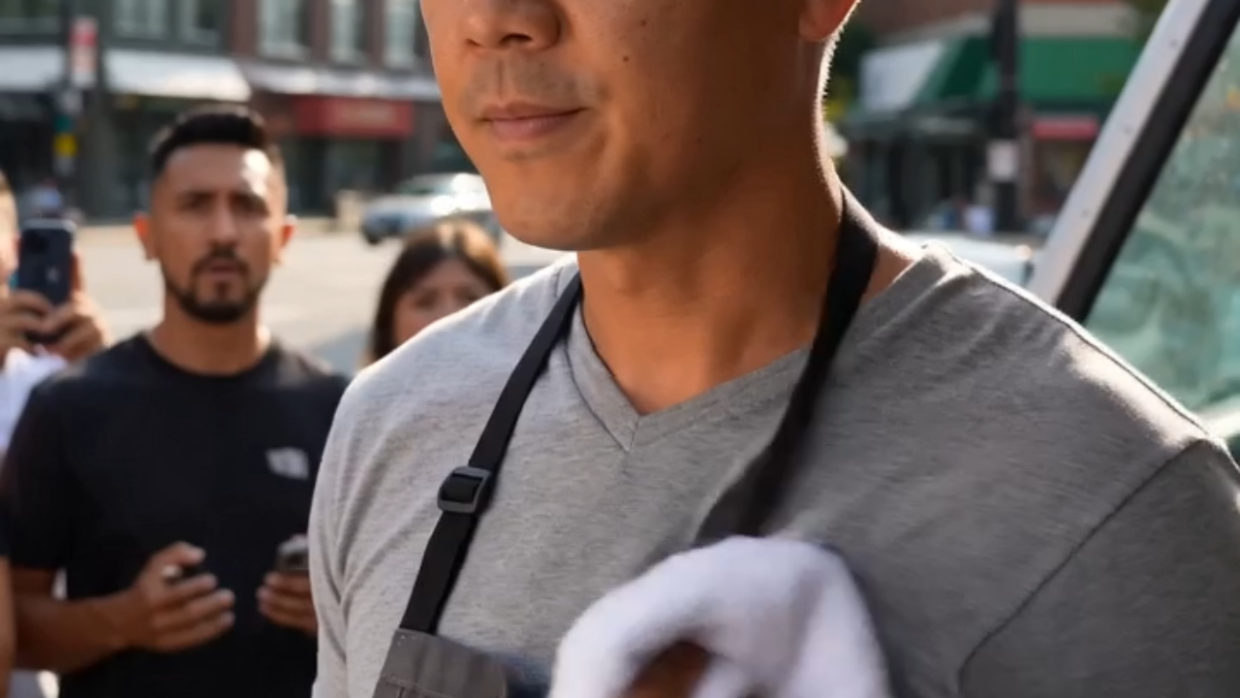
The food truck owner screamed at his dishwasher in front of fifty customers during lunch rush… But the old man quietly pulled a city badge from his apron.
Marcus Chen had been washing dishes at Rodrigo’s Fusion Truck for exactly fourteen days. His back ached from the cramped workspace. His hands were raw from the industrial soap. And every single night, he went home and typed detailed notes into his official city health department case file.
The lunch rush on Southeast Hawthorne was brutal. The line stretched around the block. Rodrigo’s Fusion Truck had been featured in Portland Monthly twice. Food bloggers called Rodrigo Vasquez a genius. His Korean-Mexican fusion had a cult following.
Marcus scrubbed a stack of plates in the tiny sink. The water ran lukewarm. The cooler motor behind him made a grinding sound it had made since his first shift.
“Marcus! Faster!” Rodrigo shouted from the grill. “We’re backed up!”
Marcus nodded. He’d learned quickly that Rodrigo’s temper was legendary. Three employees had quit in the two weeks Marcus had been there. One of them had mentioned the cooler. Rodrigo had screamed at her until she cried.
The grinding sound grew louder. Marcus glanced at the temperature gauge on the cooler door. Forty-eight degrees. The safe zone was thirty-seven or below. He’d documented this every single day. He’d photographed it. He’d recorded the ambient temperature of the truck interior—often exceeding ninety degrees during service.
“Order up!” Rodrigo slammed a plate onto the pass. “Marcus, take out the trash before it overflows!”
Marcus wiped his hands. He walked past the prep station. The cutting board had visible chicken residue. The same board Rodrigo used for vegetables. No sanitizer bucket in sight. Marcus had noted this seventeen times.
He pushed through the back door into the alley. The dumpster was surrounded by recycling bags that hadn’t been sorted. A health violation. He’d photographed it twice.
When he came back inside, a woman was standing at the service window. Her face was tight with anger.
“I want to speak to the owner,” she said loudly. “Right now.”
Rodrigo wiped his hands on a towel that Marcus knew hadn’t been changed in two days. “I’m the owner. What’s the problem?”
“The problem is I ate your carnitas bowl yesterday and spent last night in the emergency room,” the woman said. Her voice carried across the crowd. Phones came out. “Food poisoning. The doctor said it was likely from improperly stored meat.”
The line went silent. Marcus kept washing dishes, but his attention sharpened.
Rodrigo’s face flushed. “That’s impossible. Our food is fresh daily.”
“The ER doctor asked me specifically where I ate,” the woman continued. “When I told him, he said two other people came in this week with the same issue. Both ate here.”
Marcus’s hands stilled in the water. Three hospitalizations. That confirmed what his supervisor had suspected. This wasn’t just violations. This was a pattern.
Rodrigo’s jaw clenched. “Our food is safe. If you got sick, it was from somewhere else.”
“I only ate here,” the woman said. “And I’m reporting this to the health department.”
“You do that!” Rodrigo shouted. “They inspect us all the time! We pass every inspection!”
Marcus almost smiled. Rodrigo’s last scheduled inspection had been eight months ago. He’d passed with minor violations. But scheduled inspections were easy to prepare for. That’s why Marcus was here.
The woman left. The crowd murmured. Rodrigo slammed a spatula onto the grill.
“Marcus!” he shouted. “Get over here!”
Marcus set down the dish he was washing. He walked to the prep area. Rodrigo’s face was red.
“How long has that meat been in the cooler?” Rodrigo demanded.
Marcus kept his expression neutral. “I don’t handle the meat, sir. I only wash dishes.”
“Don’t give me that!” Rodrigo’s voice rose. “You’re in and out of that cooler all day! When did we put the carnitas in there?”
“I believe it was Monday morning,” Marcus said quietly. “Three days ago.”
“And what’s the temperature been?”
Marcus met his eyes. “The gauge has read between forty-six and fifty degrees since I started working here.”
Rodrigo’s face went pale, then flushed darker. “That’s a lie.”
“It’s not,” Marcus said. “The cooler motor is failing. I mentioned it to you on my second day.”
“You never mentioned anything!” Rodrigo shouted. Several customers stepped back from the window. “You’re trying to cover your own ass! You probably left the cooler door open!”
Marcus shook his head slowly. “I don’t open the cooler, sir. Only you and Carmen do.”
“Bullshit!” Rodrigo grabbed a towel and threw it. It hit Marcus in the chest. “You’re sabotaging me! That woman probably knows you! This is a setup!”
The crowd was fully watching now. At least a dozen phones were recording.
Marcus picked up the towel calmly. He folded it and set it on the counter. “Sir, I need you to calm down.”
“Don’t tell me to calm down!” Rodrigo stepped closer. “You’re fired! Get out of my truck! You’re the reason that woman got sick! You and your incompetence!”
Marcus stood perfectly still. “You’re saying I’m responsible for the food poisoning.”
“Yes!” Rodrigo shouted. “You left the cooler open! You contaminated the food! This is your fault!”
“In front of all these witnesses,” Marcus said quietly, “you’re stating that I, the dishwasher, am responsible for food storage and safety in this truck.”
“That’s exactly what I’m saying!” Rodrigo’s spit flew. “Now get out before I call the cops!”
Marcus reached into his apron pocket. He pulled out a laminated badge. He held it up so Rodrigo could see it clearly.
“My name is Marcus Chen,” he said. His voice was calm and clear. “I’m a senior inspector with the Portland Health Department. I’ve been working undercover in this truck for fourteen days as part of an investigation into three hospitalizations linked to this establishment.”
Rodrigo’s face went white. The crowd gasped. Phones lifted higher.
Marcus continued. “During that time, I’ve documented forty-three health code violations. These include improper food storage temperatures, cross-contamination, lack of handwashing, failure to maintain sanitizer buckets, improper waste disposal, and evidence of pest activity.”
“You… you can’t…” Rodrigo stammered.
Marcus pulled a small recording device from his other pocket. “This conversation has been recorded. You’ve just stated, on record and in front of witnesses, that you believe your dishwasher is responsible for food safety. Oregon food safety law clearly states that the person in charge—that’s you—is solely responsible for all food handling practices.”
Rodrigo’s hands shook. “This is entrapment.”
“It’s not,” Marcus said. “I applied for the job legally. I performed the work I was hired to do. I observed and documented violations that occurred naturally during normal business operations.” He pulled out his phone. “I’m now calling my supervisor to initiate an immediate closure order.”
“Wait,” Rodrigo said. “Please. I can fix this. Give me a chance.”
Marcus dialed. “You’ve had multiple chances. Three people are in the hospital. One is a fourteen-year-old girl who’s still on IV fluids.”
A woman’s voice answered. “Health Department, Inspector Rodriguez.”
“This is Chen,” Marcus said. “I’m at the location. The owner just attempted to blame me for the contamination incident in front of approximately fifty witnesses. I’m ready to issue the closure order.”
“Confirmed,” Rodriguez said. “I’m ten minutes away with the police liaison. Secure the scene.”
Marcus hung up. He looked at Rodrigo. “Step away from the grill, please.”
“You’re shutting me down?” Rodrigo’s voice cracked. “Right now?”
“Yes,” Marcus said. “Effective immediately, this food truck is closed pending a full investigation and remediation.”
“But I have a line of customers! I have food prepped! I’ll lose thousands!”
Marcus walked to the service window. He addressed the crowd. “Ladies and gentlemen, I’m Inspector Marcus Chen with the Portland Health Department. This food truck is now closed due to multiple health violations and an ongoing investigation into foodborne illness. If you’ve eaten here in the past week and experienced any symptoms of food poisoning, please contact the health department immediately. The number is on our website.”
The crowd erupted in noise. Some people looked angry. Others looked vindicated. Several were already on their phones.
Rodrigo sank onto a stool. “This will ruin me.”
Marcus turned back to him. “Three people are in the hospital. You knew that cooler was broken. Carmen told me you’ve known for two weeks. You chose not to fix it because you didn’t want to lose business during peak season.”
“It was going to be expensive,” Rodrigo whispered.
“A new commercial cooler motor is about eight hundred dollars,” Marcus said. “The fine for operating with unsafe food storage is up to ten thousand. The lawsuit from the family of that fourteen-year-old girl will be significantly more.”
Rodrigo put his head in his hands.
Carmen, the prep cook, emerged from the back. She looked at Marcus, then at Rodrigo. “He’s really a health inspector?”
“Yes,” Marcus said.
Carmen pulled off her apron. “I told you to fix that cooler. I told you three times.”
“Carmen, please,” Rodrigo said.
“I’m done,” Carmen said. She walked out the back door.
Marcus heard sirens in the distance. He pulled out a folder from beneath the sink—he’d hidden it there on his first day. Inside were printed photographs, temperature logs, and detailed notes.
He set it on the counter. “This is a copy of my documentation. The original is already filed with the department. You’ll receive an official notice of violation within twenty-four hours. The closure order will remain in effect until you’ve completed all remediation requirements, passed a full re-inspection, and paid all associated fines.”
A police car pulled up outside. Inspector Rodriguez stepped out, along with an officer.
Rodriguez entered through the service window. She was a short woman in her fifties with sharp eyes. “Marcus. Status?”
“Scene secured,” Marcus said. “Owner is cooperative. No customers were served after I identified myself.”
Rodriguez looked at Rodrigo. “Mr. Vasquez, I’m Inspector Rodriguez. We spoke on the phone three weeks ago when the first hospitalization was reported. Do you remember that conversation?”
Rodrigo nodded weakly.
“I asked you directly if you were experiencing any equipment failures,” Rodriguez said. “You told me everything was functioning properly.”
“I thought I could fix it,” Rodrigo said.
“You lied to a health inspector during an active investigation,” Rodriguez said. “That’s a separate violation with its own penalties.”
The officer stepped forward. “Mr. Vasquez, we’re not arresting you today, but you need to understand that the district attorney’s office has been notified. If the investigation determines criminal negligence, charges may be filed.”
Rodrigo’s face crumpled. “I didn’t mean for anyone to get hurt.”
Marcus felt a flicker of something—not quite sympathy, but an understanding of how people made terrible choices. “Mr. Vasquez, you built a successful business. People loved your food. But you cut corners. You ignored warnings. And when someone got hurt, your first instinct was to blame your employee instead of taking responsibility.”
Rodrigo looked up at him. “I’m sorry.”
“Tell that to the fourteen-year-old girl,” Marcus said. “Her name is Sophie Martinez. She missed her eighth-grade graduation because she was hospitalized with severe dehydration from food poisoning.”
Rodrigo’s shoulders shook.
Rodriguez pulled out a clipboard. “I’m issuing the formal closure order now. This truck may not operate until all violations are corrected and a re-inspection is passed. All food currently on-site will be disposed of under supervision. You’ll receive a detailed violation report and remediation requirements by email tonight.”
She handed Rodrigo a document. He took it with trembling hands.
Marcus removed his apron. Underneath, he wore a polo shirt with the health department logo. He’d kept it hidden for two weeks.
“Marcus, good work,” Rodriguez said. “This is the kind of case that prevents deaths.”
Marcus nodded. “The cooler’s the main issue, but the cross-contamination practices were almost as bad. He was using the same cutting board for raw chicken and fresh vegetables.”
Rodriguez winced. “How many times?”
“Every single shift I worked,” Marcus said. “I’ve got photos.”
She turned to Rodrigo. “You’re lucky no one died, Mr. Vasquez. If that fourteen-year-old had been immunocompromised, we’d be having a very different conversation.”
The officer began taking photos of the truck interior for evidence. Rodriguez walked through with a checklist, verbally noting violations. Marcus watched Rodrigo sit motionless on the stool.
A news van pulled up outside. A reporter jumped out with a cameraman.
“Great,” Rodriguez muttered. “Marcus, you want to do the statement, or should I?”
“You do it,” Marcus said. “I need to finish the evidence documentation.”
Rodriguez went outside. Through the window, Marcus could hear her crisp, professional explanation of the closure.
Rodrigo looked at Marcus. “Did you really work here just to catch me?”
“I worked here to investigate a pattern of illness,” Marcus said. “Three people got sick. That’s not random. That’s systemic failure. My job is to find out why and stop it from happening again.”
“You could have just inspected me,” Rodrigo said.
“Scheduled inspections don’t show the real picture,” Marcus said. “You know when we’re coming. You prepare. The truck looks perfect for two hours, then goes back to normal. Undercover investigations show us what actually happens every day.”
“How many of these do you do?”
“Enough,” Marcus said. “Usually we’re looking for specific issues—pest problems, temperature abuse, sanitation failures. This case was flagged because of the hospitalizations. When we see multiple incidents in a short time frame, we investigate.”
Rodrigo was quiet for a moment. “What happens now?”
“You hire a licensed contractor to replace the cooler,” Marcus said. “You complete a food safety certification course—the advanced one, not the basic. You implement a daily temperature log and sanitization schedule. You get re-inspected. If you pass, you can reopen.”
“How long will that take?”
“If you start immediately? Three to four weeks,” Marcus said. “If you drag your feet, months. Some places never reopen.”
Rodrigo’s phone buzzed. He looked at it and closed his eyes. “The Portland Monthly food editor just texted me. Someone sent her the video of you shutting me down.”
“It was probably live-streamed,” Marcus said. “There were at least fifteen phones recording.”
“My reputation is destroyed,” Rodrigo said.
Marcus packed his folder. “Your reputation was built on food that put people in the hospital. Maybe it should be destroyed.”
Rodriguez came back inside. “Okay, we’re clear with the media for now. Marcus, the department wants you to write the full report tonight. This is going to be high-profile.”
“Understood,” Marcus said.
She looked at Rodrigo. “Mr. Vasquez, you need to leave the truck now. We’re padlocking it. You’ll get one supervised visit tomorrow to retrieve personal items—no food, no equipment.”
Rodrigo stood slowly. He looked around the truck like he was seeing it for the last time. Then he walked out.
The officer attached a bright orange closure notice to the service window. Rodriguez secured the padlock.
Marcus stepped out into the alley. The crowd had mostly dispersed, but a few people lingered, talking in low voices.
Carmen was sitting on a curb across the street. Marcus walked over.
“You okay?” he asked.
She looked up. “I should have reported him myself. I knew the cooler was broken. I knew people were getting sick.”
“Why didn’t you?” Marcus asked gently.
“I needed the job,” she said. “And I kept thinking he’d fix it. He kept saying ‘next week, next week.’ I believed him.”
Marcus sat down next to her. “You told him multiple times. You did what you could.”
“It wasn’t enough,” Carmen said. “That girl is in the hospital because I didn’t push harder.”
“That girl is in the hospital because Rodrigo Vasquez chose profit over safety,” Marcus said. “You’re not responsible for his choices.”
Carmen wiped her eyes. “Will I get in trouble? I worked there too.”
“No,” Marcus said. “You’re an employee, not the person in charge. Unless you actively concealed information from inspectors, you’re not liable.”
She nodded. “I’m going to file for unemployment. And I’m never working for someone like that again.”
“Good,” Marcus said.
Rodriguez called from the truck. “Marcus, we’re ready to seal it up.”
Marcus stood. He handed Carmen a business card. “If you need a reference for your next job, call me. You showed up, did your work, and tried to speak up. That counts for something.”
Carmen took the card. “Thank you.”
Marcus walked back to the truck. Rodriguez had finished the paperwork. The officer was taking final photos.
“This one’s going to make waves,” Rodriguez said. “Famous food truck, undercover inspector, dramatic shutdown. The local news is going to run this for days.”
“Good,” Marcus said. “Maybe it’ll make other owners think twice before ignoring equipment failures.”
They walked to their cars. Marcus’s back still ached from fourteen days of washing dishes in cramped conditions. His hands were still raw. But the case file was complete. The truck was closed. And three families would get answers about why their loved ones got sick.
Two weeks later, Marcus sat in a conference room at the health department. Across from him sat Sophie Martinez’s parents and their lawyer.
“We wanted to meet you,” Mrs. Martinez said. “The inspector who shut down the truck.”
Marcus nodded. “How’s Sophie?”
“She’s home,” Mr. Martinez said. “Still weak, but recovering. The doctors said if she’d been sick for another day, it could have been much worse.”
“I’m glad she’s okay,” Marcus said.
Mrs. Martinez leaned forward. “We read the report. You documented violations for two weeks. You watched him serve unsafe food every day.”
Marcus met her eyes. “I know how that sounds. But if I’d shut him down on day one, we wouldn’t have had enough evidence to make the closure stick. He could have claimed it was a one-time mistake. He could have reopened in days. This way, we have proof of a pattern. The closure is permanent until he makes major changes.”
“So you let people eat there,” Mrs. Martinez said. “Knowing it was unsafe.”
“I documented every violation and reported it immediately to my supervisor,” Marcus said. “We made the decision together to continue the investigation. I understand if you’re angry about that.”
Mr. Martinez put a hand on his wife’s arm. “We’re not angry at you. We’re angry at Vasquez. Our lawyer says the evidence you collected makes our case much stronger.”
The lawyer nodded. “The documentation is exceptional. Temperature logs, photos, recorded conversations. It’s very clear that Mr. Vasquez knew about the problems and chose to ignore them.”
“What happens to him?” Mrs. Martinez asked.
Marcus glanced at his supervisor, who’d joined them. She answered. “The DA is reviewing the case for possible criminal charges. At minimum, he’ll face significant fines. The truck can’t reopen without major renovations and a passed re-inspection. Realistically, he’s out of business.”
“Good,” Mrs. Martinez said quietly.
They talked for another twenty minutes. When the family left, Marcus’s supervisor turned to him.
“You okay?” she asked.
“Yeah,” Marcus said. “It’s just hard sometimes. The waiting. The watching.”
“It’s the job,” she said. “And you’re good at it. The undercover work you do saves lives.”
Marcus nodded. He thought about Rodrigo’s face when the badge came out. The shock. The fear. The realization that his shortcuts had caught up with him.
“Next assignment?” Marcus asked.
His supervisor smiled. “How do you feel about working in a nursing home kitchen?”
Marcus groaned. “You’re kidding.”
“Wish I was,” she said. “We’ve got two cases of suspected food mishandling. Same pattern—elderly residents getting sick, no clear source.”
“When do I start?”
“Monday,” she said. “And Marcus? Good work on this one. Really good work.”
Marcus gathered his files. Outside, the Portland sun was shining. Somewhere, Rodrigo Vasquez was probably meeting with lawyers. Somewhere, Sophie Martinez was recovering in her bedroom. And somewhere, another restaurant owner was making a choice—fix the problem, or hope no one noticed.
Marcus’s job was to make sure someone always noticed.