It begins, as all great talent nights do, with a hush, a glance, and a small risk. The stage lights glow. A trainer holds out a steady hand. On it perches not a pop star or a stand‑up comic, but an Amazon parrot who has no interest in stage directions. He could fly. He could freeze. He could, as his handler puts it with a nervous laugh, do nothing at all. “The worst that could happen,” she tells the judges, “is that he sits on my hand and says nothing.”
Then the bird says hello.
Echo finds his voice
Sarah Hough steps forward with Echo, a double yellow‑headed Amazon she calls her “baby boy.” He answers the first question the room throws at him—“What’s your name?”—with a clear, cheeky, “Echo.” He powers through greetings. “Can you say, ‘hello’?” Sarah asks. “Hello,” he replies. “How about ‘hi’?” “Hi.” The theater warms.
Echo’s party trick isn’t only talk. He turns the stage into a miniature menagerie. A chicken cluck, a rooster’s crow, a sheep’s bleat, a tender “kitty,” even a tiny “chihuahua.” He sneezes like a person, then fake‑cries on cue. Each sound is uncannily right, so crisp the judges glance—just to be sure—at Sarah’s lips. She smiles and says what many in the audience are thinking: “Not ventriloquism.”
Then comes the moment that flips curiosity into awe. Sarah leans in. “You ready?” she whispers. “Echo, honey, where do bluebirds fly?”
The melody answers. Echo slides into a clear, fragile line that pulls the air tight. He holds a pitch, sweet and bright, somewhere over the rainbow. Sarah, who admits he “sings much better than I do,” lets him lead. The judges are grinning at each other now, trying to decide whether to laugh or blink back tears. When he finishes, Sarah urges, “Give everyone a big kiss,” and the room melts.
By the end of their exchange, Echo even chimes in on the judges’ praise. “It’s just incredible,” someone says. “Incredible,” Echo echoes, the smallest of encores, comic and kind. When asked who manages this unexpected star, Sarah doesn’t miss a beat: “It’s whoever has the peanuts in their pocket.”
The Birdman and a diva named Tika
It turns out Echo isn’t alone. A few beats later, Joe—the Birdman—takes the floor with Tika, a yellow‑naped Amazon he rescued a year ago after nearly four decades of training. “She has one of the largest vocabularies of any parrot I’ve ever met,” Joe says. “When we pull up to drive‑through, she tries to order.”
Tika is a talker, yes, but also a born performer. She plays peekaboo with the crowd, flips a sound effect from a pat into a comedic honk, then raises the stakes with a lullaby. Joe sets her up: “Tika actually sings several songs. We’re gonna start with this one.” He cues her gently. “Sing it. Sing it.”
“Hush, little baby, don’t you cry.”
The room softens to a murmur. It’s not just that the notes are there; it’s the phrasing. The delicate pauses. The breathy finish. A parrot with vibrato. When Joe coaxes, “There you go. One more,” she tilts her head, measures the moment, and delivers again, like a pro saving her big showstopper for the right beat.
It would be easy to think of this as novelty—birds dressed in human tricks—but the animals give off another energy entirely. These are not bells and whistles bolted to a feathered frame. They are trained relationships. They are trust on a stage, with bright lights, noise, and the unknown whir of cameras. The risk is right there in Joe’s grin, and in the way he waits out Tika’s pauses with patience forged from years around beaks and moods. You can’t fake that kind of ease.
The hen at the keyboard
Just when the judges think they’ve run out of ways to be surprised, a pair of contestants carry in a small keyboard and introduce their partner: a chicken named Joku. One judge blurts the first thought that hits the brain: “Is it a chicken?” Another, delighted, answers the obvious with a laugh. Joku’s handlers say she “picked it up very quickly.” The promise is simple: she’s going to play.
And then she does.
It’s not clumsy pecking at a random cluster of keys. Joku taps her beak with purpose, note after note, a tune the audience knows by heart. The skepticism that filled the first bars—this can’t be real—collapses into cheering. A judge mutters, “No way,” then says what everyone is thinking: “That is crazy.” Another observes, in disbelief, “When you feel like you’ve just seen it all, you have a chicken playing this song.”
Do chickens need bands? One judge floats the idea half‑as‑joke, half‑as‑business plan. Joku’s team lights up: they already have a drummer. The panel riffs on the idea—“It’s all chicks”—before pulling themselves together to vote. “This is historic,” someone declares, and the result follows: yes, yes, yes, yes.
When feathers won’t cooperate
Not every animal steps onto a stage and turns into Ella Fitzgerald. Andrew arrives with Rocky, an owl, promising “owl agility.” The theater holds its breath for silent wingbeats, smooth arcs, secretive glides. Rocky, however, has other ideas. He turns away from cues, mistrusts the hoops, and seems far more interested in a distant corner of the rafters than the obstacle course.
The trainer’s voice grows tight. “Come on, Rox,” he pleads. “Wrong way.” The crowd pulls for the bird, then for the man, then for both at once. The judges blink at each other with affectionate pain. When it ends—mercifully—one delivers the verdict with a quip as sharp as a talon: “Potentially, one of the worst animal acts we’ve ever had… you’re like a very old, unmagical Harry Potter.” It stings, but the humor is kind, and the subtext is clear. With animals, even the misses hum with a weird warmth. You cannot script a willful creature. You can only invite it.
A chicken that reads minds
Then comes the act that tilts the night from curiosity to legend. A soft‑spoken performer from Belgium, who goes by Yo, brings out Curry, a chicken he has lived with for seven years. They eat together, he says. They watch the show together. “She can really sense what I’m feeling.” He says she can read minds—not with words, of course, but by the way she responds to the world. The judges raise eyebrows. A chicken… that reads minds?
He asks Howie to hold out his hands. “Whatever happens, don’t move.” The theater giggles at the risk in that sentence. Then he hands out cards. Each judge is asked to write down a fear—anything that knots their stomach—and pass the papers to Simon to mix.
Yo steps close to Simon and speaks in the gentle rhythm of someone calming both bird and human. “Think about your fear,” he says, “and then look.” Curry, perched and focused, tilts her head. The room tightens again when Yo quietly asks Simon to “think less” because even a chicken can sense panic when it rolls off a human in waves. “I’m not thinking, I’m not thinking,” Simon shoots back. Laughter, breath, suspense.
Finally, the question. Was it “dark oceans”? “A fear for flying”? “A fear for drawing”? Or “giant spiders”?
“What is Simon thinking about?”
Curry points—decisive, unambiguous—at giant spiders. Simon nods. “Yes.” The audience roars, half in relief that it worked, half because the image of a judge confronted by an honest chicken is its own kind of theater.
Yo isn’t done. He turns to Sofia. She channels the energy of her fear to her hands and pats Curry gently. He tells her to make it harder. Turn over the papers. Mix them up. Curry pecks on one, chooses, and Sofia reveals it: “dark oceans.” It matches what she wrote. A small miracle in a small gesture. The magic deepens.
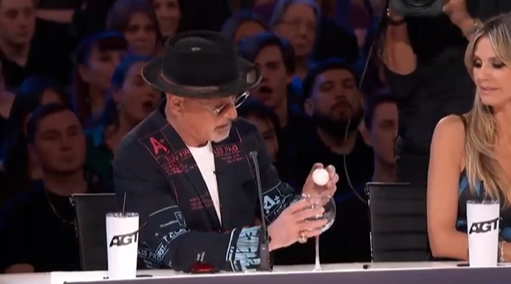
The closer, though, belongs to Howie. Yo has been thinking of him all day, he says. Before Howie even chose, Curry “knew which fear you would pick.” Yo hands him an egg and asks him to open it. He cracks the shell.
“There’s a word in here.”
Howie unfurls a tiny message: “drowning.” He looks up, stunned. “This is my fear.” The judges don’t reach for cleverness. They sit in the plain truth of what they have seen. “That was amazing,” someone breathes. Another adds, with the steady certainty of a talent judge who has seen every trick: “Impossible to do what you just did without having magic powers. Seriously.” Then, the sweep. One yes. Two yeses. Three. Four. The chicken and her human are through.
“Shut up,” then showtime
Debbie arrives next with Danny, a blue‑and‑gold macaw she raised “from the day he hatched out of his egg.” He’s 21 now, with the frank charm of a bird who has shared a home long enough to pick up the family’s habits. Debbie jokes that people sometimes “get upset… because they all expect him to talk, but they don’t expect him to squawk like that.” The line she hears from strangers—“Shut up”—has even made it into Danny’s repertoire. So has a sneeze, picked up while Debbie was under the weather. “Mommy’s been sick,” she says. Danny obliges with an explosive little “achoo.”
But like the others, Danny saves the best for after the warm‑up. He proves his brain the old‑fashioned way: by doing impressions, then identifying them from sound alone. Pigeons. Ducks. Dogs. Kitties. The theater plays along as Debbie tests him without telling the audience the answer.
“Listen. Listen. Ready? K— I’m a chicken.”
Danny nails it, bobbing with pride at each correct call, then finishing with a comic bow. “That is amazing,” someone gushes. Another judge laughs, shaking his head. “Even Howie can’t do that. He’s a human being.” The panel wants more, and Debbie obliges with a promise that lands like a sequel teaser: “I have parrots that paint and read minds.” Vegas beckons. “It’s three yeses. You’re going to Las Vegas.”
Why we lean in when birds talk
Strip away the bright lights and the scoreboard feel of televised competition, and what holds this night together is something quieter: a tug of recognition. Birds are not people, and yet we hear our world in their voices. We hear lullabies that rocked us, jokes we toss around tables, the way fear and delight move through a room like weather.
It feels like flattery when a parrot copies a sneeze or a laugh. It feels like partnership when a hen pecks a tune we know. And it feels like something deeper—a mirror turned outward—when an animal meets us where words run thin. That’s what Yo means when he says, “She can really sense what I’m feeling.” That’s what Sarah means when she shrugs and says, “You can’t make them do anything.” Training is structure, yes. But the performance is a choice the animal makes in that instant.
This explains why the night holds both perfection and collapse in the same kind hand. Echo lines up dazzling tones with the poise of a choirboy. Tika hushes a few thousand strangers with two lines of a nursery song. Joku pecks her way into history. Curry reads a room so well she appears to read minds. And Rocky the owl? He reminds us there is no contract in show business more fragile than trust with a wild‑hearted friend. When it works, it’s a miracle. When it doesn’t, it’s still honest.
The training you don’t see
It’s easy to watch these acts and imagine an overnight story. A viral video here, a quirky talent there. But these birds tell a different timeline. Joe speaks about “thirty eight years” in the making. Debbie has put in two decades with Danny, from hatchling to headliner. Sarah has learned most of all to wait, to cue, and to accept that results are never guaranteed. Even Yo’s airy calm is earned: he must build an environment that lets Curry choose the right card under intense pressure, with laughter shooting across the room and the judges’ eyes like beams.
There’s also empathy, baked in. Sarah coaxes Echo without crowding him. Joe adapts to Tika’s pace, letting the lullaby fill exactly as much space as she wants. Joku’s handlers, who say their hen “picked it up very quickly,” set her up to succeed at a familiar keyboard. Yo protects his bird from overload by keeping the tone soft, the steps clear, the demands human but the reading uniquely chicken. The craft is invisible by design.
And because the craft is invisible, the effect reads as wonder. A judge’s face cracks open with pure pleasure. Another blurts, “This is historic.” Simon, who has made a career on studied skepticism, hears a chicken nail his fear—“giant spiders”—and answers with a simple, boyish “Yes.”
Comedy as the safety net
One gift of animal acts is that they puncture ego before ego sets the rules. When Rocky the owl drifts from the plan, the crowd laughs with affection rather than scorn. When Echo repeats “Incredible” back to the panel, he turns high praise into a wink the whole theater shares. The chicken band suggestion becomes a bit the judges build together, goofy and earnest at once. These small eruptions of play steady the night. They hold space for the nerves the trainers nurse, and for the animals who do not owe us anything.
Comedy also smooths the stakes. It is wild, after all, to write down a secret fear in front of an audience and pass it to Simon Cowell. It is wilder to let a bird crack open an egg with your private panic curled inside. The room needs a laugh to breathe again. It gets one in Howie’s sideways grin, in Sofia’s delighted shriek, in Simon’s brittle “I’m not thinking, I’m not thinking.” It gets more in the exchanges between trainers and judges: the throwaway brag about a parrot that “does magic,” the half‑mocking feud about who does and doesn’t attend bird shows.
What makes a yes
Under the banter, the panel shows a pattern. They say yes when there is a clear idea, a clean execution, and a spark. Echo earns that spark by threading personality through perfect notes. Tika earns it by turning a lullaby into theater. Joku earns it by doing something both funny and musically true. Curry earns it by taking an abstract claim—mind reading—and proving it with three precise hits, each bolder than the last.
They say no when the plan falls apart in ways not even charm can patch. Rocky’s turn is an example. The best line of the night might be the one hardest to hear: “It’s over.” Not said with malice—more like a parent calling the end of a backyard game when the light is gone. Sometimes the audition doesn’t land. Sometimes grace is letting it go fast.
Why these birds moved a million hearts
If you’ve ever sat at a kitchen table while a parrot paraded along the back of a chair, or stood in a yard while a hen looked at you with the tilting curiosity only birds can muster, you know the spell. They are witnesses in our lives. They listen. They imitate. They argue. They insist. We see ourselves in their timing and their temper, their sudden moods and their long loyalties.
That’s what plays across this night. The handlers crack jokes because they must. A little humor makes space for the huge, tender thing they carry onstage: a relationship that has survived mornings and misfires, molts and small illnesses, and the thousand nameless repetitions that make any trick possible. The animals meet that effort with their own gift, which is presence. They stand where the noise is loudest and choose to try.
It would be easy to reduce all this to novelty. It isn’t. It’s vulnerability on both ends of the leash—or in this case, the glove and the perch. It’s a parrot climbing out on a limb for a high note it doesn’t have to sing. It’s a hen pecking the right key even when the world is watching. It’s an owl reminding us that consent is not a slogan but a reality, and no bird works without it. The judges feel that truth even when they joke. The audience does too. That’s why the applause that follows the best moments isn’t just loud; it’s warm.
What comes next
More, if Debbie has her way. “I have parrots that paint and read minds,” she says, leaning into the panel with the confidence of someone who can already picture the canvas on an easel and the gasp when the first strokes appear. More, if Joe keeps cueing Tika with a steady hand and a calm eye. More, if Sarah trusts Echo to pick his moments, and if Echo keeps surprising her with when he decides to shine. More, if Yo listens to Curry and lets her lead, which is another way of saying: if he keeps reading her as well as she seems to read us.
There will be flubs. There will be bows, and nods, and jokes about chicken bands, and the nightly miracle of an animal finding its courage in a room full of strangers. There will be, if we’re lucky, another egg with a word inside it that proves what we all hope about connection—that it can cross species, and stages, and the gap between what we say and what we feel.
Watch the full performance lineup and you’ll see it for yourself: the soft breath before a song, the whip‑smart timing of a peck on a piano key, the stunned faces of judges who think they’ve seen it all, and the ease of trainers who know that the best ideas are the simple ones done with love. The birds took over, and for one unforgettable night, the theater felt like a perch the whole world could share.