There’s a special electricity that hums through a theater when a magician says, “Watch.” It’s a word that flips the room into a different gear. It’s also a challenge. From the very first beat of this showcase of master illusionists, the performers lean into that dare — to make us look closely, to doubt our own eyes, and to feel, if only for a moment, that the impossible might be within reach.
The night opens with candor. A magician steps forward, offers no safety net, and says what most of them will not: he is going to test our perception. He tells us plainly that we will be in “direct contact” with him, visually and audibly. But he also warns us with a grin: be careful, because if you blink, you might miss it. Then he does something quietly radical for a conjurer — he lets us peer behind the curtain, just enough to heighten our awe instead of lessen it.
The art of showing and hiding
“What you didn’t know from the beginning is that I use the stage light to catch your attention, to show you certain thing, but also to hide thing from you,” he says, and the room tilts. With that one confession, the lights themselves become accomplices. He steps into a reflective jumpsuit, bathes the stage in UV, and redraws the rules of where our eyes will go. We see a chair, a shadow, a suggestion of a body. We learn there’s a moving plate on the back, a mechanism that would mean nothing without timing and nerve. “I must be fast, precise, and do all this in pitch black,” he adds. He counts down, and a beat later the full trick lands — it’s an escape, sure, but more than that, it’s an elegant lesson in how misdirection doesn’t just hide; it also tells you a story about where to look.
The judges are startled into honesty. “I’ve never seen an act like that before. Bravo,” one of them says. Another leans into the larger show-business reality: “This is exactly what I believe works in Vegas.” Then, with a laugh equal parts praise and surrender, a final line that could double as a mission statement for the entire night: “You have disturbed my mind.”
A ring that learns to walk
If the escape artist explores darkness and light, the next performer lives in the fan-width between two fingers. He sets the tone with a tease: “Don’t blink.” A simple ring sits on his pinky. He asks the audience to “watch carefully,” and we do, but even forewarned, we’re not ready for the jump — from pinky to ring finger, from ring finger to middle, like the jewelry has discovered its own gait. He resets, apologizes playfully for going “too much,” and then gives us the real punchline.
Many people think the magician moves the ring quickly, he confesses. They’re wrong. He grins and offers the explanation only a trickster can deliver with a straight face: “Watch. I moved the finger.” He doesn’t just slide the band; he appears to shift the finger itself, a visual glitch that has the judges half-laughing, half-gasping, unsure where anatomy ends and sleight of hand begins. It’s comedy balanced on knife-edge dexterity, and when the panel finds its words again, they go straight to the superlatives. “I had never seen anything like this,” one judge says. Another calls it “one of the most crazy close-up magic” moments they’ve ever seen. For once, the praise feels less like applause and more like admission: the stage can be as small as a knuckle and still hold a universe.
Comedy, candor, and control
What marks these magicians as masters is not simply the mechanics of a move; it’s the control of rhythm, the timing of a confession, the way a single word can turn the air. “Any question?” the escape artist asks after a jaw-dropper, feigning casual. A voice from the panel calls back, “How did I do it?” He answers himself with a half-apologetic shrug: “Oh, sorry. A magician never reveal his secret.” The grammar trips and the charm doubles. It’s a wink, a deflection, and a reminder: revelation is not the point. The point is the feeling.
When the panel presses, he teases a little more of the method — the chair’s moving plate, the blackout, the need for precision — then pulls it right back with another audacious countdown and a fresh miracle. He both lets us in and keeps us out. That paradox is the heartbeat of the evening.
“Fierce,” and a woman who owns the room
Then a woman strides onstage with a smile that says she’s read the room perfectly. “You do not need to apologize,” a judge says when she opens with a playful mea culpa, and the warmth clears the runway for the work. She asks Simon to pick up a laser pointer and choose a word. He picks “Fierce.” She repeats it for the crowd — “The card that you chose here is Fierce. Yes. Fierce.” — as if stamping it into the show’s memory. It’s not just a reveal; it’s a reframe. Of course the word is fierce. Of course this is the card. She owns the selection, then the stage, then the theater.
When the judges weigh in, it’s with something rarer than flattery — context. “We don’t have many female magicians,” one says, the kind of line that can land like a burden unless the performance has already rerouted the narrative. In this case, it becomes celebration. She is “amazing,” has “stage presence,” is “funny,” and “enthralled us.” Another grins and blurts a line that sounds like a confetti cannon: “Hot start, baby.” The vote crescendos into a comic exaggeration of unanimity — “That’s about 4,000 yeses” — and in the space of a few minutes a magician has rewritten a story much bigger than a trick.
The board that knows your card
Part of the evening’s pleasure lies in variety — a kaleidoscope of subgenres that all get to play hero. A soft-spoken card worker arrives with a flat board and a borrowed deck. He makes sure we see that there’s “nothing” inside the board, that the deck is normal, that the card picked is freely selected and signed. He puts the card “in the middle of the deck,” shuffles openly, and then gestures under the board. There it is. The signed card.
He does it “once again.” And again. The phrasing is almost childlike — “shuffle, shuffle, shuffle” — which somehow amplifies the impact when the impossible repeats. Then, just as our brains start to sketch a method, he yanks away the scaffolding. He places the card in the middle, and the entire deck vanishes. “Okay,” he says, with a showman’s apology for reality’s failure to keep up, “there’s only one card left.” And that last card changes — impossibly — into the signed selection. The deck reappears under the board as if it had been napping there all along. There it is, under the board again. It’s a running joke with perfect posture.
Quick change, and grace under pressure
A quick-change artist takes a different route to astonishment — speed, choreography, the alchemy of fabric into persona. When a snag threatens the flow, he does not flinch. He resets with a smile that reads as both apology and vow, then barrels forward. The panel sees the grit as clearly as the glitter. “What an absolute professional you carried on,” a judge says, cutting to the heart of live performance. Another falls in love with the concept: unique, “cool,” “slick,” “modern,” with “attention to detail” that makes the act more than a costume carousel. In a twist, one judge admits that “the fact it went wrong sort of made the act better.” The night allows for that, too — the human seam that makes the magic feel real.
Fizzy orange, champagne, and a tiny prodigy
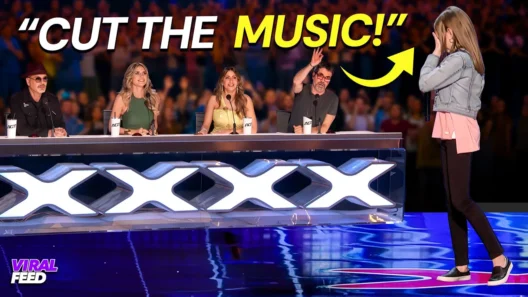
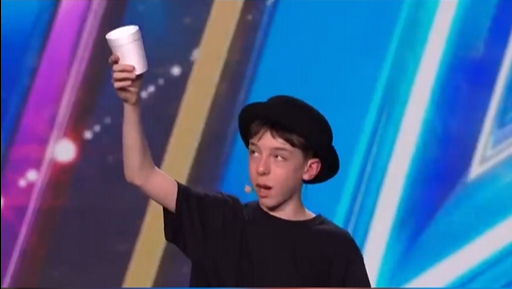
Then comes a bell-clear voice from someone who can barely reach the mic. “I’m eight,” he chirps, deadpan and disarming, and proceeds to manage the room like a veteran. He offers drinks to the panel — champagne for one, fizzy orange for another — and turns a shaken bottle into a prop he wields with cheerful authority. “Can you shake the bottle for me, Simon? Harder? More. Harder.” He barks the beats like a drill sergeant who still likes recess. When asked whether the fizzy chaos is going to “go up in my face,” he volleys back with timing beyond his years.
What marks him as more than a charmer is the construction. He asks Simon to take a card that reads, “Let me show you some magic,” and then to rip it — not once but twice — keeping a single corner as a receipt. There’s laughter, a theatrical aside about a spider and an aside about socks, and then the hammer falls. He asks KSI to peel the label off the champagne. “Wait. What? There’s a card.” Inside the label, sealed where no human fingers could reasonably have placed it in the last ninety seconds, sits a card. He has Simon hold up the piece he kept. “Do they match?” The answer lands like a drum hit: “Yes.”
The panel goes soft, proud, a little stunned. “You’re already a star at your age,” one says. “I cannot believe you’re eight years old. Honestly, the whole thing was absolutely fantastic,” adds another. The votes thump in with the inevitability of a final bow: “I would like to be the first person who gives you a yes,” followed by a cascade — “It’s a yes from me,” “I’m saying yes,” and, finally, a “massive yes.” It’s not just approval; it’s a coronation.
The black hole, and the light it gave
Some magicians work with thread. Others work with story. One walks onstage and announces a concept as big as the cosmos and as intimate as a diary. “Simon, think of a playing card,” he says, then swats down the guess — “Seven of diamonds.” “Wrong.” A beat, a smile, and then a sentence that feels like thesis and trick at once: “Sometimes everything is not quite as it seems. Watch.” The lights narrow. “The black hole, a journey that begins where everything ends.”
What follows is not simply a sequence of reveals but a portrait of a life reframed by wonder. “I’ve learned that having autism is not a disability. It’s an ability,” he says, voice steady, proud. He remembers the before — “When I was younger, I was unable to interact with people… I felt invisible” — and the after. “After discovering magic, my life changed. It was like a light switch coming on inside my head… I found a way to interact with people through my magic.” He lets the last line hang long enough for the theater to breathe it in: “Magic is my universe, and my life is now whole.”
In between these sentences, the effects land — objects vanish and return; choices foreseen in ways that should be impossible are revealed as inevitable. The trick is not the point. Or rather, it is only the point in the way a doorway is the point: you pass through it to somewhere else. The somewhere here is belonging.
Jelly beans and the mathematics of awe
Prediction is the coldest branch of magic — numbers and counting and the quiet, smug chess of it all — until a performer warms it with personality. One conjurer flips through a notepad stuffed with sweets. “Have a look and see,” he offers, then asks a judge to say “stop.” The voice lands on “Jelly beans.” It feels arbitrary in the way only deeply controlled choices can. He points the panel to a pre-set surprise waiting nearby. Lids off a jar, and there they are — jelly beans, as if the word itself had conjured sugar. Someone in the front row blurts the question hanging in the air: “How’s he doing that?”
He isn’t done. He asks Simon to guess how many are in the jar. There’s a pause, a private calculation, a grin. “Got it.” “What is it?” The answer, and then the kicker — a reveal that makes the guess seem less like a shot in the dark and more like a landing in a net strung before the night even began. It’s an old principle done freshly, which is the evening’s quiet refrain.
What we choose to see
Across this cavalcade of astonishments, certain phrases keep returning, like motifs in a symphony. “Don’t blink.” “Are you ready?” “Watch carefully.” They sound like instructions, but they are really invitations — to listen with your eyes, to trust the story, to give the performers the one resource that, once spent, cannot be returned: attention.
What also returns is generosity. The panel is quick with its praise, but more importantly, it is specific. “Totally in control of the stage. I cannot take my eyes off of you,” one judge tells the opening act. Another, after being toyed with by finger-born acrobatics, finds a direct line to the heart of the matter: “I have no idea genuinely how this happened.” That sentence, plain as a handshake, is the bedrock beneath the applause. The stage can be flashy or spare, the props grand or borrowed, but at the center of a good trick is the willingness to say, I don’t know — and be happy about it.
Even when the mechanics are half-revealed, the wonder holds. The escape artist’s frankness about plates and blackout does not leak air from the balloon; it changes the balloon’s shape. When he says he uses light to “show you certain thing, but also to hide thing,” he is making a promise the entire evening keeps. The hiding is not a cheat. It is a form of telling.
Mistakes, on purpose and otherwise
Live magic courts chaos. A thread can snag; a volunteer can mishear; a timing window can close one beat too soon. The quick-change artist’s near-miss becomes a lesson in how entertainment isn’t the absence of error, but the presence of grace. “Things do go wrong,” a judge says, “and that happens in life.” The audience is moved not because perfection was maintained at all costs, but because artistry survived contact with reality.
This is why the eight-year-old’s routine hits as hard as it does. The method requires choreography, misdirection, and precise delay — the sorts of components we tend to assume belong to adults with decades of practice. But when he says, “Can you peel off the label for me?” and the card appears where it should not be, we are seeing a child wearing a master’s jacket and finding it fits. The laughter onstage when he bosses a famous judge into shaking a bottle “Harder” isn’t just about cheek. It’s about competence disguised as play.
The thread that runs through
At first glance, the night is a collage: UV suits and whispering rings; laser pointers and lip-service wordplay; notepads and jelly beans, fabrics that flip identities, and cards that slip sideways into sealed places. The deeper structure reveals itself as a meditation on attention — how performers claim it, shape it, and respect it. When a magician tells you to “watch,” they aren’t simply asking for stillness. They are asking you to set aside, for a moment, the insistence that the world make sense in the way you expect. In return, they offer you a story where the rules bend but the feelings are true.
This bargain is at its most tender in the “black hole” sequence. “Sometimes everything is not quite as it seems,” he says, and while he is talking about a card, he is also talking about himself, and about us. The journey that “begins where everything ends” is not just an interstellar metaphor; it is a life that felt “incomplete” and “invisible” and found, in magic, a way to be seen. It matters that the tricks are good. It matters more that the voice telling them has found its own gravity.
“You have disturbed my mind”
Praise can blur if it is wasted on superlatives. Here, the words feel earned. “You kind of let us into your secret, and then you let us down again… I can’t wait to see what’s coming next,” a judge says early, and that’s the blueprint for the entire night: reveal and conceal in dancing turns, always leaving one more step ahead. Another line hangs in the rafters long after the applause fades: “You have got this great stage presence… This is exactly what I believe works in Vegas.” That isn’t a note about location; it’s about scale, ambition, polish — the sense that magic, done well, deserves the biggest room you can find for it.
There are other throwaway lines that lodge like souvenirs. “Speechless.” “Hot start, baby.” “A million percent yes.” They punctuate the evening with a rhythm that makes the acts feel part of the same heartbeat. By the end, the cumulative effect is less like watching a variety show and more like touring a museum where every gallery has a different climate but the same weather system: a front of astonishment moving inexorably across the room.
Why we still fall for it
It’s tempting, after a night like this, to chase method — to rewind the moments when the ring seemed to sidestep from one finger to the next, to replay how a signed card could slip itself under a rigid board again and again, to wonder which hand must have smuggled the torn message into a champagne label sealed by a factory a continent away. But the wiser impulse is the one the judges model: give up the chase and keep the feeling.
Because the feeling is why people return to theaters, why they buy decks and practice double lifts, why they grant strangers on a stage the one thing none of us have enough of — focus. The feeling is in the way an adult’s voice can soften to tell you the truth about their childhood, and in the way a child can stand in front of thousands and say, with impish authority, “Now can you read it out to everyone?” It’s in the way a conjurer can show you the tool of his deception — light itself — and still leave you giddy at the final count of three.
“Any question?” one magician asked after an escape that had us cheering before we remembered to breathe. The question is generous. It admits that what happened onstage is a conversation, not a sermon. The answer, of course, is yes. We have a thousand. How did you do it? How long did it take to learn? Where did you put the thing when our eyes were elsewhere? But the better answer is silence, the kind that arrives when you are so outmatched by wonder that words aren’t up to the job.
The curtain call
By the time the final bows arrive, the theater has been threaded and rethreaded with surprises. There are acts that play big and acts that play small, pieces that make you laugh before they make you gasp, and others that do it the other way around. What unites them is not genre or method but care — in staging, in tone, in the compact they sign with the audience at the top of each routine: trust me for a moment, and I’ll give you something we both can keep.
There’s a line from early in the evening that feels like a benediction for the whole affair: “Be careful, because if you blink, you might miss it.” It’s a warning, to be sure. But it’s also advice for a life larger than a night in a theater. Don’t blink. Don’t roll your eyes at the first hint of the incredible. Don’t sell your attention short. The magicians on this stage know what they can do with it when you give it to them. The least we can do is give them the chance.
If you want to feel your sense of what’s possible stretch and snap back with a smile, watch the performances gathered here from start to finish. Let the ring take its walk. Let the word “Fierce” ring in the air. Let a torn corner find its mate inside a label that should have kept it out. Let a “black hole” open and, paradoxically, fill you up. The only trick left is yours: press play, keep your eyes open, and enjoy being amazed.