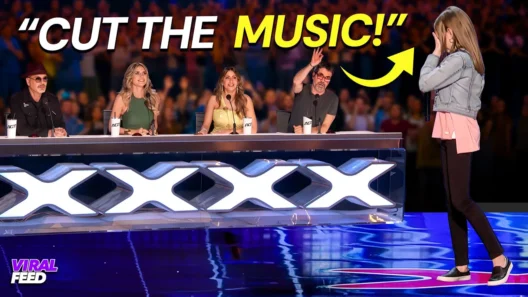
“Woah. Woah. What’s going on there?” The exclamation cut through the roar of a primetime crowd as bodies snapped, clicked, and seemed to glide on invisible rails. The promise of robot-style dance is simple and thrilling: make the human body move like a machine, then surprise us with the heart that powers it. Across America’s Got Talent and Britain’s Got Talent, that promise ignites a night of standing ovations, sharp disagreements, and one golden moment that changes everything.
Switzerland’s Precision, Britain’s Stage
The journey opens with introductions that feel almost modest for what follows. “Can you tell us who you are and where you’re from?” comes the question. “We are the blackouts from Switzerland,” the leader replies, adding, “and it’s a pleasure to be here. Thank you so much.” How did they get started? “It started as a small project, but we never imagined that it could grow to into something big.”
Then the music hits and the room tilts. The crew’s timing locks into a shared pulse—limbs articulating on micro-beats, torsos hinging like pistons, faces composed. When the stage erupts into cheers, a judge grasps for words. “Talk about a magic ride choreographed to perfection.” Another piles on the superlatives.
“It was world class.”
“Absolute perfection in every level. Flawless artistically, technically, the performance, the graphic, the choreography, the dancing.”
There’s laughter at the sheer release of it. “I need a lie down,” one judge jokes, before getting earnest: “You genuinely make people smile. You make people feel good. I love the music, especially Coldplay. You can’t go wrong with Coldplay.” Another judge frames the stakes: “That is exactly the kind of act that I believe can win the entire series this year… it’s different. It’s original. It’s creative.”
Not everything is seamless—an early hiccup sparks a frank appraisal: “Even the fact that it went slightly wrong at the beginning, it wasn’t your fault, actually made it better because it shows how difficult this act is.” And then the moment that sends a shockwave through the season: “We’ve got a team golden buzzer now.” Confetti. Hugs. A dream accelerates.
Backstage emotion rushes in. “You did it. It was so good,” someone blurts, as the crew tries to grasp their new reality. On stage, the gratitude is palpable. “You’re in the final. How do you feel?” “It’s so wonderful. Thank you so much,” comes the reply. “I’m speechless. I’m just thankful.” Later, amid still more praise—“It does not get better than what you did”—the crew explains their theme. “Our show is a tribute to the British people. We feel so welcome here… We worked so hard for this moment, and we put on everything.”
One judge, surveying the sweep of the night, puts a fine point on it. “Yeah. That, honestly is what we call a moment… the amount of work that goes into something like this… This was absolutely sensational. Seriously.” He looks down the panel and sums up: “This is one of the best final act acts in the final I think we’ve ever had. I really mean that.”
“Turn down the lights. Turn up the volume.”
The MC’s rallying cry feels apt: “Turn down the lights. Turn up the volume. And get ready to be entertained.” In these shows, entertainment is also an argument—about taste, risk, and what counts as dance in an age of screens and sensors. Praise lands hard. So does dissent.
Later in the episode, a judge casts forward to a national stage: “That was an absolute triumph… All I kept thinking when I was watching that is what an amazing start to the Royal Variety that would make with the king and queen in the audience… You smashed it. Well done.” The night keeps cascading upward. “It’s amazing. Absolutely dazzling… You blew my mind.” Another judge can only laugh at the abundance: “I honestly feel like I’m at the greatest show on earth tonight. This show tonight is getting better and better.”
Animation Crew and the Cost of a Big Idea
On America’s Got Talent, a different robot-language arrives with a wink. “Animation crew, the last time you made a painting come to life. What do you have for us today?” The dancers volley back: “Watch us, and let’s talk.” The host plays along. “We watch you, and then we talk. Alright. Good luck.” After a burst of popping and precision pops, they return to the panel. “Thank you. You dance, now we talk.”
The feedback splits. One judge loves the originality but wants consistency. “When you are in robot form, it is so entertaining, and then suddenly you break character, and I wish you’d stay. And it gets a little confusing for me… you guys are very talented, but watch that.” Another judge grins at the power: “Your pop lock was so, like, pow pow. At one point, I thought your heart was gonna pop out your chest. Great job.” A third notes, “You’ve taken something, made it original, and kind of gone with it and thoroughly entertained us.” The caution is practical. “The category of dance is a tough category, and you gotta do something different. I think you’re gonna stand out… We’re gonna deliberate, and then we’ll talk.”
When the crew returns to the live stage, ambition ramps up: giant retro graphics, lasers, joystick nostalgia. The result is polarizing. A judge hammers them. “Animation crew, this was a very lazy routine, a very poor use of the stage of Radio City Music Hall… I didn’t see anything new or original… you guys were asleep at the wheel tonight.” Another adds, with reluctance, “The video game kind of took over, overshadowed you guys… If you guys were just dancing without all of that, it wouldn’t have been special enough because you guys dance better than that… The game won, unfortunately, not you guys.”
But there’s a defense. “You’re giving me all this graphics behind you. That is part of their act. That’s what makes their act unique… I think the young kids of America are gonna get behind you and vote because it’s young and it’s fresh.” The finale critique lands like a gavel. “I like the concept… I don’t think that your talent lived up to your concept… it said game over, and I think it might be.”
In that push and pull is a lesson every modern dance act must absorb: technology can deepen the illusion of machine-like movement, but it can also swallow the dancers whole. The trick is to command the screen without becoming wallpaper to it.
The Tin Man With No Heart—and No Limits
“What’s your name?” “Kieran.” “Where are you from?” “Essex.” Seventeen years old, alone on a vast stage, he introduces his piece: “A dance performance… called the Tin Man.” The reveal arrives in a line that doubles as a thesis. “The tinsman forgot to give me a heart.” Then his body liquefies into angles and stops that look hand-drawn, a one-man comic panel animated in real time.
The panel erupts. “Wow, Kieran… Unbelievable,” one judge says. Another is swept away. “Kieran, you just absolutely blew our minds with that. I think the idea was brilliant. We keep saying to dancers, come with a concept, come with a theme. You’ve done it.” A third stacks on praise: “Brilliant concept. You are a brilliant dancer. Those moves were absolutely out of this world. Plus, you have huge charisma. It was faultless, Kieran.” And then a line that becomes lore: “It’s like you’re made of plasticine. I mean, the shapes you’ve made with your body was like you weren’t human.”
Even the show’s toughest critic is all in. “You know what, Kieran? You are without question one of the best dancers we’ve ever had on this show. And if you… put that together yourself, you’re a real genius, Kieran.” The verdict is lightning-quick. “It’s a yes.” “It’s a yes for me, Kieran.” “It’s a yes for me.” “You’ve got four yeses, and congratulations.”
But robot dance, like any high concept, must evolve. When Kieran returns later with an expanded production, the reaction shifts. The same critic who once crowned him bristles. “You’re 17. Very, very talented. Love, I’m being honest with you. I found… I got bored halfway through. I did. I thought it was too static. It was too self indulgent. You were trying to be too clever, and it didn’t show you well enough because I thought your first audition was way better than that… I would have probably switched over halfway through.”
Others push back. “Kieran, that was a fantastic performance. Well done. That is very imaginative… it was a brilliant, brilliant concept.” Another judges the arc kindly: “When you started, I thought this is really strong. It did fall a little flat in the middle… I would have liked to have seen you move across the stage more… However, you are a talented dancer, Kieran, I think you deserve a shot.” The final word returns to the balance between craft and spectacle. “The production on it was absolutely incredible, but it shouldn’t be about that. It should be about you… you were kind of limited within the fabulous production, if you see what I mean.”
Between Perfection and Personality
By night’s end, a picture emerges of what it takes to be “not human” on stage—and why audiences care. Robotic dance dazzles because it convinces us, briefly, that bones can hinge like servo motors and muscles can tick like metronomes. But the acts that endure give us more than math. They bake in story, warmth, even vulnerability. The Swiss crew’s gentleness off-stage—“It’s so wonderful… I’m speechless. I’m just thankful”—casts their perfect lines in a new light. The British tribute, the Coldplay lift, the humility in victory—these are the human gestures that keep technique from becoming sterile.
Likewise, Animation Crew’s duel with scale is a parable: if you design a world so big it becomes the star, you risk shrinking in your own spotlight. The judges weren’t arguing about steps; they were arguing about focus. And in Kieran’s case, the “Tin Man” metaphor cuts both ways. The act that first thrilled because it seemed to remove the heart needed, in a later round, to show more of it.
In moments of awe, the panel’s language turns simple and loud—“They were sensational.” “It was world class.” “Dazzling.” In moments of frustration, it grows precise—“too static,” “poor use of the stage,” “didn’t live up to your concept.” Both modes tell us the same thing: the bar is sky-high, and the smallest choice—when to hold character, when to break it; when to let screens sing, when to mute them—separates unforgettable from forgettable.
“I envision machines that not only compute, but learn, and perhaps even think for themselves… the future holds the promise of harmony, where man and machine intertwine… exploring the vast landscapes of knowledge and creativity together.”
That reflection, drifting over the closing beats, lands like a mission statement for the genre. The future isn’t about erasing our humanity to become machines. It’s about mastering the machine’s language so completely that we can speak it with feeling.
So, turn down the lights. Turn up the volume. Whether you thrill to the Swiss crew’s precision, wrestle with Animation Crew’s big ideas, or marvel as a teenager from Essex becomes elastic, this showcase captures a turning point for robot-style dance. Watch the video, listen for the gasps and the disagreements, and decide for yourself where the line between human and machine really lies.
https://www.youtube.com/watch?v=nt6oOx0htGs