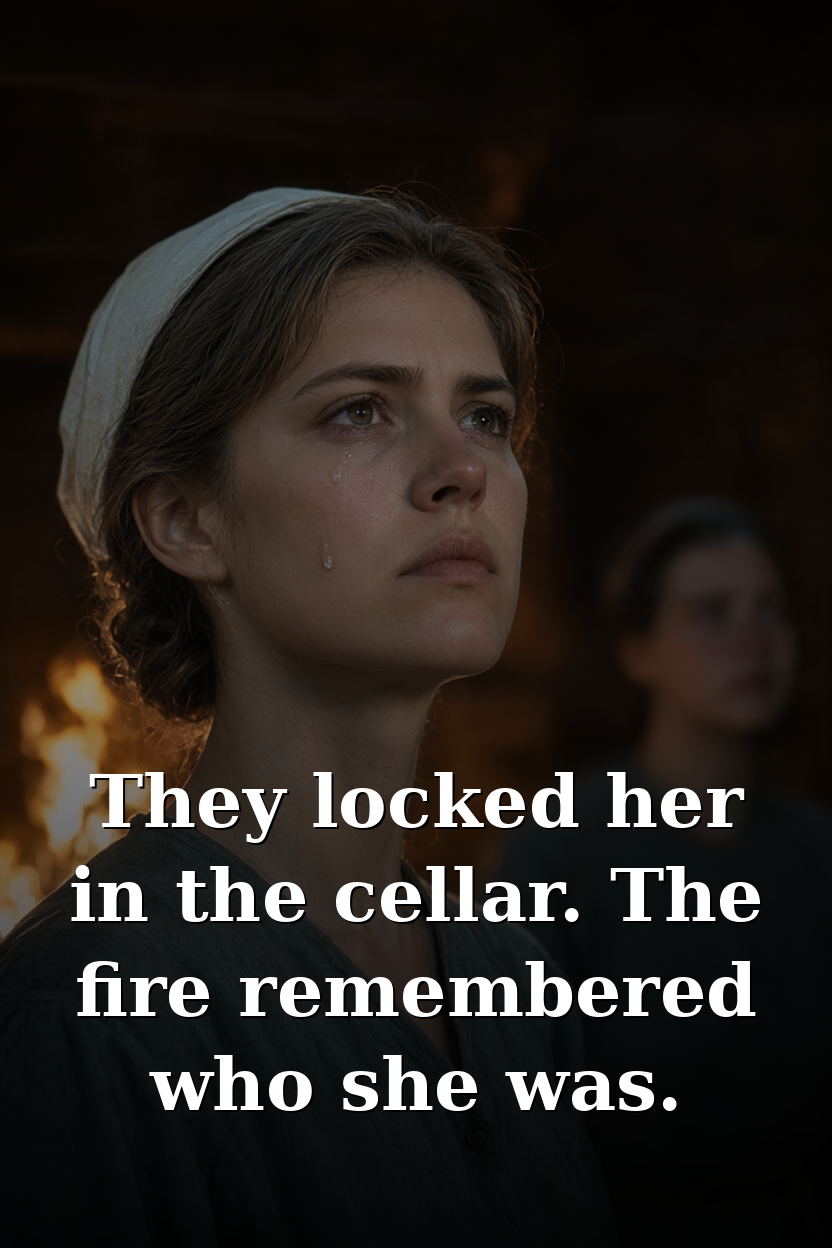
It was 11:00. The year’s fire has to burn before the midnight bell.
They finished the rite in the charred Hall, because the charter gives no second night.
Four hearths burned. The Bell’s was gray. Steward Morton carried the Book like he was carrying a town.
“The Bell seat,” Margaret said. “Ninety years dark. The line is ended. Open the seat to petition.”
“The Bell page,” I said.
He opened it. The leather smoked at the corner; the pages were whole.
“‘Joseph Bell, son of Samuel. Issue: one daughter, Anna.'” He turned the page. “‘Anna Bell. Issue: one daughter—'”
“Stop,” Margaret said.
“‘—one daughter, Cora. Born on Ember Night.'” The steward looked up. “A midwife’s mark is beside the entry.”
“That page was never there,” Sabine said. “That page burned with—” Then she heard herself. The whole Hall heard her too.
“The parish register,” Parson Crane said, his page shaking. “The church fire missed this one.”
Aggie read it. “‘Cora, born Ember Night, to Anna Bell, of the Bells of Ember Hollow.’ I know every Bell mark, and I’ve seen this one for twenty-four years.”
“Show them,” the steward said.
I turned my head. The town looked at the little bell mark and went quiet. Near the door, Mrs. Vane whispered, “That night. The night the stray died. The hearth lit itself.”
Margaret was not quiet. “This is a servant. No name, no claim. Steward, I will fund this Hall’s roof for ten years if the seat stays quiet.”
The room heard her — her own voice, in front of everyone.
“The Trust doesn’t take bids,” Steward Morton said. “Stand back.”
“Then let me prove it,” Sabine said. “My grandmother was a Bell cousin. Let me kindle the hearth.”
By charter, any hand may carry the year’s fire. The fire decides.
Sabine laid her taper on the Bell hearth.
The flame went flat like water. Black smoke rolled up the stone, and every family in the ring stepped back.
“No,” she whispered. “Something’s wrong with the hearth—”
“Stand back.” The steward looked at me. “Cora Bell. Bring the year’s fire.”
Nine steps. I counted them. I laid the taper down, and the Bell hearth took my light the way a mouth takes bread.
Gold.
It rolled across the ceiling in one wave — the same wave I saw through the grate in another life — and the four other fires bent toward it. Like grass in wind.
“The Bell seat is filled,” Steward Morton said. “The petition is void.”
Margaret stood with her mouth open. Nothing came out.
“And the Calder year-fire,” he said. “The Calder hearth has stood cold these four days. The charter is plain. The Calder seat is quiet for the year.”
“The box told us at noon,” Mrs. Vane said. “A dead coal. The girl never touched it.”
Margaret looked at the keys in her hand like a language she’d forgotten. The Trust took them at 12:02.
Sabine caught my wrist at the door, and I let her, because I wanted to watch her face.
“Cora. We grew up in the same house. You can’t — Mother, tell them, we fed her, we housed her—”
“You housed me in a cellar,” I said. “I heard you through the grate. You said I learned my place.”
“Please—”
“I know exactly what you meant.”
The midnight bell rang while her mouth was still open. She never finished the sentence. That was the whole point.
By morning, the story was everywhere: the Calders burned the town’s Book to steal a seat that was never theirs, and the girl who scrubbed their floors was the last fire in the valley.
Aggie took the east room of the Bell house. Parson Crane got his roof. Doane keeps the Book locked, key on his watch chain.
Margaret’s petition went to the county as evidence of fraud. Sabine left in the spring with three trunks and no name worth using.
The Bell hearth burns in the Hall again, and once a year I carry the year’s fire the nine steps across the floor myself.
Sometimes, late, I sit by the hearth and look at my right palm. Two lives. One mark. The fire gave both days back, and I paid for the second with every memory of the first.
For twenty-four years, Ember Hollow called me the stray. Tonight, the fire called me by my name — Cora Bell — and I answered.