The holidays feel a lot lighter when the money part is already handled. This free printable Christmas savings tracker turns one big December bill into six small weekly deposits, so gifts, food and hosting never land all at once. It includes a budget worksheet, a six-week deposit plan and a spending log you can print at home.
What’s inside the printable
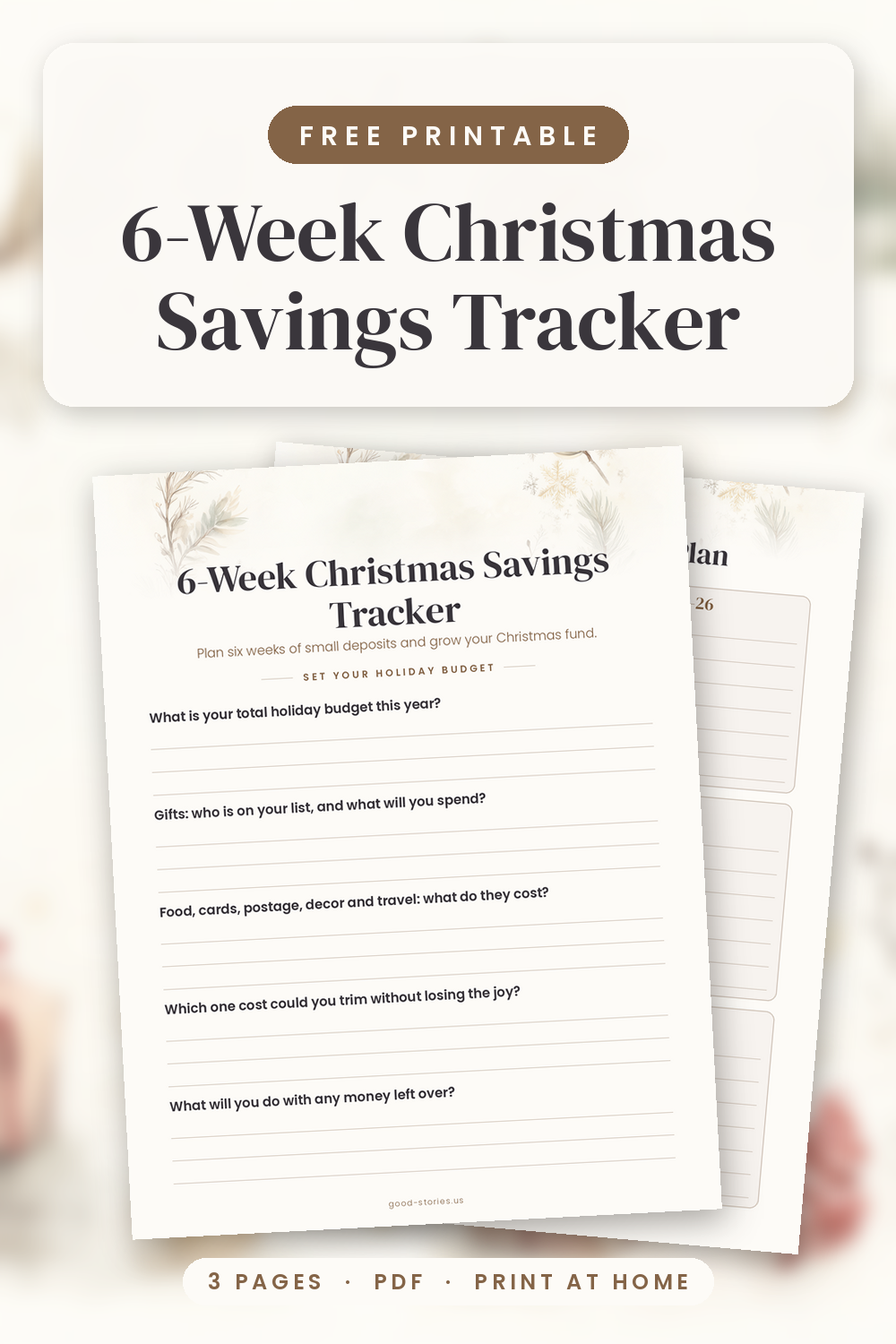
The free PDF is three pages, and each one has a clear job. Nothing to assemble, nothing to sign up for.
- Page 1 is a budget worksheet with five prompts and writing lines for your total budget, gifts, extra costs, trims and leftover money.
- Page 2 gives you six lined weekly boxes dated Nov 13-19 through Dec 18-24 for deposits and running totals.
- Page 3 is a 31-day December spending log with rows for gifts, food and hosting, cards and postage, decor, travel and total spent.
Why Six Weeks Is the Right Runway
Count back six weeks from December 25 and you land on November 13. That date does more for your holiday budget than any coupon code. Weekly deposits starting in mid-November spread the cost across six ordinary weeks instead of leaving everything to one frantic December bill.
Six weeks is also short enough to feel doable. You are not signing up for a year-long budgeting project, just a focused run through the most expensive stretch of the calendar. And if you find this plan later than November 13, do not skip it. Shorten the runway and raise the weekly number to match; five weeks of $120 still beats a panicked December.
Add Up What Christmas Actually Costs
Before you can divide anything, you need an honest total. On page 1, write down what you expect to spend on gifts for everyone on your list, food and hosting, cards and postage, decor, and travel. Do it on a calm evening with your bank app open rather than in a crowded mall.
Then add a buffer of about 10 percent. This is not pessimism, it is realism. There is almost always one extra gift exchange, one last-minute ham, one shipping upgrade. When the buffer is already part of the plan, surprises stop being emergencies.
Turn Your Total Into Six Weekly Deposits
Now the simplest part of the plan. Divide your total by six. A $600 holiday fund means $100 a week. Write that number at the top of page 2 where you will see it every single week.
Some weeks will not go to plan. A repair bill may eat the deposit, or a payment may arrive late. The printable is built for that: each weekly box has room for a running total, so a shortfall rolls into the next week instead of quietly disappearing. If a week goes better than expected, bank the extra in the following box rather than spending it; the running total is there to absorb both directions. You are not aiming for perfect, just visible.
How the Three Pages Work Together
Page 1 sets the number. Page 2 logs the six weekly deposits from November 13 to December 24, with a lined box for each week and space for the running total. Page 3 follows you through December with a 31-day spending log, rows for gifts, food and hosting, cards and postage, decor, travel and total spent.
The spending log is the page people skip, and it is the one that teaches the most. Comparing the budget on page 1 with the real numbers on page 3 shows where the money actually went, and which categories deserve more room next year. By mid-December the log becomes a quiet early-warning system: if gifts are already over budget, you can shift money from decor before it becomes a problem. The three pages turn guessing into a simple loop: plan, save, check.
After December: Review and Start Next Year’s Sinking Fund
On December 26, before the decorations come down, spend ten minutes with your finished pages. Add up the spending log, compare it with the plan, and jot one note about what you would change.
Then start a small sinking fund for next year. A sinking fund is simply money set aside monthly for a known future cost, and Christmas is the most predictable one of all. A modest $25 or $50 a month removes the entire problem before next November even begins. Write the monthly amount on a sticky note in your planner, and by next autumn you will have most of the fund built before the six-week countdown even starts.
How to use your printable
A few practical notes to make printing painless:
- Print on US Letter paper; the layout is sized for it and the writing lines stay generous.
- On A4, choose “Fit to page” in your print dialog so nothing gets clipped at the edges.
- Fill in page 1 in pencil first, then go over the final numbers in pen once you are happy.
- Keep page 2 somewhere visible, like the fridge or the inside of your planner, and log each deposit the day it leaves your account.
- If you use cash envelopes, pull the weekly amount out on deposit day and tuck it with the tracker.
- Leave the page 3 log on the kitchen counter with a pen, so December purchases get written down while the receipt is still in your hand.
Six weeks of small, deliberate deposits is all this plan asks of you. Print the tracker, set the number once, and let the weekly boxes do the rest, so that when Christmas morning arrives you can spend the day on the people around you instead of on the bill.