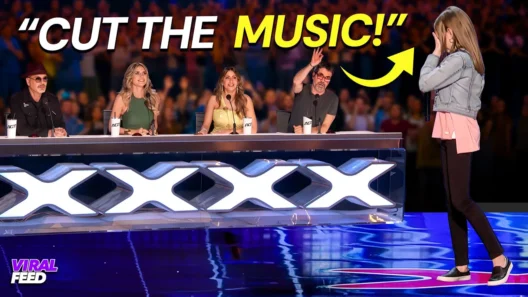
From the first moments, the show’s usual ceremony wobbles. There is a welcome, a greeting to the room, and then the simple, honest admission from the panel that sets the tone for what follows: “I’m a little afraid now. I don’t know what’s gonna happen. Yeah.” Fear quickly yields to curiosity. A judge tries to make sense of the figure in front of them—“You’re taped. You’re taped.”—and asks what everyone is thinking: what is he going to do? He only offers a shrug, a glance, a barely visible smile tugging under the strip of tape.
Some performers sell themselves with statistics or sob stories. Tape Face, the stage persona of New Zealand-born entertainer Sam Wills, arrives with only a bag of everyday junk and the confidence of a silent-era star. He communicates in the grammar of props and posture. If modern television has taught audiences to expect high notes and pyrotechnics, Tape Face’s show is a reminder that the highest stakes can be built out of almost nothing—cotton, elastic, cardboard, and a performer’s absolute belief that imagination, handled well, is louder than any mic.
The First Laugh: Two Mitts and a Love Song
The first act of mischief begins with a clap unlike any other: two oven mitts smacking together to make a pop that wakes the room. He slides them on and brings them to life—two plush, lipless faces mouthing along to a melody only he can hear. In that instant, the mitts become characters, lovers, vaudevillians. They flirt, they bicker, and soon they kiss, to the delight of a crowd that arrived skeptical and now giggles like co-conspirators. Across the panel, a judge points and laughs; in the front rows, hands rise to cover mouths because the surprise of it—the sheer bold simplicity—is a giddy kind of shock.
Then comes the red dress. He flicks it from a bag and, with the lightest touch, turns it into a dancing partner. The dress sashays and swirls, as if a body had ghosted into its seams. He holds it at arm’s length and then close, a full ballroom romance powered by quick wrists and rhythm. The illusion is not expensive; it’s clever. The applause rises until even the skeptical are on their feet, a standing ovation for a puppet that isn’t a puppet at all. If the mitts explain his language, the dress proves his scale: within a minute, Tape Face can give feeling to a piece of fabric and sell it as a star.
Part of the thrill is the risk of nothingness. With no voice, he can’t course-correct a joke that sags. He must read the room like a conductor watching the breath of a choir. When a judge tries to push the envelope of the mystery—“Maybe we’ll will we talk after?”—he gives a tiny nod and then a single, irresistible cue from the panel turns the key: “Okay. I love a mystery. Go ahead and do what it is you do.” He does exactly that, and more.
The Character in the Helmet
Somewhere in the middle of disaster and dream stands a lone stool. He straps on a pilot’s helmet and goggles and takes the stool not as furniture but as a flight plan. He leans into the air, body taut, and balances so the stage itself becomes a sky. No words, no music swell, just the clean image of a grown man who refuses to let gravity steal the joy from a simple childhood game. There’s a sweetness to it that cuts through any irony in the room. This is what he’s offering: not just gags, but a door back to a time when a piece of tape and imagination could build a world.
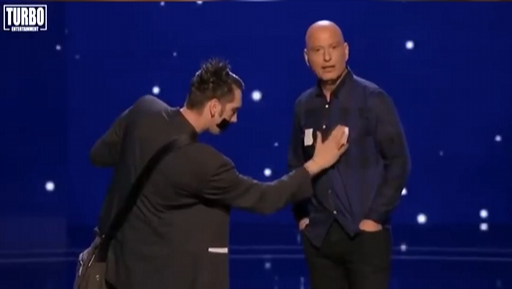
As he peels a roll of white tape, the audience anticipates a line on the floor or a mark for choreography. Instead, he walks to the judges’ desk and sticks two squares of tape to a shirt—Howie Mandel’s, as it happens. Then the magic escalates. In quick, purposeful moves, he snaps pencils, hands one to the judge like a scepter, and suddenly Howie’s arms are no longer his: Tape Face is the puppeteer, and Howie is the marionette.
Howie Becomes a Puppet
What makes this sequence glorious is the care. Tape Face never humiliates; he recruits. He puts the judge at the center of the joke and then treats him like the lead. The crowd already trusts him, but the silent clown still ratifies the contract: his gestures ask permission even when they don’t verbalize it. He tests the waters—lift an arm, drop an elbow, turn a wrist—and waits for the room’s roar to ratify each beat. He gives Howie the power to play along and, in the process, gives the entire theater permission to be foolish too. The result is the kind of laughter that ties strangers together, the communal high of a shared ridiculousness that never turns mean.
And it’s not just one judge. When the clown slides behind Heidi Klum and wraps his arms around to guide her hands, the audience sees the whole room flip into a stage. Heidi’s composure becomes part of the choreography; Tape Face turns her into an orchestra of fingers tapping and waving, and the theater thunders with delight. If parody can bruise, his does not. It lifts and winks and moves on, always in search of the next sight gag that feels both fresh and inevitable.
Chaos With a Choreographer’s Ear
Nick Cannon, the ringmaster who thrives on kinetic moments, can’t resist joining. He slips on sunglasses and starts bouncing to the room’s pulse. Tape Face hands him a matching pair, and together they find a rhythm that feels half-disco, half-playground. It’s a dance, yes, but also an agreement: the performer curates the chaos with the easy authority of a busker who has wrangled city traffic and toddlers and knows exactly when to punch the joke and when to step aside and let the crowd see itself.
Then the danger arrives—comic danger, but danger all the same. A toy gun appears, absurdly small, and he points at a bright balloon held aloft by a brave volunteer. He fires. The room holds its breath at each tiny “pop,” every shot a test of aim and timing. In a heartbeat the duel doubles: he recruits an audience member, hands over another toy gun, and they face off in a low-stakes Western. Stagehands don’t rush in. No one shouts instructions. It plays as organized anarchy, the kind that, in the right hands, builds a bond between player and crowd.
The exchange has a running commentary, clipped and funny in its brevity—“Take that. Be careful, ma’am.”—and it reminds everyone that even silence can carry a voice when props and posture deliver the lines. The tiniest firearm produces the largest gasps, a reversal worthy of a magician. The visual punchline lands in confetti-sized pieces of yellow rubber floating to the floor, victory as a squeaky whisper.
Horses, Thrones, and Toilet Paper Finish Lines
On his best nights, Tape Face turns the stage into a sandbox. Two toy horses on sticks appear, and he bounces them as if they’ve got real hooves and stubborn hearts. He cut-pastes childhood into prime time without apology and never once looks embarrassed about it; that’s the trick. He makes it safe for everyone in their seats to enjoy a toy-shaped fantasy because he enjoys it first and most of all.
Then comes one of his great, goofy coronations. He swings a toilet seat like a necklace and drops it gently around Mel B’s neck. For a split second there’s surprise—wide eyes, hands up—and then a wave of laughter breaks and crests. The crown slips, the throne wobbles, and the gag escalates in the most literal way: a finish line made of toilet paper unfurls from a stand, a thin white ribbon begging to be broken. There’s a flicker of miscalculation, a confession that lands like an aside from the wings: “Broke the toilet seat.” The room howls, because failure is baked into the cake with this character. He never hides the seams. He shows the duct tape and the scuffs because the joy is in seeing a man build a circus out of flimsy things and win anyway.
He crosses the toilet paper line like a champion, a grin creasing around the tape, and what registers isn’t victory but play. A judge, beaming, offers the kind of simple benediction that sums up a night where the laughter never feels forced: “We love it.” The reply from the stage, or maybe from the air around it, seals the mood: “That’s how much fun we have.” It’s hard to argue with results when the house refuses to settle down even as the lights shift toward the next stunt.
The Human Bridge
In his most audacious tableau, Tape Face doesn’t rely on a single object. He relies on people. He builds a living sculpture out of volunteers, each body angled just so, each chair set as a fulcrum for the next. One man is painted like an anatomy chart, sinews and organs sketched in color, a walking reminder that the human body is both machine and mystery. Tape Face moves them like pieces on a game board and then—and this is the crucial part—steps back to hold the silence while the crowd measures the risk.
This is not cheerleader stacking or acrobat twirling. It’s tension in stillness. Four men tilt into a human bridge, shoulders becoming footings, thighs turning into beams, and in that sharp breath before the applause the theater hears the soft groan of chairs and the crowd’s choked gasp. The bridge holds. The performer snaps a selfie, not with smugness, but with the glee of a kid who just proved a dare could be fun and safe at the same time. No one falls. No one is tricked. Everyone is included in the illusion. That is his ethic: gather the room and let it carry the weight together.
Why Silence Wins
It sounds like a contradiction, but in a show built around chatter—judges’ banter, hosts’ patter, stories of triumph—silence is not an absence. It’s an instrument. Tape Face tunes it well. He uses a judge’s raised brow as a cymbal crash, a surprised gasp as a baseline, the slack-jawed pause of a child seeing a dress come alive as the song’s bridge. The effect is part Chaplin, part Mr. Bean, part every busker who ever learned that eye contact can be a punch line.
Silence also levels the playing field. Without an accent, without a language barrier, without a shouted plea for sympathy or votes, a joke lands on its own terms. Tape Face can gesture to a cup, drop a red ball into it, and the entire room understands the setup. He can extend a hand toward a judge, or wrap his arms around a model’s shoulders to puppet her fingers, and the audience sees the implied question and its joyful answer. In exchange, the room grants him an uncommon grace: the right to slow down time. Laughter has a rhythm; he keeps it with the patience of a street performer who has worked a hundred corners and learned to wait for the exact right second to turn a glance into an explosion of sound.
None of this would work if he used people as props instead of partners. Watch how he approaches the table, how he shows the tools—tape squares, a pencil, a toy gun—before engaging. He asks permission without words, and he listens with his whole body for what comes back. When a judge says, “Anything you wanna tell us?” and he signals no, the next line—“No. No. Alright. Then start. Great.”—lands not as rebuke but as a happy dare. The crowd wants the show as much as he does. Consent, once earned, lets him play at the very edge of absurdity without tipping into cruelty.
The Joke Is the Journey
There’s another piece of the puzzle that deserves its due: confidence in materials that don’t look like much. In a medium prone to spectacle, Tape Face leans on the throwaway. The bag he carries is closer to a kitchen drawer than a magician’s trunk. Mitts, a dress, sticky squares of tape, plastic guns, toy horses, a toilet seat, a roll of toilet paper. By spotlighting the cheap and ordinary, he makes a case for the democratic nature of delight. Anyone could, in theory, do this. Of course, that’s the bluff. The just-so timing, the finely tuned facial control, the elegant physics of a human bridge—they’re anything but easy. Craft hides inside play, the way a symphony hides inside a whistle if you know how to shape the note.
The show’s staging underscores the point. Props don’t announce themselves with thunder; they simply appear, already part of a story he is telling with hands and eyes. A small table becomes an altar to the red ball. A pair of sunglasses transforms two men into a syncopated duo. A toilet seat, hoisted like jewelry, blesses a pop diva with a crown so silly it feels regal. The joke isn’t the prop itself; it’s the gap between what an object is and what he convinces you it could be for a few charged seconds.
Audience Alchemy
It takes a particular temperament to coax a theater into play without words. Sometimes the secret is as simple as a wave. Sometimes it’s the courage to endure a long pause. The night even carries little eruptions of feeling—“I’m scared.”—as the panel surrenders to the not-knowing that anchors good comedy. And then, just as quickly, there’s a soft greeting—“Hi.”—when the tension is released, a reset that invites the next round. Those tiny quotes dot the evening like road signs through a fog bank. We don’t know what’s next, but we’re together while we find out.
There’s a sequence late in the show where the performer’s roving eye catches on a woman with a balloon and, without any script, a whole room leans in. He doesn’t rush. He paces the stage, waiting for the electricity to peak before the first tiny gunshot turns surprise into celebration. By the time the duel ends, the crowd has shifted from spectators to participants, finishing punch lines in unison. That shift is a hallmark of his best work: he turns audiences into collaborators, never into marks.
What Lingers After the Laughter
When the tape finally peels off at the end of a long season—or even if it never does—what remains is not a catalog of props but a sensation: the feeling that you were part of a friendly heist. Tape Face steals nothing but time, yet he hands you back more than he took. The memory of a woman clutching a balloon, of a judge’s arms moving on strings that aren’t there, of a group of men balanced into a sculpture that shouldn’t stand but does—it all settles into that warm, grateful space where shared entertainment becomes a story you’ll tell someone else later.
Television is loud. It shouts to keep you from flipping away. Tape Face does something radical in that context. He trusts you. He holds a stare, taps a mitten, sets a toilet paper finish line, and bets that you’ll stay because the next beat will be worth it. He bets, in other words, on joy. And that’s why the odd scraps of dialogue land so sweetly at the end: “We love it.” “That’s how much fun we have.” They’re not slogans. They’re little thank-yous, exchanged back and forth between a crowd and a man who came prepared to lose his voice so he could hear the room.
So here is the invitation: watch the full run and let yourself get recruited. See the mitts sing. See the dress dance. Marvel as a judge becomes a puppet, as sunglasses turn chaos into a duet, as a toy gun makes a room hold its breath, as a flimsy ring of plastic becomes a queen’s collar, and as a human bridge stands because trust and posture say it can. The tape is real; the silence is realer. But the noise that follows—the laughter, the gasps, the applause that rushes like weather through the theater—that’s the point. Press play, meet the man who talks with everything except his mouth, and discover how a sealed strip of black can open a thousand doors.