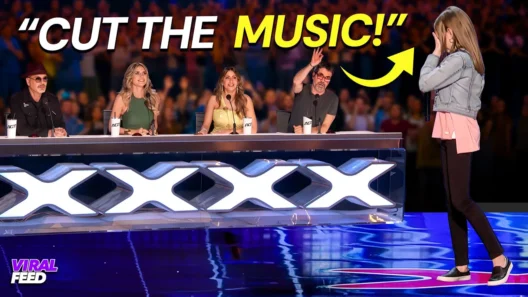
“Breathe in.” A beat. “Breathe out.” It’s a ritual you can hear from the stage, a tiny metronome for nerves. Audiences settle, cameras blink red, and the contestants—hands, decks, rings, sunglasses—go to work. What follows across these Got Talent stages is sleight-of-hand not as a set of tricks, but as theater: suspense, laughter, shock, and that sweet, satisfying confusion that makes a crowd leap to its feet.
This video is a tour of ten magicians who understand that the smallest motion can bend a room. They trade in rhythm and silence, in a borrowed ring or a flicked corner, in one perfectly timed breath. And they keep finding new ways to make the familiar feel brand new.
Borrowed Sunglasses, Borrowed Time
The opening salvo is disarmingly simple: a question to the room—“Does anyone have sunglasses right now?”—and a confident “I do.” A pair appears from the judges’ desk, and in seconds the magician’s style is clear. Nothing is rushed, nothing is fussy. He treats the stage like a sketchpad, turning jokes into feints, pockets into portals. A few beats later, the atmosphere tilts.
“Oh, what’s happening?” someone blurts as the set itself seems to slide into the act. “Did this thing close?” “Yes.” Laughter morphs into a chorus of “Woah.” It’s light and cinematic all at once, and the panel catches the moment. “You found a whole new way of presenting magic,” one judge says. Another stacks praise on delivery: “Your stage presence is sensational.” “That was so slick,” a third adds, “choreographed to perfection.” Pens hit voting buttons: yes, yes, yes, yes.
Dreamers on a World Stage
That confidence doesn’t come from nowhere. “What is your name?” a judge asks a fresh-faced performer. “My name is Florian Savay. I come from France.” The next question is blunt: what’s the plan if he wins? Florian doesn’t hedge. “My dream is to have my own show and to do a world tour with it. Before to do it, I need to show my magic to the world.” It’s charming, earnest, and as soon as the cards and coins surface, instantly credible.
Later, in a different theater, another dreamer steps into the light. “Where are you from?” “I’m from very, very tiny village. It’s called Totsukawa Village in Japan.” He smiles, sheepish and proud. “To perform in front of you and you and you was biggest dream.” Two minutes later, the room is radiating: a dove snap, a ripple of color and feathers, and a punchline that drops jaws. One judge all but shouts what everyone is thinking: “The fact that you just turned into a pigeon in front of our eyes, that is unbelievable.” Another distills the feeling: “It was like being in the happiest place. I can’t describe it, and I just didn’t want it to end.” The panel doesn’t hesitate. “A million percent yes.” Four lights go gold.
A Master Class in Pure Sleight-of-Hand
The best sleight-of-hand isn’t loud; it’s precise. One act arrives with no set pieces beyond a deck, a table, and a tempo. It’s the kind of routine that demands you lean in, and as you do, simple displays—dealing, squaring, pausing—accumulate into something surgical. You hear it in the feedback: “Technically, this is like a master class, isn’t it?” one judge muses. Another pares it down to its truth: “There’s something to be said in magic for the big effects. There’s really, when it comes right down to it, no jive, just raw, brutal, unbelievable skill. Those hands, they are the best I’ve seen.”
It lands because it’s unadorned. A color seems to change while you’re focused elsewhere. A pattern recomposes right under your gaze. A panelist tries to keep up and admits defeat with a grin: “We were missing some of the tricks because it was like, oh my gosh. What is this? Change color. We haven’t even realized that because we were looking at the cards.” Simple and yet so complex—exactly the razor’s edge where sleight-of-hand lives.
Fingers No One Believed
Then comes a kind of close-up delirium that only a live camera and a silent room can deliver. A young magician grins, shows his hands, and asks the audience to do the one thing you should never do during great sleight-of-hand: “Don’t blink.” A ring jumps—pinky to ring finger, ring to middle—so cleanly that you search the air for wires that aren’t there. He winks at the suspicion. “Many people think I moved the ring very quickly, but, actually, I didn’t move the ring. Watch. I moved a finger.”
He says it playfully, then appears to detach a digit, pivoting it out of sequence like a hinge. Gasps spill into laughter. “He’s shut down his finger,” a voice yelps. “I’ll put it somewhere else,” the magician teases, then restores it with an apology: “That’s too much. I’ll put back like this for real.” The panel is floored. “I had never seen anything like this. Never.” “We’ve never seen anything close to that.” Another judge adds the sentiment that so many international contenders carry to these stages: “I love that you came all the way from Taiwan to show us that.” Four yeses, and a new genre of impossible is born.
The Arrow Card and the Empty Wallet
Comedy is a weapon, too. “Today, I will show you guys a card trick,” says a soft-spoken card worker. “I practiced this for a long time.” The premise is classic—finding four aces—but he complicates it with a sidekick. “Do you see this arrow card? This arrow card will help me whenever I make a mistake.” The arrow winks in and out of play while the aces surface with casual elegance.
He shuffles mischief into the mix with a prop. “This is a wallet. Empty wallet. Empty wallet. I’m broke.” The gag lands; the wallet, of course, isn’t done. A spectator selects a card—“Show it to everyone”—and soon the routine spirals into a suite of spades. “I refined the all spades from the deck,” he says, then deals: “Ace, two, three, four… and five is here.” Six, seven, eight—“that is all I can do”—until the arrow card earns its keep, finding the nine. An “Uh-oh” later, court cards cascade, and with a flourish he declares, “There we go. I found the king of spades.” Somewhere between the deadpan and the dexterity, the room forgets to breathe.
When Imagination Becomes Reality
Not every story begins with a deck. One segment rewinds a life. “This is me when I was one year old,” the narrator says as keepsakes flicker into view. “This is when the real magic began for me.” Memory becomes method; nostalgia, misdirection. Props appear as if cut from childhood—photographs, toys, paper pieces that transform. “Ever since I was a little, I’d love to play with the imagination,” he says, then completes the thought with a promise: “When you believe in your imagination, sometimes the pieces of your imagination become reality. Just like this moment.” The theater goes still. The trick is strong; the feeling is stronger.
Signed, Sealed—Check Your Cup
Modern champions know how to raise the stakes: get a name on the card. “Pick one of these cards. Show it to the camera,” a headliner instructs. “Can you open the marker? Write your name right over there.” A judge complies—then, on command, even stands up. A beat passes. “You can sit back then,” the magician says, almost too casually.
Soon, there’s a second signature. The routine is a symphony of pacing and silence, the kind where spectators forget to suspect the obvious because the timing is just that persuasive. When it’s over, the revelation isn’t a pocket or a mouth—it’s the object no one thought to guard. “Can you try opening your cup?” a voice suggests. The judge blinks. “No.” He opens it anyway. “Look at that. That’s my card.” Another lid clicks. “And Howie’s card.” The panel breaks. “Unreal.” The commentary is half laughter, half hygiene PSA. “I had so much to say,” the judge jokes, “but now I realize I’m holding cards that were in your mouth.”
Even then, the compliments carry weight. “You did it yet again,” one judge says, calling it “another jaw dropping performance.” Another salutes the nerve it took to return: “I don’t think many people, having won the show, would have had the guts to come back again this year and do what you’ve done. And for that, you have my utmost respect.” The summary is simple and earned: “The great Shin.” “Best of the best.” “You were amazing. Literally amazing.”
And, as if to underline the rule that signatures make miracles matter, the host gets drawn in. “Pick a card. Any card. Sign it,” the magician says with the warmth of someone dealing to an old friend. “Terry, your card is unique. Yes. It’s your signature. I put your card in the middle of the deck slowly.” The coda lands with a wink: “Take it and take it safe.” It’s showmanship: protect the impossible you just witnessed.
What Makes These Miracles Land
Across theaters and accents, the thread is control. A breath before a vanish. A borrowed prop that rearranges the physics of the stage. The soft confidence of someone who has rehearsed until motion turns into muscle memory. Sleight-of-hand, at this level, isn’t about hiding things. It’s about directing sight and thought so completely that an audience volunteers to dream with you.
That’s why a laugh line like “Empty wallet. I’m broke.” can guard a revelation, or why a gentle instruction—“Don’t blink”—is both a dare and a decoy. It’s why a judge’s praise—“Your stage presence is sensational”—matters as much as a method. Magic on television is a paradox: millions watch, but the best of it feels private, whispered from hand to eye. In these sets, the magicians let the cameras come close, then make intimacy their ally. The closer you look, the more you want to look closer still.
There’s something else these performances share: a sense of purpose. “My dream is to have my own show and to do a world tour,” says one hopeful. Another calls this shot a “biggest dream.” Those aren’t throwaway lines. They’re an artist’s mission statement—the reason to polish a false transfer until it gleams, to practice an in-jog at midnight, to learn how to borrow a judge’s prop without borrowing their attention.
Put it all together and the showcase plays like a study in timing. Flashy, funny, lyrical, or spare, each routine respects the same core principles and spins them into a signature. A pigeon blooms out of a scarf, a stage set joins the conspiracy, a finger appears to unhinge, a king of spades arrives fashionably late, and a pair of cups turn into vaults for signed pasteboards. And when it ends, the air in the room has changed. People are smiling at strangers. The judges are still muttering “How?” Magic, for a moment, is the language everyone speaks.
If you want to feel that language at full volume—if you want to hear the laughter when the wallet proves it isn’t empty after all, see a ring jump across knuckles like a hummingbird, and watch a world-class champion turn a Styrofoam cup into a finale—settle in and press play. These ten artists will make you lean forward, hold your breath, and then lose it, joyfully.