If you have ever been curious about tarot but did not know where to begin, this simple 3-card spread for fall is a gentle place to start. It uses three cards for self-reflection rather than prediction, and it comes with a free printable so you can keep track of what you notice. Here is how the spread works, how to draw your cards, and how to use the two-page reading log that goes with it.
What’s inside the printable
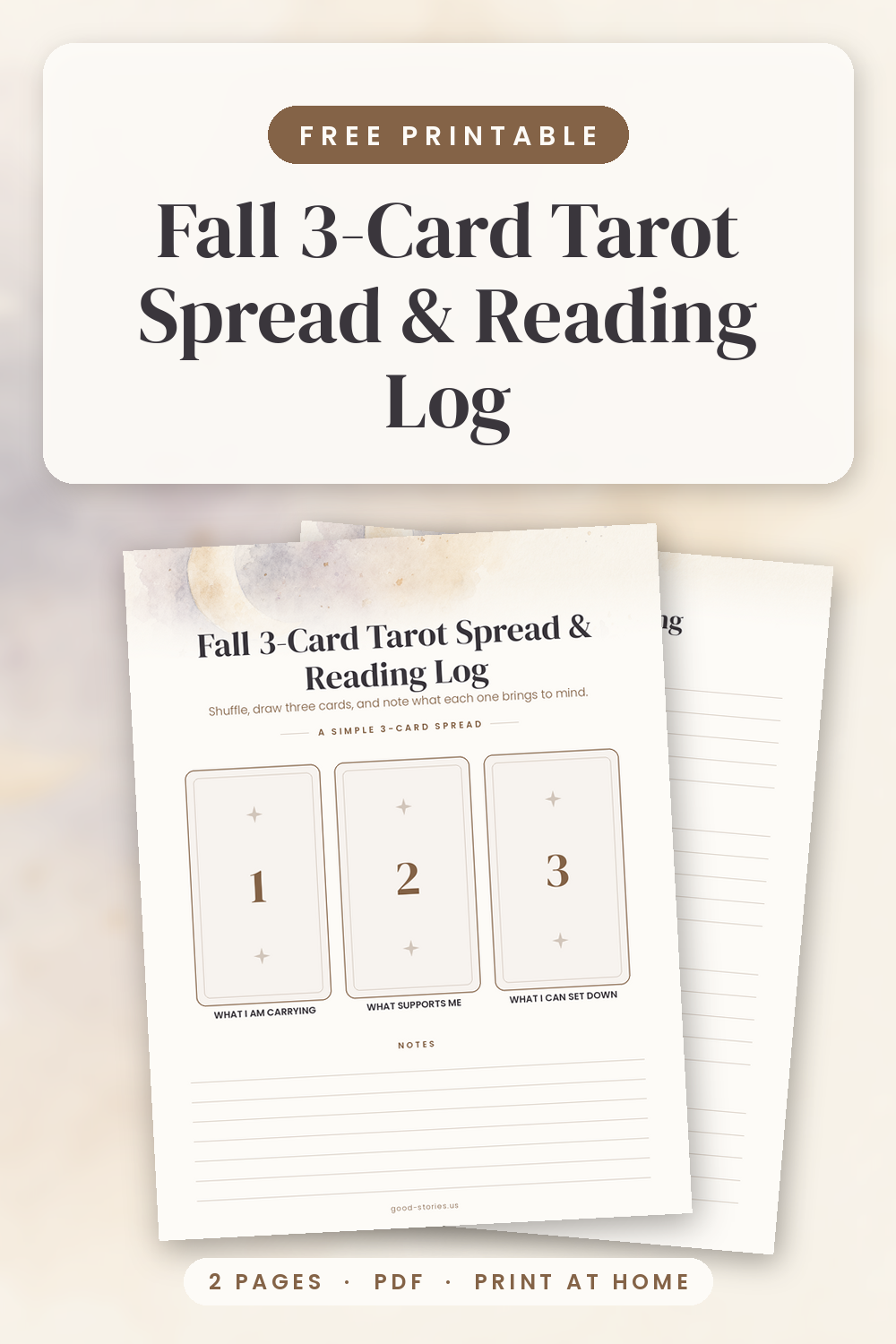
The free printable is called Fall 3-Card Tarot Spread & Reading Log, and it runs two pages. Here is exactly what is on each page:
- Page 1: “A Simple 3-Card Spread” — a spread sheet with three numbered card spaces labeled What I am carrying, What supports me and What I can set down, each with note lines to record the card drawn.
- Page 2: “Notes on My Reading” — four reflection prompts with writing lines: first impression of the card, feelings or memories it brought up, what to carry forward, and a card to sit with again.
What a 3-Card Spread Is and Why It Suits Total Beginners
A 3-card spread is exactly what it sounds like: you draw three cards and lay them out left to right. Each position asks a different question, and together the three cards form a small, manageable reading. Tarot is a tradition that many people use for self-reflection, and a three-card draw is one of the friendliest ways to meet it. A tarot deck has 78 cards. Twenty-two of them are the Major Arcana, numbered 0 through 21, and the other 56 are the Minor Arcana, divided into four suits: Wands, Cups, Swords and Pentacles. You do not need to memorize any of that to begin. The purpose here is to slow down, look at three pictures, and notice what they bring up for you.
How to Shuffle and Draw Your Three Cards
There is no special skill required to shuffle or draw. Hold the deck however feels natural, keep the cards face down, and draw three. Then flip them over one at a time, left to right, so the reading unfolds in order. If you want to look up meanings in a guidebook as you go, that is completely normal. Many experienced readers still reach for a book when a card does not immediately speak to them. You are not being tested, and there is no wrong way to do this. Take your time with each card before moving to the next.
The Three Positions of This Fall Spread
This spread uses three simple positions that work well for a seasonal check-in:
- Card 1 — What I am carrying: the concern, thought or feeling that is most present for you right now.
- Card 2 — What supports me: a source of steadiness, whether a person, a habit or something you already know about yourself.
- Card 3 — What I can set down: something it may be time to loosen your grip on as the season changes.
These are journaling prompts, not predictions. The cards are not telling you what will happen. They are giving you a way to put words to what you already sense, and the printable gives you a place to write it down.
Reading Your First Cards Without Fear
When you turn over a card, describe the art and your first reaction before you check any meaning. What do you notice first — a color, a figure, a feeling? Your honest first response is often the most useful part of the reading. If a card looks intimidating, remember that tarot’s most dramatic images are traditionally read as markers of change, not doom. Death, card 13, is usually understood as an ending that makes room for something new rather than a literal one. The Tower, card 16, is read as a sudden clearing away of what was already unstable. Neither card is a prediction of disaster. In a self-reflection reading, they simply ask: what in my life feels like it is shifting?
Getting the Most from Your Printable Log
Write down each card you draw and whatever notes come to mind, using the spaces on the spread sheet for the three positions and the prompts on the second page for deeper reflection. At the end of the month, read back through your log. Look for cards that appeared more than once and themes that kept showing up. A repeated card is not a sign that something is wrong; it is simply a pattern you chose to notice. Over time, the log becomes a record of how you were thinking and feeling through the fall, and that is worth keeping.
How to use your printable
A few practical notes so the pages print the way you expect:
- Print on US Letter paper at 100% for the intended layout.
- If you use A4 paper, choose “Fit to page” in your printer settings so nothing is cut off.
- Print the spread sheet and keep it beside your deck while you draw.
- Use the notes page right after your reading, while your first impressions are fresh.
- Revisit both pages at the end of fall and compare what you wrote with how the season actually felt.
Tarot does not have to be mysterious or complicated. Three cards, a few quiet minutes and a pen are enough to start a simple fall practice that helps you check in with yourself. Download the free printable, draw your first three cards, and see what this season brings up for you.