Your brain is a very confident liar. Every day it fills in gaps, smooths over shadows and decides what a scene means long before you have had a chance to look closely, and that speed is usually a gift. It is also why a good photo can stop you in your tracks.
These nine images are built entirely around that shortcut. Each one hides a small visual trick in plain sight: a face where there is only furniture, a pet that has become part of the scenery, a hand or a watering can that seems to bend the rules of size.
The game is simple. Take each photo on its own, decide what you think you are seeing, and only then read the explanation underneath. Some will give themselves up in a second. Others may keep you looking for a while, which is exactly the point.
All photos in this gallery are AI-generated illustrations of everyday visual tricks.
1. The Quiet Plant Lady Of The Greenhouse
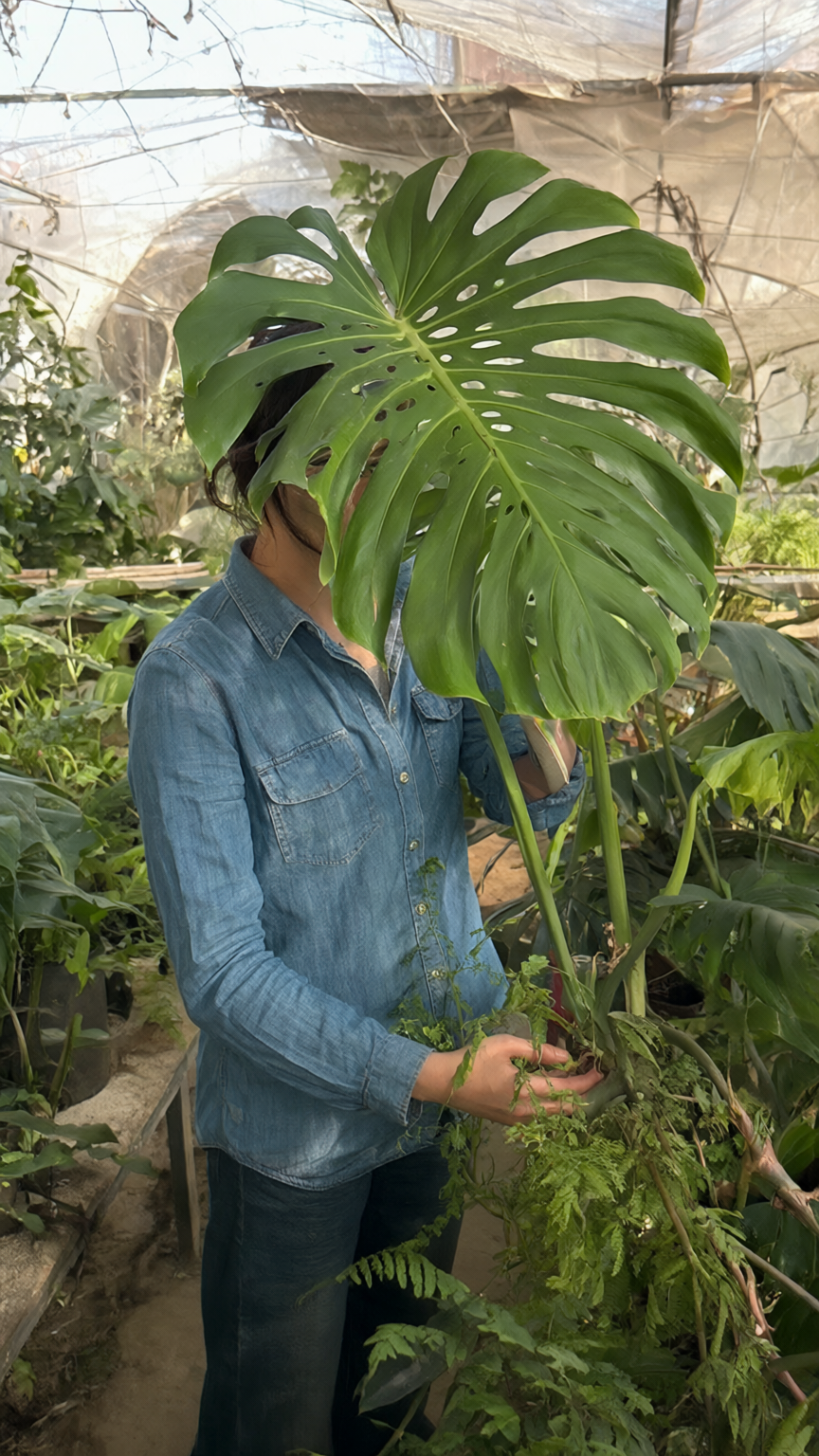
At first glance this is a straightforward portrait of a gardener at work. A woman in a denim shirt leans over a bench of ferns, and the eye lands on the big glossy leaf at head height, accepts it as a face turned away, and moves on. The brain is so eager to find a person that it happily swaps a plant for a head.
Look at the left edge of that monstera leaf, where a few strands of hair slip out from behind it, and at the collar of the denim shirt directly below. The leaf is hanging well in front of her, close to the camera. She is behind it, holding a fern, and the large leaf simply covers the exact patch of the frame where her face should be.
This is the same filling-in habit that lets you recognise a friend across a crowd from the back of their head. Give the brain a body and a hairstyle, and it will supply the rest of the person for free.
2. A Handful Is An Understatement
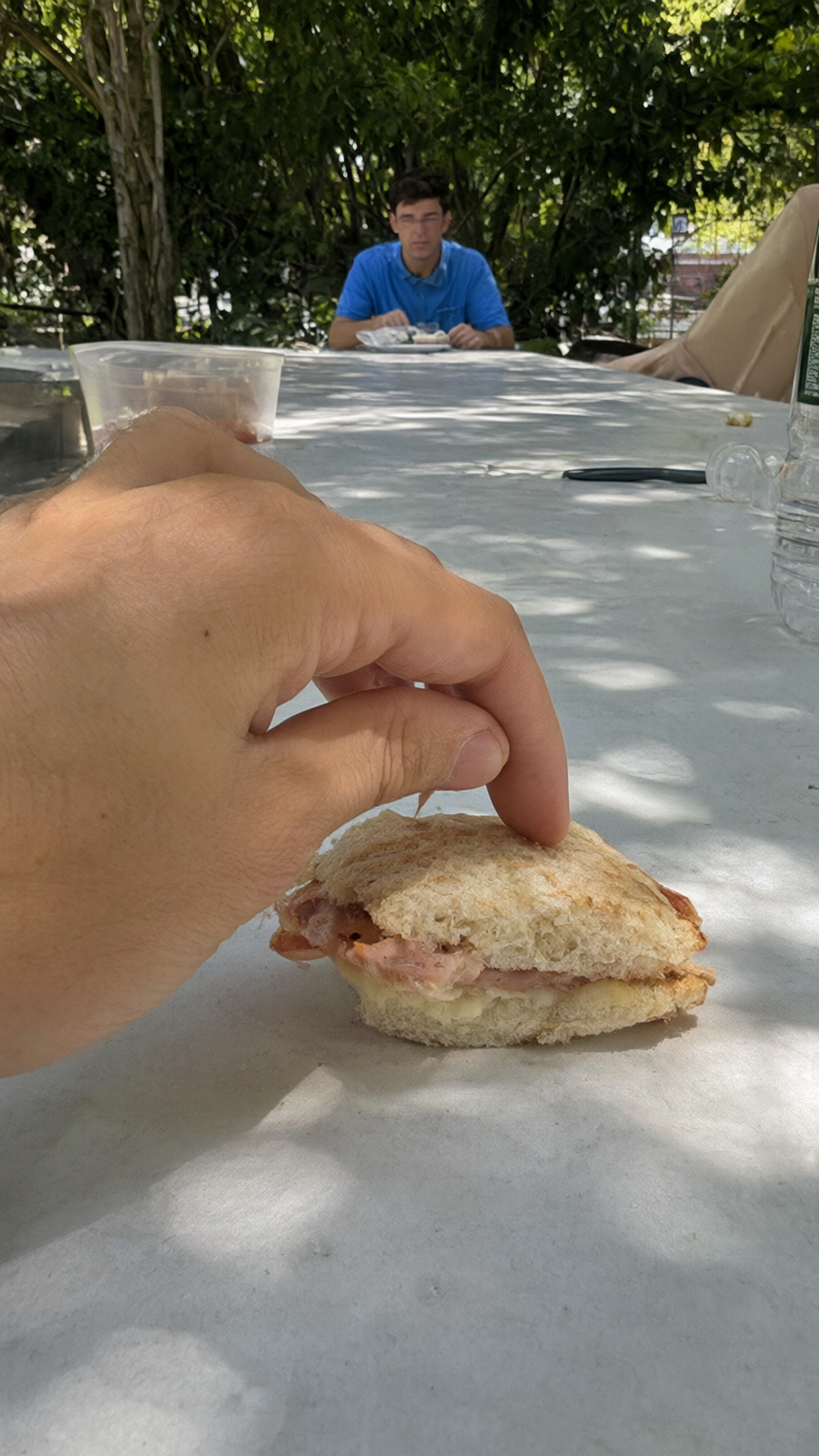
The hand in the foreground looks like it belongs to a giant. It fills a third of the frame, pinching a sandwich over a picnic table, while a friend sits at the far end looking positively miniature. Most people read the scene as a joke about scale and stop there, which is precisely what the arrangement is designed to make you do.
Nothing here is large except the distance. The hand is close to the lens, maybe an arm’s length away, while the second man is several meters back at the other end of the table. Because a camera flattens depth, both are rendered at a similar sharpness, and the eye has no reliable cue that they are not standing side by side. Check the table edge: it runs continuously from the near hand to the far friend, and that line is the only real clue to how far apart they are.
Photographers call this forced perspective, and it works best in flat, even light with a small aperture, where nothing blurs to reveal the gap.
3. Nothing To See Here, Just Flower Pots
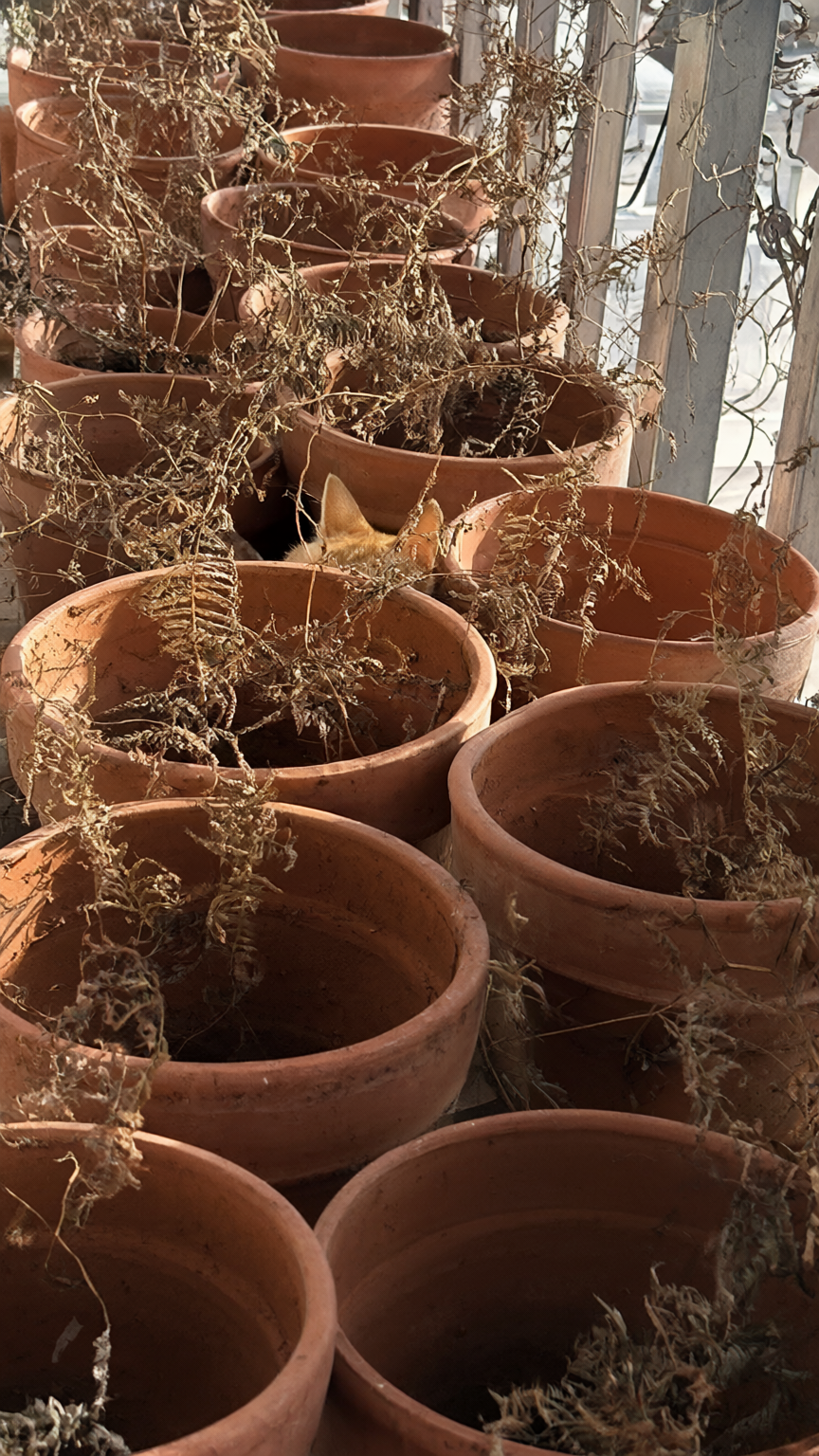
A row of dry terracotta pots on a sunny balcony, a few tired ferns, and nothing else. That is the honest first impression, and it is a convincing one, because the pots are the most textured, most colourful thing in the frame and they pull the eye along the row. A ginger cat is not what you expect, so the brain does not spend long looking for one.
Then something in the middle of the group refuses to stay a pot. Just above the centre there is a rounded ginger shape with a single pointed ear standing up, and lower down a tail curls against the clay. The cat’s coat is almost the same warm orange-brown as the pots, and the dry fern fronds break up its outline, so only those two small details separate animal from pottery.
Camouflage like this is not invisibility. It is a delay, a couple of extra seconds before the pattern breaks. Try scanning the photo in narrow strips from top to bottom instead of all at once.
4. The Quietest Tenant On The Shelf
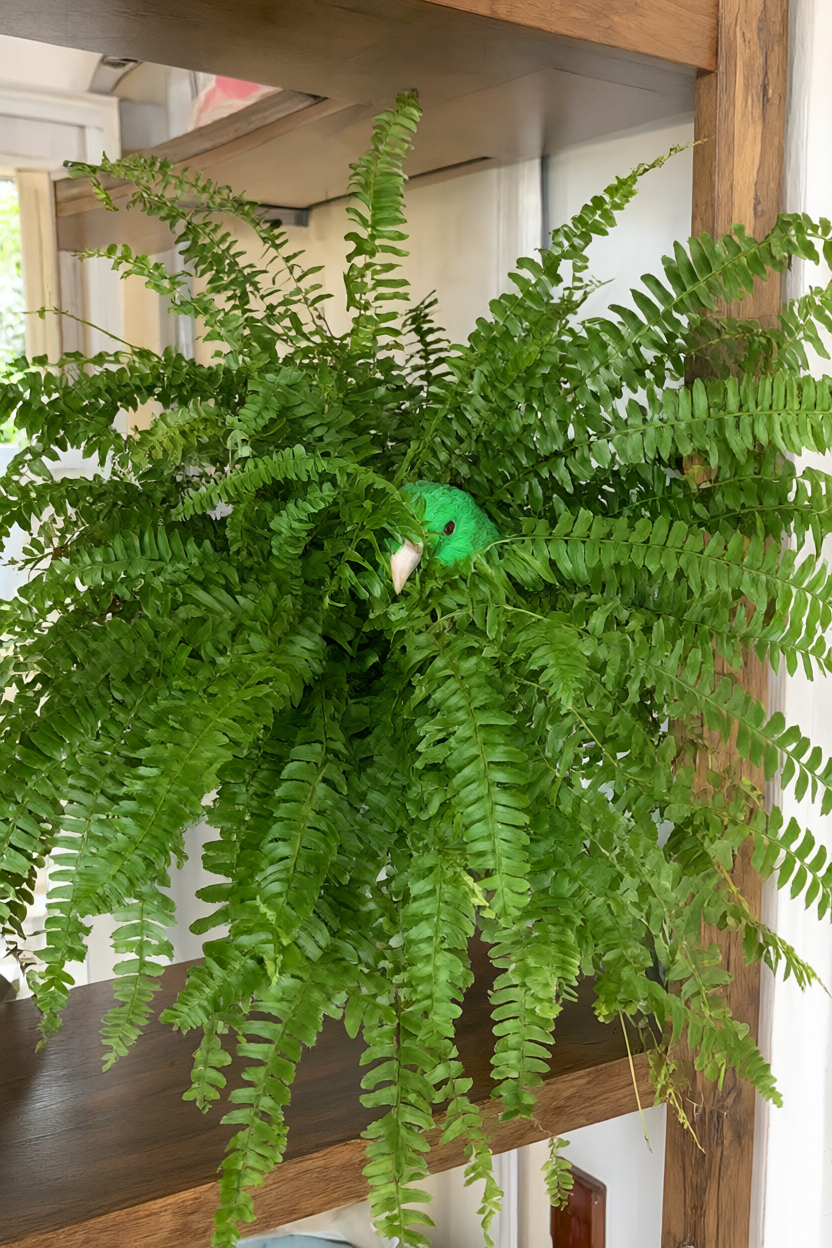
The shelf looks like a plant collection, and a healthy one: broad green fronds, a bright room, a wooden ledge. Nothing in the composition suggests an animal, so the eye treats the whole rectangle as foliage and slides across it. That is the trick, because the parrot is the same green as everything around it and is sitting perfectly still.
Find the centre of the fern and look for the one spot that is not a leaf. There is a small, glossy dark eye, and just below and to its left a pale curved beak, both framed by fronds that hide the rest of the bird. The parrot has tucked itself into the middle of the plant, so its body outline never appears against the background; only those two hard, non-plant shapes give it away.
Parrots in the wild rely on exactly this: sit still, match the canopy, and let the eye finish the job of not seeing you.
5. A Very Slow Game Of Hide And Seek
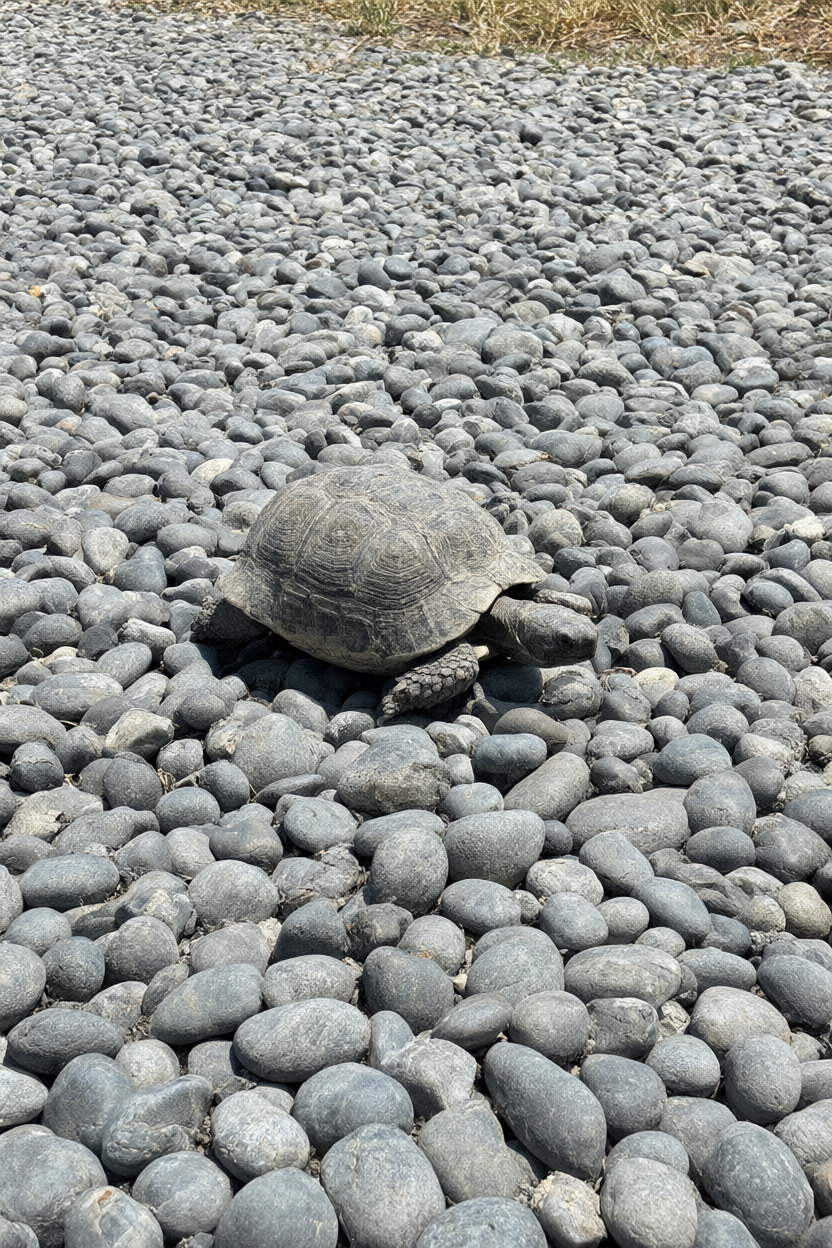
A path of grey pebbles in flat noon light is about as unremarkable as a photo gets. There is no strong shadow, no colour to catch the eye, and the stones repeat in a steady pattern that the brain quickly decides is background. Most people look at this one for several seconds before anything separates itself from the gravel.
The tortoise is sitting just below the centre. Its mottled grey shell has the same size, tone and speckle as the surrounding stones, so the only parts that read as animal are the wrinkled head stretched forward and the front feet, both a shade warmer than the pebbles. Once you have found the head, the shell resolves around it and the whole animal appears, which is why the second look feels so different from the first.
Hard midday light is usually called bad for photography, but it is perfect for camouflage puzzles: no shadows means no silhouette.
6. Which Way Is Up In This Lobby?
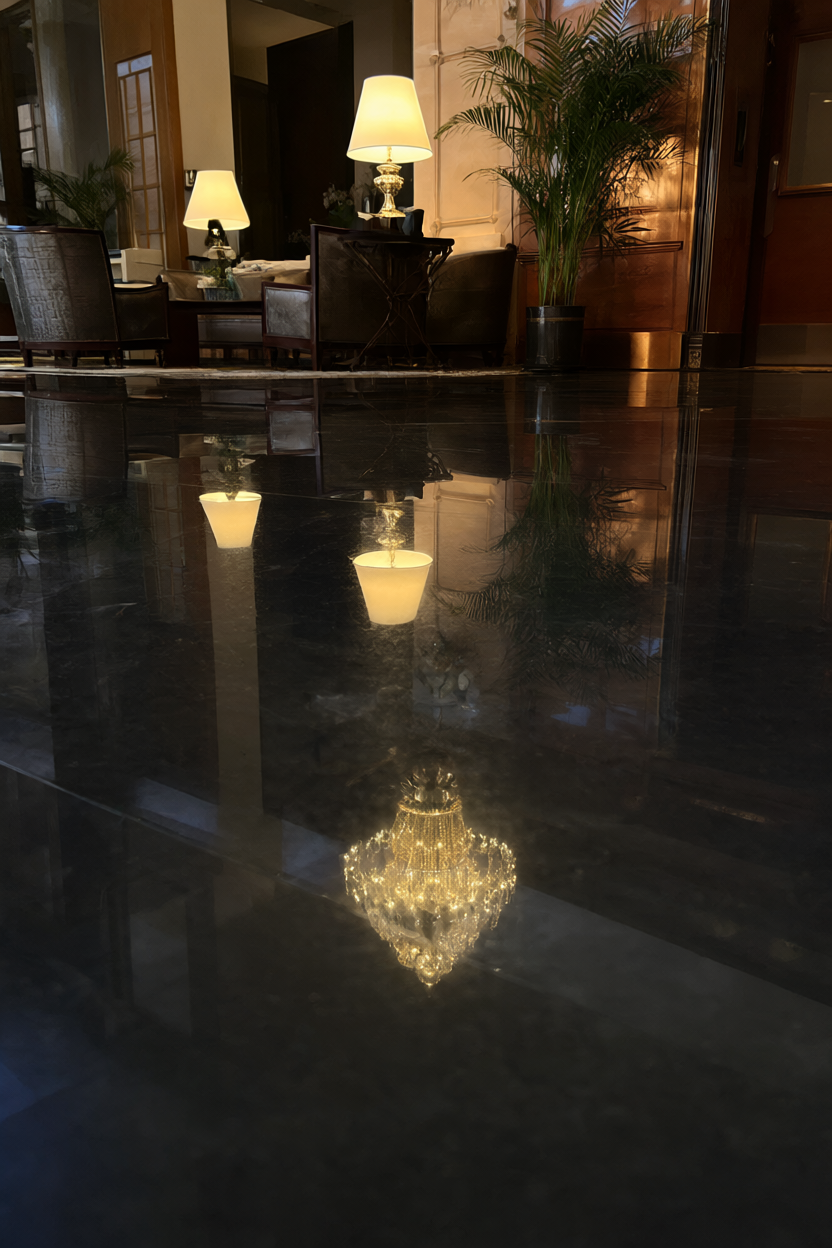
The first reaction to this photo is usually a small sense of vertigo. Chandeliers seem to hang below the furniture, the palm appears to grow downward, and the room reads as though it has been flipped. The brain insists on a floor and a ceiling, so it picks the wrong one and then cannot unsee the mistake.
The give-away is the seam across the middle of the frame, where the real furniture meets its reflection. Everything below that line is a polished dark floor acting as a mirror: the glowing lamps, the armchairs, the potted palm and the chandelier are all doubled there. Follow the legs of the chairs and you will see them meet their own reflections, foot to foot, at the surface of the floor.
Still water, wet sand and polished stone have been used for this illusion for centuries. The camera only has to be low enough to keep the seam quiet.
7. The Garden Is Smaller Than It Looks
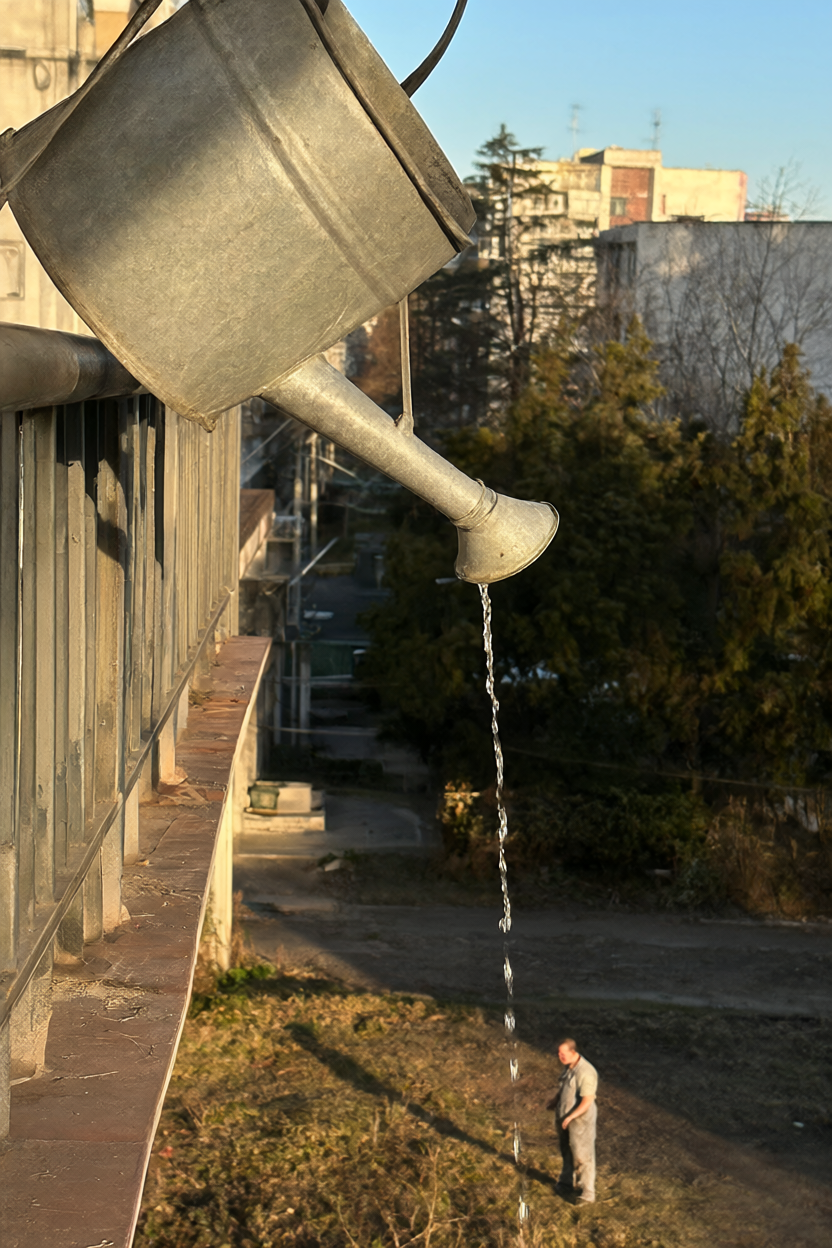
A watering can tips over a balcony railing and pours a thin stream onto a gardener below, and at first glance the two look like they belong in the same small scene. The can seems enormous, the gardener tiny, and the water appears to fall exactly where it should. It is a satisfying little picture, which is why few people question it.
Look at how much space sits between the railing and the figure in work clothes. The can is right at the camera, close enough to show every scuff on the metal, while the gardener is many floors down on a path. The stream is real but thin, and it does not actually reach him; it simply points in his direction. The forced perspective does the rest, letting a foreground object and a distant person share one line of sight.
Water features like this are a favourite of forced-perspective photographers, because a falling stream reads as a single unbroken line no matter how far away it lands.
8. This Armchair Has Had A Long Day
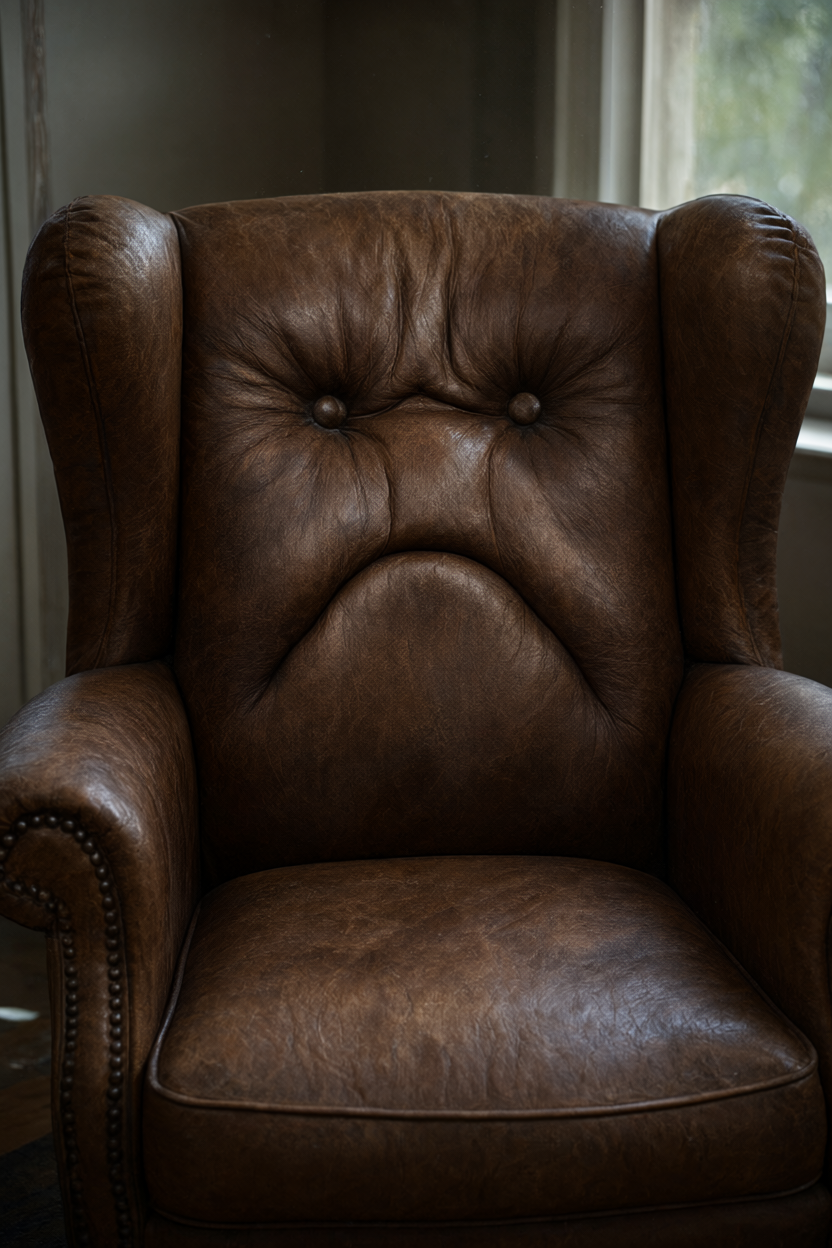
Most people see the face before they see the chair. Two tufted buttons sit where eyes should be, deep creases in the leather arch like furrowed brows, and the sagging seam near the bottom turns down at the corners like a frown. Within a second the brain has assembled a grumpy character, and the actual furniture becomes hard to notice.
Then the illusion comes apart, pleasantly. The buttons are simply buttons, pressed into the backrest in a regular pattern; the brows are creases where the leather has softened over years of use; the mouth is a seam that has given way under the seat. Nothing was arranged. The face exists because the shapes happen to fall in the right places, and because the chair is photographed straight on, in soft light, with no distractions.
This is pareidolia, the habit that also finds faces in clouds and power sockets. It is strongest for faces that are slightly off-centre and a little sad, which may be why this chair looks so put-upon.
9. This Gate Is Not A Morning Person
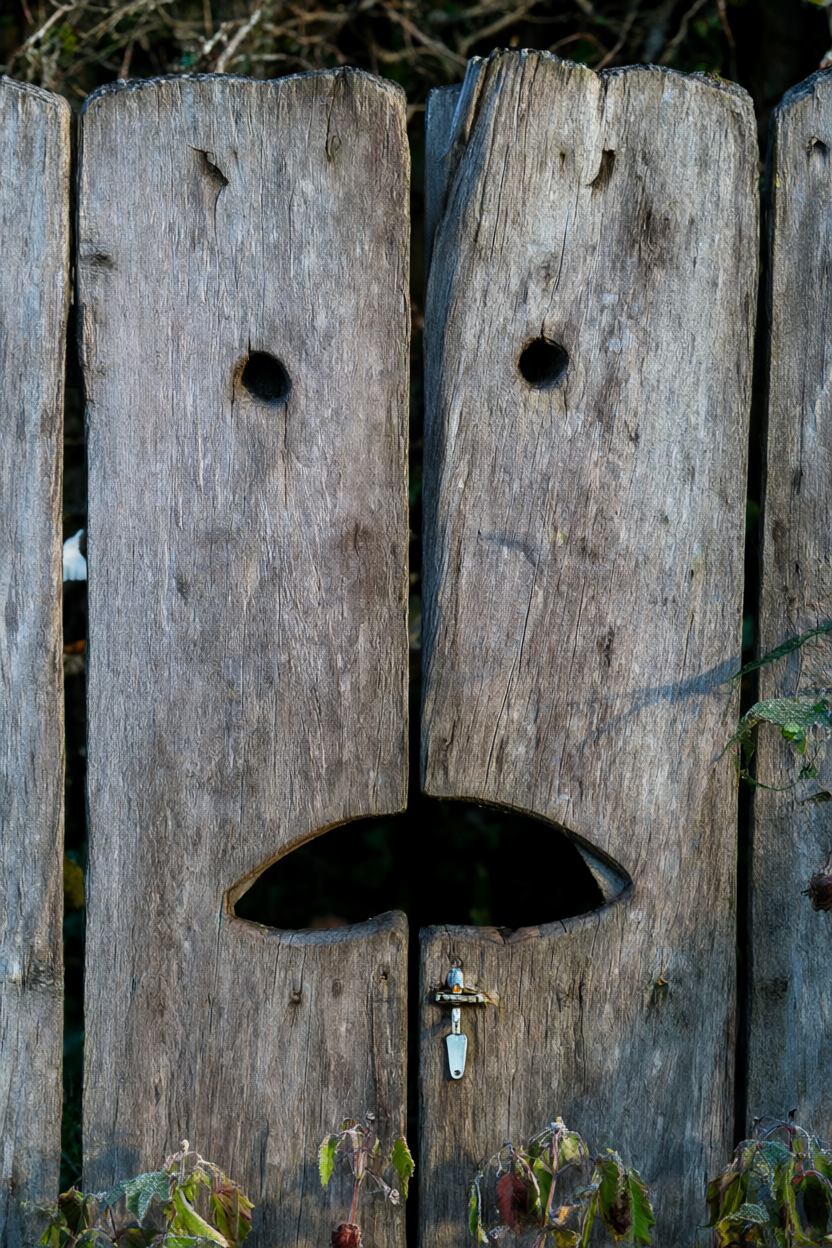
At a glance the gate is just weathered wood: pale planks, dark knots, a gap where the timber has warped. But almost everyone reads a face in it immediately, with two closed eyes and a wide open mouth in the middle of the frame. Morning light rakes across the surface, sharpening every edge, and that contrast is what makes the expression so clear.
The two dark knot holes near the top are the eyes, sitting at a natural spacing and slightly tilted, so they read as heavy lids. The warped gap between the planks below them widens toward the middle, and that shape becomes the yawn. Look closely and you will see the gap is not symmetrical: one edge bows out further, which is what gives the mouth its sideways, sleepy look.
Faces are the first thing human eyes learn to recognise, and the skill is so strong that two dots and a curve are enough.
For me it was the lobby. It had me convinced the ceiling was the floor for a good ten seconds before the chair legs meeting their reflections gave the game away, and the pebble path ran a close second.
There is another set of these small visual puzzles on the way, so come back for the next gallery when it lands and see how quickly you spot the trick next time.