The first words are a whisper that turns into a wave: “How’s he doing this?” Before long, gasps ripple into cheers, the judges lean forward, and someone blurts, “Bloody hell… Wow.” It’s the sound of a theater discovering that on a show built for spectacle, magic can still outpace belief—and then give it something deeper to hold onto.
The street dancer who turned magic into movement
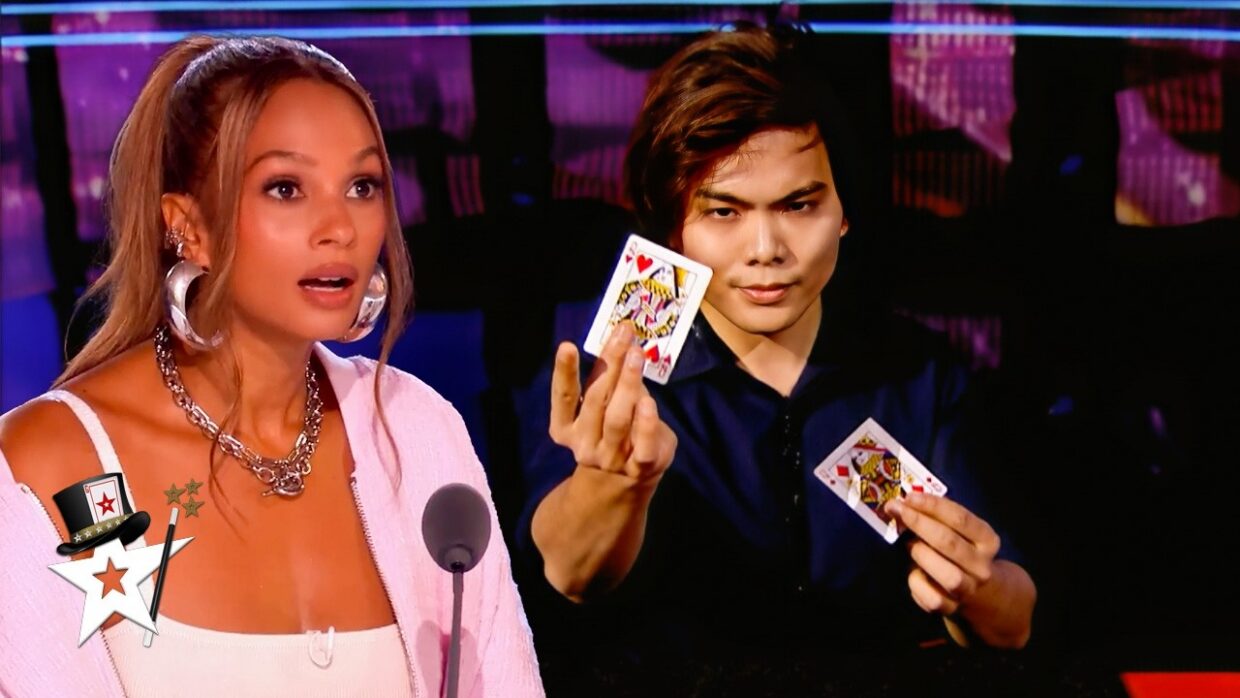
One performer opens not with a flourish of cards, but with a personal history. “My way to magic actually started with dancing. I used to perform as a busker out on the streets. I eventually started incorporating magic into my dancing routines, and that’s how I come about today.” He invites a volunteer: “Olivia, if you wouldn’t mind, can you please come up? Hi, Olivia.” She’s asked to place her hand over a spot and not move. The instruction is simple, the suspense immediate. The room stills as he layers rhythm onto misdirection—footwork guiding eyes, timing disguising method.
Then a toast: “Britain’s Got Talent 2020. Cheers.” He pivots to something more reflective. “History is very important to me. Let’s say if you don’t know where you come from, you don’t know where you’re going. I’ve loved sharing the story of Henry Vogt’s brand with you guys, and I hope it’s inspired you like it’s inspired me. Henry escaped in a wooden crate that was pretty much this size.” The image of a box becomes a metaphor for limits—how to slip their grip without breaking them apart. “Tonight, wanted to create one final piece of magic. That’s not the end of my story. It’s the beginning.”
“The wings of hope carry us high. Nothing ever change, there’ll be no butterflies.”
In a show that thrives on surprise, this act stakes a claim on feeling. The dancing isn’t window dressing; it is the patter. Every spin and pause rewrites the question from how to why—why this object, why this story, why this man’s past has found its way under a spotlight.
Vegas, without leaving the judges’ table
Another team strides out with a promise and a challenge. “Simon, the last time you said you would love to spend the weekend with us in Vegas. And we thought we’ll bring Las Vegas to you. We want to show you something we have no influence on, a game of chance.” They ask for the props of Vegas reduced to their essence: “a die,” “a deck of playing cards,” and “money.” A blindfold is inspected. “Have a look if there is anything hidden. So you can’t see anything through it?” The answer comes crisp: “I can’t. No.”
They begin where probability is honest. One judge rolls the die, hides the outcome beneath a hand. The performer turns away, then pivots back with certainty. “I don’t think you rolled a very high number. It was not a 4, not a 5, and not a six. I’m pretty sure… you rolled the one.” The reveal lands—“Number one”—and so does the rhythm of their claim: one in six, one in 52, one in a million.
Cards next—shuffled, fanned, selected face down. “Louis, you chose the five of heart.” A beat, then a burst from the panel. “How do they do that?” Awe is infectious because it’s shared; what the audience feels, the judges echo aloud.
And then the step into “impossible.” “You all know there’s a serial number on every bill. To know this exact number, it’s more impossible than to win a million in Vegas, but that is what I want to know.” A bill is chosen. The blindfold goes on. They listen, then speak the digits into the hush: “The first number is an 8. Yes? Then there’s a 9. Yes. A 7. Yes. And a 5.” A pause. “There’s a 3. I sense a 2. No. Wait. There is a 3. The next number must be an 8.” A correction slices through the trance—“That’s a 4”—and is absorbed without a flinch. “And there is a letter, and there must be an a.” The verdict, disbelieving and delighted: “She’s not from this planet.”
What this duo understands about theater is simple: vulnerability builds credibility. The moment of “No. Wait” is not a crack. It’s a hand extended to the room that says, we are doing this live with you. The effect multiplies because the guesswork never looks like guesswork; it looks like listening.
Breath, suspense, and stagecraft
Between crescendos, the tempo changes. “How did he sneak on?” a voice asks, and the answer is folded into a meditation. “Breathe in. Breathe out. Breathe in. Breathe out.” It’s a theatrical reset—inhale the disbelief, exhale the suspicion. On a night like this, breath is more than biology; it’s pacing. It readies the room for something that doesn’t just provoke wonder, but invites meaning.
The art of hope
Meaning arrives with a story about pain that refuses to hide. “Through times of challenge, we often learn life’s most valuable lessons. When my wife was diagnosed with cancer, she displayed a courage and a strength that I’d never seen before. And I remember I asked her, where does it come from? And she said, I just see the bigger picture. I see the moment when I will finally become a mother.”
He tells us he made a work over “two and a half years,” then asks a neat question: “What is it?” There are books, bookmarks, a promise of random choices. He places “quote cards” in Simon’s hands. “They contain lots of inspirational quotes written by some truly amazing people. Now, I say they’re a gift because you will keep these.” A selection is made, the card kept private. On either side, two more judges open books “featur[ing] over a thousand incredible human beings,” turn to pages controlled by where a bookmark lands. “It’s very important that at no point do I see the page that you’re ultimately looking at.”
He doesn’t ask for the authors. He asks for a single word—the last word of Simon’s secret quote. “What is it, Simon?” The answer arrives, clean as a bell: “Heart.” He nods, then threads family into the frame. “I have to finish this piece of art, Simon, but Isabella drew a picture for you. It’s in front of you in that envelope. Can you open it up for me and show everyone what it says?”
The next turns on trust. “Alicia… for the very first time, can you tell us who are you thinking of?” The reply: “Gandhi.” A small voice is invited from the wings of the story. “Isabella, who does daddy been painting over the last two and a half years?” She answers what the canvas has been keeping: “Gandhi.” The audience doesn’t just see a likeness; they see time—the patience of a parent turning hope into paint.
There’s one more thread hidden in the image. “For the first time, who are you thinking of?” he asks another judge. “John Lennon.” He smiles. “What [she] didn’t realize is that daddy hid a second picture in person inside this picture.” Two ideals—nonviolence and imagination—share space inside a single frame, revealed not by cutting a deck, but by cutting to the point.
“In our best moments when we listen, we can understand. And when we understand, we can empathize, and then we are truly connected.”
The hosts return to help widen that connection. A glass jar holds handwritten memories. They sift them, confirm they’re different, then take one at random and wait. On a giant screen, circles and squares appear with words inside them. The room is given instructions that crisscross the grid: “Please look at the screen and choose a circle as a starting point. Now move left or right to the nearest square. Now move up or down to the nearest circle… Move diagonally to the nearest square… Finally, move left or right to the nearest circle and focus on the word within that circle.” The magician breathes with thousands of people at once and names what they are now all holding.
“If we have truly connected, we should all have hope.”
They stand. The jar is opened. The random memory, untouched until now, is read aloud: “Hope.” The emotional architecture of the piece, built across pages and choices and a child’s drawing, resolves in a single word spoken by many mouths at once.
Even the coda ties back to the thesis. A short film rolls through the show’s shared past with this masked persona, reminding us, “When you first met X at the auditions in Manchester, it was about hope.” The voice narrows the lens and names the through line. “It was always about hope and never giving up.” The final confession lands as both secret and signature: “It’s been an honor sharing x with you. I am x. Thank you.”
Why these moments matter
On talent shows, magic often lives or dies by method. Here, it lives by meaning. The dancer-busker ties wonder to lineage and reinvention. The Vegas duo turns odds into a duet where confidence and correction coexist, making the audience complicit in every gasp. And the artist who calls himself X collapses the distance between trick and truth, anchoring revelation in the steady beat of a word powerful enough to outlast the lights. The nightly grammar of spectacle—set-up, beat, payoff—is still intact, but it’s been translated into a language that speaks to more than curiosity.
There’s a case to make that the best illusions don’t ask us to abandon reason; they ask us to choose attention. To the sound of a die skittering under a hand. To the pause before a number is named. To the last word on a secret card. To the way a child says “Gandhi” without irony, because children don’t need it. And to breath itself, which turns a theater into a single body long enough to make a promise to itself: in the worst moments, we will still have something to reach for.
“The wings of hope carry us high,” the lyric insists earlier in the night. Its twin lands much later, unannounced and unforced, when a random slip of paper inside a jar delivers the same word the crowd has already chosen on a screen. That echo isn’t an accident of craft alone; it’s the point. Magic can be a diversion. On this stage, it’s a direction.
The final word
If you come for the how, you’ll get enough impossibilities to keep you arguing all week: a die divined, “the five of heart” named from a shuffled spread, a serial number recited through a blindfold, a painting that hides another portrait until someone names it. But if you stay for the why, you’ll leave with the word that ties everything together and dares you to carry it out of the theater. Watch, listen, and let yourself be moved. The show asks only this: keep choosing hope.