Crystals are easy to love and just as easy to neglect. Between dust on the shelf, a scratch from a crowded bowl and a slow dulling that creeps in over months, the stones you already own can lose the quiet beauty that made you bring them home. This crystal care guide walks you through gentle, practical ways to clean, cleanse, charge and store them, and it comes with a free printable checklist and care log so the routine actually sticks.
This printable is not a substitute for professional help.
What’s inside the printable
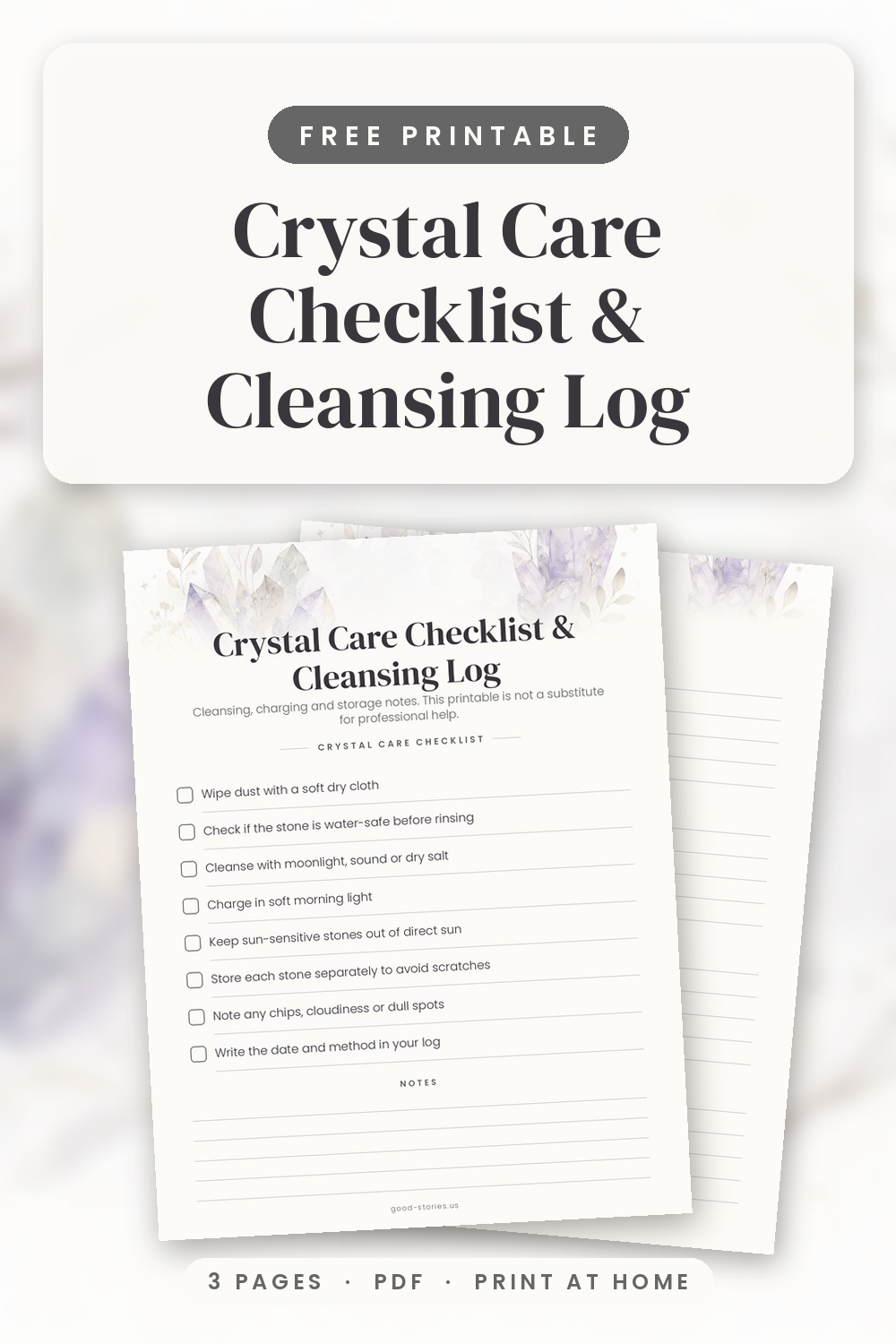
- Page 1: an eight-row crystal care checklist covering dusting, water safety, cleansing, charging, sun exposure, storage, damage checks and logging.
- Page 2: a care log with writing lines beneath four prompts: the stone you cared for today, the method you used, how it looked before and after, and what to try next.
- Page 3: six labelled note boxes for the stones you keep out of water, the ones that fade in sun, your favorite cleansing method, where each stone lives, stones you want to learn next and questions to look up.
Why Crystal Care Is Worth Ten Minutes a Week
Crystal care is mostly housekeeping, and that is why it works. Dust settles into the crevices of a cluster and makes it look grey, two tumbled stones rattling in the same dish leave tiny scratches, and a stone on a sunny sill can lose color so gradually that you only notice beside an old photo.
None of this is about health, luck or energy. It is about keeping the objects you already own looking good. A soft dry cloth, a habit of checking before you rinse and a place for everything will do more than any elaborate routine. Ten minutes a week is genuinely enough.
Water and Stone Hardness: Check Before You Rinse
Before anything touches water, think about hardness. The Mohs scale runs from 1 (talc) to 10 (diamond) and tells you how easily a mineral scratches, which is a useful stand-in for how easily water and handling will damage it.
Gypsum, which is what selenite is made of, sits around 2 and can be marked with a fingernail. Halite is salt and will simply dissolve. Malachite is soft and porous, and pyrite can rust when moisture lingers in its crevices, so both are better kept dry. Quartz, at 7, is tough enough for a quick rinse and a pat dry.
The rule is simple: if a stone is soft, porous, layered or metallic, clean it with a dry or barely damp cloth and keep it away from the sink. When you are unsure, treat it as water-sensitive and mark that line on your checklist.
Sunlight, Fading and the Twenty-Minute Rule
Sunlight is one of the most common ways people accidentally damage a collection. Amethyst, rose quartz, citrine and fluorite are known to fade with prolonged direct sun, and the change can be permanent. A windowsill that feels lovely in January can quietly bleach a stone by June.
A gentler approach is to charge in soft morning light instead. Twenty to thirty minutes on a table near a window, before the light turns harsh, does far less damage than a full day on the sill. If a stone is a known fader, display it out of direct sun and cleanse it with moonlight or sound instead.
Cleansing and Charging as Tradition
Ask five collectors how they cleanse a crystal and you will get five answers: moonlight, sound, smoke, dry salt, running water. These are traditions, and many people find them a calming way to reset their attention and care for the objects in their home. They are not medicine, and they are not a promise about how you will feel.
What matters is choosing a method that suits the stone and recording it. A bowl of dry sea salt suits hard stones but should not be used on soft or porous ones, which can be scratched or dried out. Sound, whether a bell, a singing bowl or a chime, is the safest option for almost everything. Moonlight is gentle and slow, and smoke is best done with a window open.
Pick one, note the date and method on your log, and look at the stone afterwards. That record is the part most people skip, and it turns a nice idea into a habit.
Storing Crystals and Keeping a Care Log
Storage is where collections are won or lost. Soft stones scratch each other, so give each one its own pouch or a compartment in a divided box, and add a label if you are still learning the names.
Dust with a soft brush rather than pressing hard with a cloth, especially on clusters and carved pieces where a firm hand can snap a point. Check each stone as you handle it: a new chip, a cloudy patch or a dull spot tells you what to change about where it lives.
That is what the third page of the printable is for. Use the note boxes for the stones that stay out of water, the ones that fade in sun, your favorite cleansing method and where everything lives, then let the checklist carry the routine.
How to Use Your Printable
Print the three pages on US Letter paper. If you are printing on A4, choose “Fit to page” in your print dialog so nothing is trimmed at the edges. Plain paper is fine; a heavier weight of around 100 to 120 gsm feels nicer in a binder.
- Keep page one in the drawer where your stones live and tick a row each time you care for a piece.
- Fill in one log entry per stone rather than per day; knowing amethyst was last cleaned in March is more useful than a blank weekly page.
- Use page three as a reference to photograph before a crystal shop visit, or print a second copy for a friend who is just starting out.
There is no schedule to keep up with. Some people work through the checklist monthly, others once a season. What matters is that the stones get looked at and you have a record to refer back to.
Caring for crystals does not need to be complicated or expensive. A dry cloth, a little shade, a pouch for each stone and a page you actually fill in will keep your collection looking its best for years. Print the checklist, start with the stone closest to your hand, and let the log do the remembering.