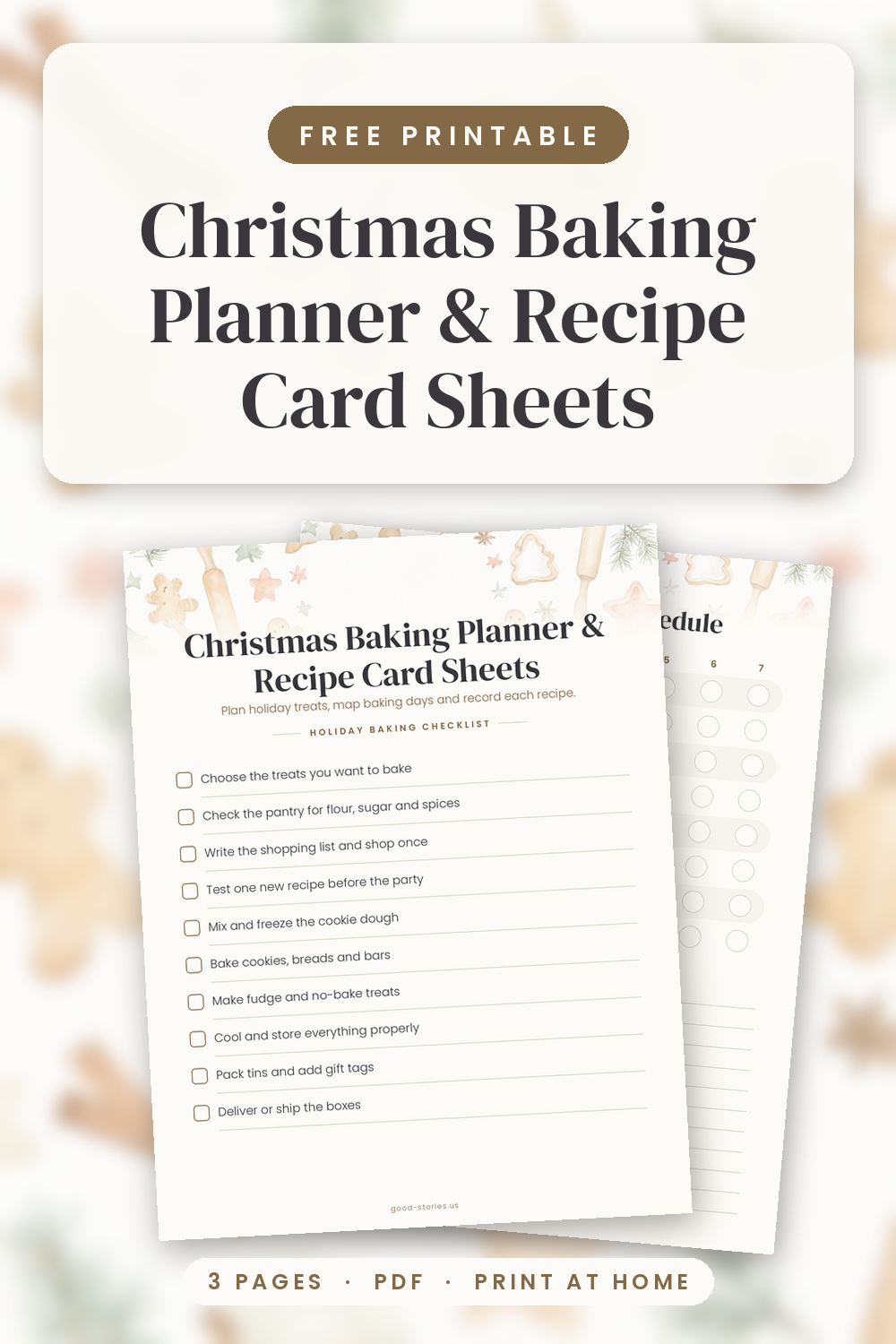
Holiday baking has a way of arriving all at once: three kinds of cookies due the same weekend, a party you forgot to write down, and a shopping list you rebuild from memory in the middle of the grocery aisle. This free printable Christmas baking planner gives you one page to choose the treats, a seven-day schedule to spread the work out, and a recipe card so the batch everyone loved does not vanish with the season. It is three pages, it prints in minutes, and it is entirely free.
What’s inside the printable
- Page 1 — Holiday Baking Checklist: ten checkbox rows that walk from choosing treats and checking the pantry through baking, cooling, packing tins and delivering.
- Page 2 — Seven-Day Baking Schedule: a tracker grid with eight treat rows for cookies, gingerbread, shortbread, fudge, quick breads, pies, gift tins and delivery, laid across seven day columns.
- Page 3 — Cookie Recipe Card: six titled boxes with writing lines for cookie name and baker, ingredients and amounts, oven temperature and time, allergens, make-ahead notes and a star rating.
Why planning holiday baking early pays off
Most home bakers make the same four to six treats every December. The sugar cookies, the gingerbread, the fudge someone always requests, the quick bread that gets handed out at the office. Once you notice that pattern, the whole season becomes easier to plan, because you are not inventing a new bake list each year — you are running a routine you already know. A single planning page replaces the notes app, the back of an envelope and the row of recipe screenshots buried in your phone. When the plan lives in one place, the shopping becomes predictable and the freezer work becomes obvious. You stop discovering on December 22 that you are out of butter, out of eggs and out of evenings.
Map every bake onto a seven-day schedule
The schedule page has one column for each day and eight rows for the treats that usually fill a holiday kitchen. Start with the date you actually serve — a cookie exchange, a party, Christmas Eve — then work backwards from it. Doughs that need to chill, like gingerbread and shortbread, belong early in the week so they are ready when you want them. Fudge and bark fit in the middle, when the stove is already dirty and the pans are already out. Frosted sugar cookies and anything fragile come last so they are still crisp and un-smudged when they reach the table. Write each treat into the day you plan to bake it, then leave the empty cells visible. Empty space is useful information: it tells you where the week still has room, and it is the first place to move a bake when something slips.
Shop once with the ingredient checklist
The checklist page starts before you leave the house. Choose your recipes first, then read each one for amounts, then check the pantry — flour, sugar, brown sugar, butter, eggs, vanilla, baking powder and soda, cinnamon, nutmeg, cocoa. Only what is genuinely missing goes onto the list. Group the list the way your store is laid out: baking aisle, dairy, eggs, produce, bulk. Write amounts next to each item instead of just the name, so you are not guessing in the aisle between one bag of flour and four. One organized trip beats three frantic ones, and it is usually the difference between a calm baking week and a week spent behind the wheel.
Record each recipe on the card page
This is the page people skip and later wish they had not. Note the cookie name and who baked it, the ingredients with the amounts you actually used, the oven temperature and time, and any allergens worth flagging before a tin goes out the door. Add your make-ahead and freezing notes while the details are still fresh: did the dough freeze well, did the baked cookies hold their texture, did the icing survive a car ride. Finish with a rating out of five stars. Next November you will have a real record of what worked instead of a vague memory of a recipe you liked once and cannot find again.
Pack, label and share without the last-minute scramble
Let everything cool completely before it goes into a tin — trapped warmth turns crisp cookies soft within hours. Store soft cookies, like molasses cookies and bar cookies, separately from crisp ones, or the moisture will migrate from one to the other. Line tins with parchment, tuck in a gift tag, and write what is inside and when it was baked. If you are shipping boxes, plan delivery for the front half of the week so nothing sits in a warehouse over a weekend. A short plan for delivery day is what keeps gifts arriving fresh instead of arriving late.
How to use your printable
Print on US Letter and the pages will sit at their intended size. If you are using A4, choose “Fit to page” in your print dialog so the margins and writing lines stay intact. Print the schedule page twice if you bake in two waves, one for cookies and one for breads and pies. Slip the checklist into a page protector and mark it with a dry-erase marker so you can wipe it clean and start again next year. Keep the recipe cards in a small binder near the cookbooks, and tape the schedule to the fridge where everyone can see what is coming. A clipboard works well too, if you would rather carry the plan to the counter.
Holiday baking feels calmer when the plan is written down and the shopping trip happens once. Print the three pages, choose your treats, and let the schedule carry the rest of the week.