If you have ever pulled a card, felt a quiet flash of recognition, and then forgotten the whole reading by morning, a tarot journal gives those moments somewhere to live. This guide walks you through a simple, no-pressure way to record what you drew and what you noticed, and it includes a free printable so you can start with your next spread.
This printable is not a substitute for professional help.
What’s inside the printable
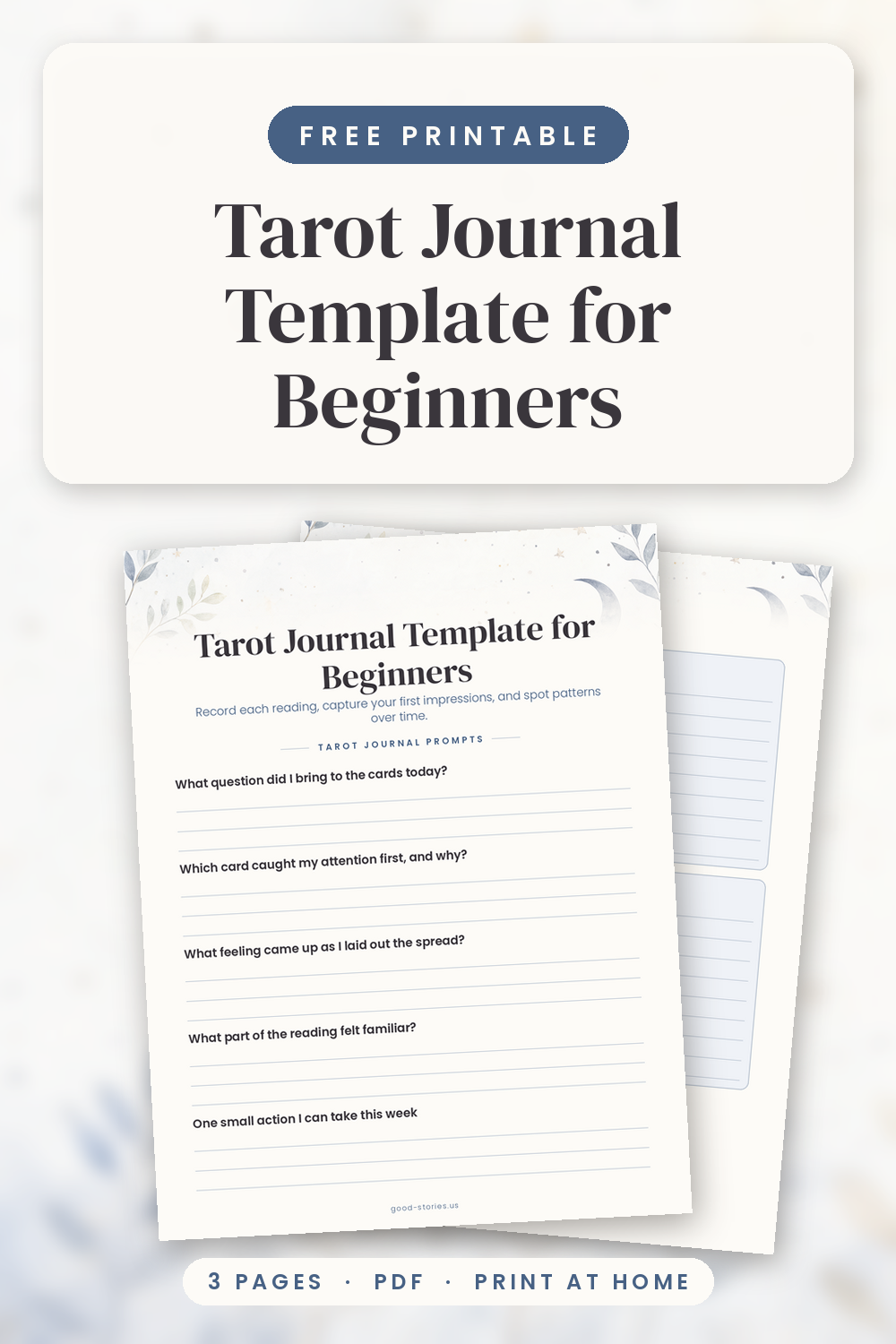
The free PDF is three pages, designed to be printed and written on by hand. Nothing is filled in for you, so the pages work with any deck and any level of experience.
- Page 1: Five tarot journal prompts with writing lines.
- Page 2: A four-box reading log for date and question, cards drawn, first impression and notes.
- Page 3: Five monthly reflection prompts with writing lines.
Why keep a tarot journal
Tarot is a card tradition used for self-reflection, and a journal is where that reflection becomes visible. A standard 78-card deck holds 22 Major Arcana and 56 Minor Arcana, and the Minor Arcana divide into four 14-card suits: Wands, Cups, Swords and Pentacles. That is a lot of symbolism to carry in your head, especially when you are new and still reaching for a guidebook after every pull.
A journal takes the pressure off memory. You no longer have to remember the exact card that unsettled you three weeks ago or the wording of the question you asked, because it is already on the page. Over time, the entries become a record of your own attention: which suits you notice first, which images you linger on, and which questions you keep returning to.
Setting up the template in five minutes
Print the three pages and keep them with your deck. There is nothing else to buy: a plain pen and a folder are enough. At the top of the reading log, write the date and the question you are bringing to the cards. Then record the cards you drew, in order, and your first impressions before you look anything up. Those first impressions are the most valuable part of the page, because they are yours rather than a definition you borrowed.
Try not to treat the page as a test. You are not being graded on whether you named the card correctly or remembered its traditional meaning. If all you can write some days is “drew the Two of Swords, felt stuck,” that is a complete entry, and it is exactly the kind of note that becomes interesting when you read it back a month later.
Prompts that ask more of you than yes or no
The prompts page is built around open questions. Which card caught your eye first, and why? What feeling came up as you laid out the spread? Which detail in the artwork had you not noticed before? Did any part of the reading feel strangely familiar? These questions slow you down and keep the focus on your own response to the images.
Many readers avoid yes-or-no prediction questions, not because they are forbidden, but because they tend to close the conversation instead of opening it. A question like “what am I not seeing about this situation?” tends to produce a more useful page than “will it happen?”, one you can reread later without feeling judged by your own past.
Reading the log over time
A single entry is a snapshot; a stack of entries is a pattern. Set aside ten minutes each week or once a month to read back through what you have written. Notice cards that appear again and again, questions that change shape, and readings that felt important at the time but faded quickly. The journal is traditionally used as a reflection tool, not a forecast, so look for changes in your own thinking rather than proof that a prediction came true.
A gentle monthly check-in
The reflection page is for the end of the month, when you want to step back without writing a full entry. Sum up the month in a few lines: the card that keeps appearing, what you understand about it now that you did not before, a reading that surprised you, and how your questions have changed. There is no minimum length. Finish by choosing one thing you want to explore next.
How to use your printable
A few practical notes before you print.
- Print on US Letter. If you use A4, choose “Fit to page” in your print dialog so the edges are not trimmed.
- Print single-sided if you write with heavy ink, or use a bleed-proof pen on double-sided pages.
- Keep the pages in a slim binder or folder with your deck, so the journal is there when you need it.
- Date every entry. Future you will thank present you.
- Reprint the pages whenever you fill them; the file is yours to use as often as you like.
You do not need a perfect spread, a memorized deck, or years of study to begin. One card, one question, and a few honest lines are enough to start the habit.
The printable is free, and it will keep working whether you read once a week or once a season. Print the pages, pull a card, and give your first impression somewhere to land.